DNIPRO, Ukraine — The cherished, century-old Ukrainian song that Americans know as “Carol of the Bells” was written for layers upon layers of voices to fill churches, concert halls and city squares.
But in wartime, Ukrainians have learned to improvise.
For one choir displaced by Russian bombardment from the very city where many believe the song was written, that means arranging the complex choral melody for just three singers this Christmas, down from their usual 30.
Hearing the arrangement performed by just three singers gives a sense of Ukraine after years of war at the moment: depleted, persistent, still beautiful.
The choir is from a historic music school in the besieged eastern city of Pokrovsk — an institution so tied to the original Ukrainian song, called “Shchedryk,” or “Bountiful,” that it bears the name of its composer, Mykola Leontovych.
The piece has long served as an unofficial anthem for the city, where he lived from 1904 to 1908.
“Wherever we would go, we would sing this song,” said Alla Dekhtyar, 67, the school’s choir director who will be one of its three singers to perform at the school’s downsized holiday concert this month. “It was like our business card.”
That was before Russia’s devastating advance on Pokrovsk forced most residents — including every member of the choir — to flee elsewhere in Ukraine or Europe.
The Leontovych music school evacuated its most precious instruments in 2024, and drone footage of the city shows the building has since been largely destroyed. Russian forces now control some 95 percent of what’s left of the city, which they aggressively shelled like so much of Ukraine they have sought to control.
The Leontovych school reopened in exile last year in Dnipro, some 115 miles to the west.
But with Pokrovsk’s population so widely scattered, the choir that once blended dozens of voices for regular performances in Pokrovsk is down to just two sopranos and an alto, including Dekhtyar.
Even so, the trio will go ahead with their modified rendition of “Shchedryk” this year. Choosing another, simpler song to perform at the upcoming holiday concert was never an option.
Singing the song in its original Ukrainian remains an act of resistance against Russian aggression — and a reminder of Ukraine’s contributions to the global cultural canon.
That’s especially true for those displaced from Pokrovsk. While the song is beloved across Ukraine, it is particularly special for the eastern city, where many believe Leontovych began writing it, long before it premiered in Kyiv in 1916 and stunned an American crowd at Carnegie Hall in 1922.
“For everyone else that melody means Christmas,” said Angelina Rozhkova, director of the Pokrovsk Historical Museum, who also lives in exile in Dnipro. “For us, that melody means home — a home that we don’t have anymore, a home that is in ruins.”
“For Russia,” she added, “our home means territory that they want to take from us.”
Leontovych was the son of an orthodox priest and an aspiring music teacher. In 1904, he moved with his young wife to the small eastern village of Hryshyne — a hub for rail workers expanding the train line, which eventually became Pokrovsk.
Born in Vinnytsia region in central Ukraine in 1877, there are competing tales of how Leontovych ended up so far east. One version is that he heard about a job posting to teach music at the railway school from rail workers themselves, Rozhkova said. Another claims he responded to a newspaper ad.
Once there, he directed several musical groups, including a choir of rail workers. They sang songs with Ukrainian, Russian and Jewish roots — but his own music was influenced by sounds from his childhood. Leontovych was a fierce believer in an independent Ukrainian state, and as he gained fame was viewed, like other Ukrainian intellectuals, as a threat to Russia’s influence over a country it claimed as its own.
“He is connected to the culture of Donbas,” Rozhkova said, referring to the part of eastern Ukraine that includes Pokrovsk, and which Russia is trying to conquer. “He was very much carrying the flag of Ukrainian culture, he was performing repurposed traditional Ukrainian songs with his choir.”
Historians believe that the opening notes of “Shchedryk” — the same ones that have come to signal the start of the Christmas season around the world — originated from a folkloric melody he heard sometime in his childhood, or that a choir member shared with him from their own memories.
In the original version — the one still sung in Ukraine — there is no “ding dong, ding dong,” no mention of silver bells, no announcement that “Christmas is here.”
The lyrics never even mention Christmas.
Instead, voices describe a swallow fluttering through the sky as it ushers in a prosperous new year, urging a farmer to greet his newborn lambs and celebrate his future. It’s because of that Pokrovsk includes a drawing of a swallow on the city’s crest, which is based off a piece of art made by Leontovych’s father.
The song only made its major debut abroad in 1922, one year after a Soviet security agent assassinated Leontovych over his nationalist views. A Ukrainian choir promoting the country’s independence and cultural heritage performed it in Carnegie Hall that year to remarkable reviews — although some American newspapers wrongly praised it as Russian music.
Eventually, Ukrainian American composer Peter Wilhousky adapted the song with a completely different set of lyrics in English, transforming it into a Christmas classic.
“When Leontovych was writing “Shchedryk,” he didn’t understand he was creating a hit,” said Elmira Dzhabrailova-Kushnir, 39, a cultural history specialist in Kyiv. “For him, this was an ethnic study.”
He built the iconic song around the distinct opening notes, building it out into a masterpiece that weaves different voices and melodies into a singular experience for the audience.
“He took three notes and through his genius, worked it into that song,” Dekhtyar said.
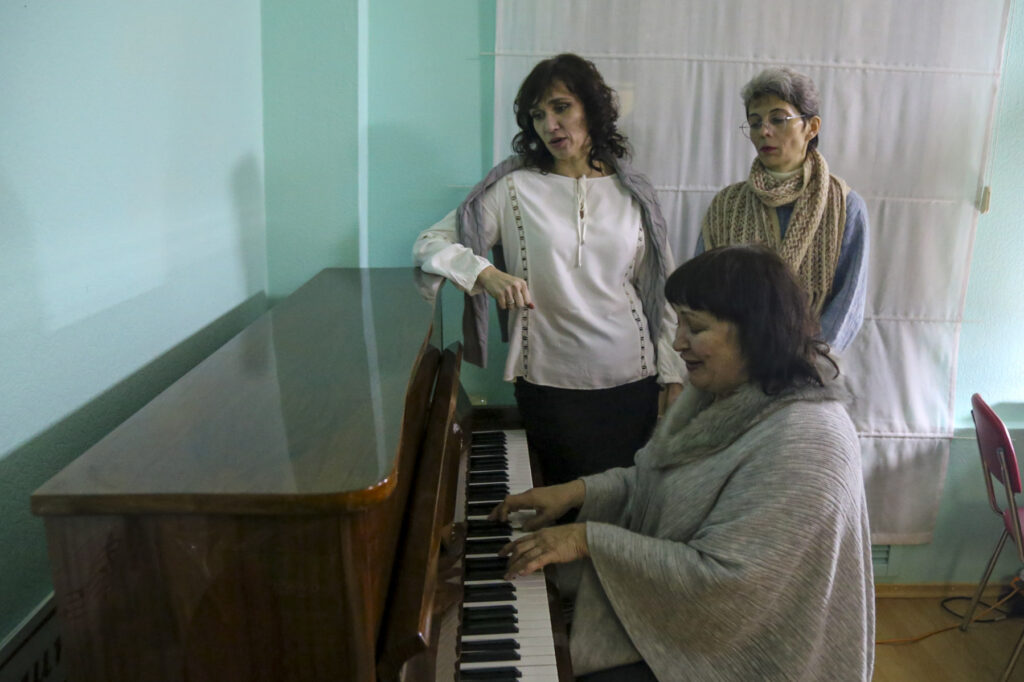
A week before Christmas, Dekhtyar and her trio from Pokrovsk gathered in the new Leontovych music school to rehearse.
The building in Dnipro is cozy and clean, the practice rooms complete with pianos evacuated from Pokrovsk last year.
But the space lacks most of the memories and people that made it home. Albums of archival photos dating back decades sit stacked in a corner. A painting of Leontovych leans against the wall.
Dekhtyar, who used to direct the choir, now sings in it as lead soprano. Her daughter, Natalia Aleksahina, 44, who also teaches vocals at the school, has taken the alto part. Their friend, Viktoriia Ametova, 43, joined Dekhtyar as second soprano.
Behind them, a Christmas tree illuminated the corner. Holiday lights twinkled on the walls. But there was little to celebrate. Inside, each singer’s happy memories of home were buried under the pain of leaving.
Aleksahina fled home with her mother in April 2022 after a Russian cluster munition tore through the roof of her parents’ home.
Her 12-year-old daughter was there at the time of the attack but was unharmed. Her father was lightly wounded. The family expected the war would soon end and they would return home and rebuild. They occasionally visited Pokrovsk even as they settled in a rental apartment in Dnipro.
But as Russian forces slowly advanced and a mandatory evacuation order was issued in August 2024, they began to realize their temporary displacement might not be temporary after all.
“It’s a painful subject,” Dekhtyar said. “We all had our own houses. Now there’s nothing left.”
“There’s nothing left,” her daughter repeated. “Our friends, social circle, family — everyone is scattered all over the place.”
Ametova left amid evacuation orders in August 2024, after her neighbor’s building was badly damaged. She still carries the keys to the house and apartment she owns in Pokrovsk everywhere she goes, even if she can’t confirm they’re still standing.
When she thinks of home, Ametova said, “I feel pain.”
The trio agree that singing is one of the only reprieves they have left. And nothing makes them feel better than singing “Shchedryk,” a song they can’t remember not knowing — a song that lives in them deeper than any other memory.
They stand up. They close their eyes. Dekhtyar raises her hands. They are just three voices, but together, they fill the entire room with the precious sound of home.
The post ‘Carol of the Bells’ was born in a Ukrainian city destroyed by Russia appeared first on Washington Post.