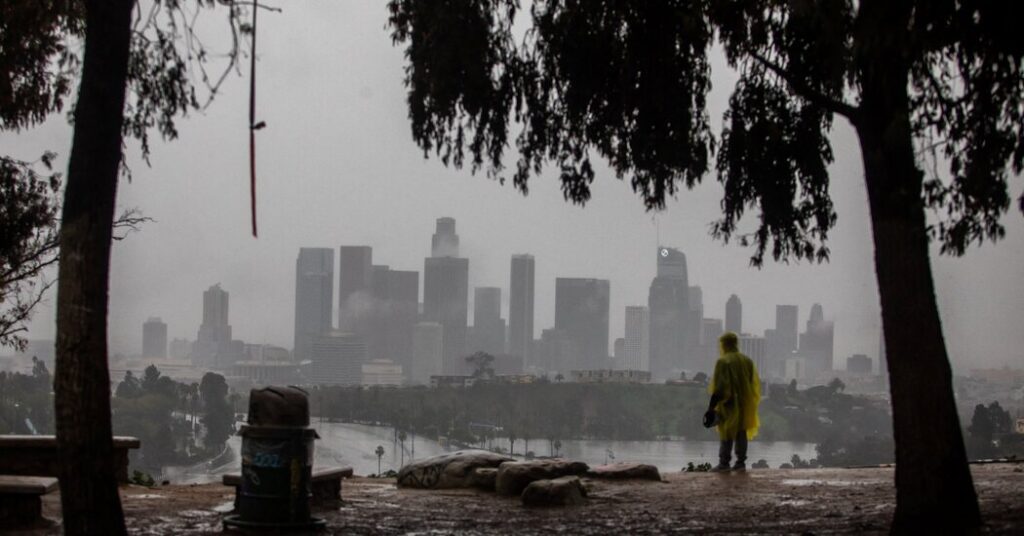
A record-setting holiday rainstorm disrupted much of California on Christmas, shutting down highways, major interchanges and airport runways as officials warned that driving to holiday celebrations on slick, muddy roads could be deadly.
Heavy downpours flooded streets in Northern California, spawned mudslides in the burn scars from Southern California wildfires and dumped wet snow across the Sierra Nevada. Residents in several mountain communities spent Christmas night under evacuation orders.
Half an inch of rain could still fall in places, including Los Angeles and other Southern California cities that set records for Christmas Eve rainfall on Wednesday. The California Highway Patrol received more than 100 reports of roadway flooding in Los Angeles County alone, according to an agency spokesman, Luis Quintero.
The airport in Santa Barbara, where more than three inches of rain fell on Wednesday — a daily record for Dec. 24 — forced an overnight closure, airport officials said on social media. The state’s major airports were in better shape, though inbound flights to San Francisco were delayed about two hours on average because of high winds, according to the F.A.A.
More than 120,000 customers were without power at 10:30 a.m. local time on Thursday, according to the utility tracking site PowerOutage.us, with the outages scattered mainly across Northern California and the mountains, where power crews were out working to repair lines. Some 40,000 customers had already regained power since dawn.
Some of the heaviest rain fell Wednesday in the Southern California counties of Ventura and San Bernardino, where fire crews evacuated homes and rushing debris flows shut down Highway 2 east of Los Angeles. Downpours also flooded parts of Interstate 5 in the San Fernando Valley, though the highway had reopened by Thursday morning.
Much of the Los Angeles region was under a “moderate” risk for excessive rain on Thursday, according to the Weather Service — a step down from the highest-level of risk that faced some areas on Christmas Eve. But with record daily rainfall totals for Dec. 24 already broken in Los Angeles, Burbank and several other spots, even moderate rainfall could cause mudslides on wet hills and drive rivers and streams over their banks.
The heavy rain is the result of a series of atmospheric rivers — large plumes of moisture drawn from the ocean — that have been flowing over California for the past week. Climate change also plays a factor: A warmer atmosphere holds more water, making intense rainstorms and flooding more common, and heaping one threat on top of another.
In Wrightwood, a ski resort town of about 5,000 in the mountains of San Bernardino County, crews were going door to door on Christmas Eve to evacuate people from their homes and vehicles, as the rain and debris flow overwhelmed roadways. The entire town was under a shelter-in-place warning, and the agency received dozens of rescue calls, said Christopher Prater, a spokesman for the San Bernardino County Fire Department.
Sarah Bailey, who has lived in the Wrightwood area for more than two decades, called it “the worst flooding I’ve seen.”
Officials in Los Angeles urged residents to be on the lookout for potentially disastrous mudslides and even worse flooding, particularly in places where the ground is still scarred from wildfires in January. On days when many families travel to be together for the holidays, officials were warning them of dangerous road conditions.
“I am urging all Angelenos to stay safe and be extremely careful on the roads if you absolutely must travel,” Mayor Karen Bass of Los Angeles said in a statement on Wednesday. “Please do not take this storm lightly.”
Joe Sirard, a meteorologist with the Weather Service, said rainfall would probably intensify again on Thursday night, bringing a couple more inches to already saturated waterways.
Some residents spent Christmas Eve in evacuation centers after the authorities ordered mandatory evacuations in parts of Orange, Ventura, Los Angeles and San Bernardino Counties. Gov. Gavin Newsom declared a state of emergency in those counties on Thursday, as well as in Riverside and Shasta counties.
Matthew Mpoke Bigg, Gabe Castro-Root and John Keefe contributed reporting.
Thomas Gibbons-Neff is a national correspondent for The Times, covering gun culture and policy.
The post California Gets Heavy Rain, Snarled Travel and Power Outages for Christmas appeared first on New York Times.