For 11 months, Haitham Salem, an electrician from northern Gaza, languished in Israeli prisons and a detention facility, enduring harsh conditions and, by his account, violent abuse.
He says he was frequently beaten, including in the area of his genitals; attacked by muzzled dogs; subjected to deafening music and denied adequate medical treatment.
“I wished I had died before living through it,” he said.
Mr. Salem, 31, was one of thousands of Palestinians seized from Gaza and held by Israel during its two-year war in the territory, ignited by the Hamas-led attack on Israel on Oct. 7, 2023. He spent months in a makeshift detention facility at the Sde Teiman military base in southern Israel, which is at the center of allegations of prisoner mistreatment.
He had been snatched away from his wife and three young children at a military checkpoint in Gaza in November 2024 as they fled Israeli bombardment. Never charged with a crime, he was released in October as part of the cease-fire deal between Israel and Hamas.
His suffering only intensified when he returned.
The New York Times was unable to verify his account independently, but it aligns with the abuse described by other released detainees interviewed by The Times, and with reports by Israeli and international organizations. Israel’s Public Defenders Office has described conditions for Palestinian prisoners during the war as harsh in the extreme, with severe overcrowding, complaints of hunger, routine violence and unhygienic surroundings.
The Israeli military did not comment on most of the specifics of Mr. Salem’s story, but broadly accused him of “spreading falsehoods.” It rejected “claims of systematic abuse of detainees in detention facilities under its responsibility.”
Israel classified Mr. Salem, like most of the thousands of Gazans jailed during the war, as an “unlawful combatant,” meaning it could hold him without charge or trial under Israeli law. He ended up being used as a kind of currency, or bargaining chip, exchanged for hostages held by Hamas.
The Israeli military said he belonged to Palestinian Islamic Jihad, an armed extremist group, and was apprehended “on the basis of his involvement in terrorist activities, which he admitted to during his interrogation.” The military did not provide evidence or details, saying the information was classified.
A military statement added that an Israeli court twice approved his continued incarceration and that he would have remained in “lawful and justified detention” had it not been for the swap.
Mr. Salem denies any involvement with armed groups or activities hostile to Israel. Before he was apprehended, he said, he had passed through an Israeli military checkpoint without being detained. The Times could not independently verify his claims regarding affiliation with armed groups.
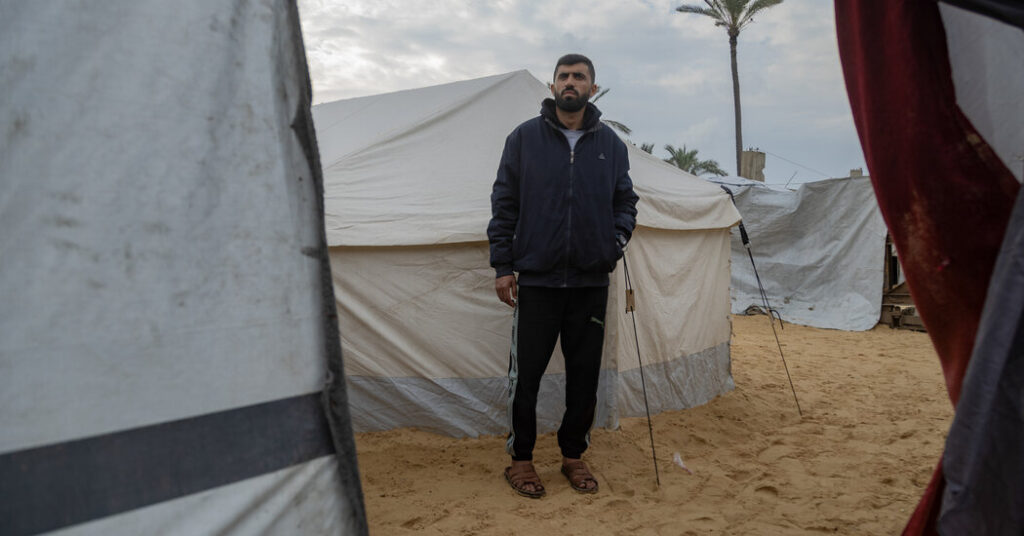
Mr. Salem spoke to The Times for several hours at his new living quarters, a tent in a densely-packed encampment for people displaced by the war beside a main road in Deir al-Balah, central Gaza.
Throughout his incarceration, he said, he had imagined reuniting with his family. He celebrated his children’s birthdays, creating confections from hoarded prison rations, and crafting a bracelet for his infant daughter from beads of bread baked hard in the sun.
When he finally returned to Gaza, he eagerly scanned the waiting crowd for a glimpse of his wife and children. He asked relatives where they were, but nobody would answer until a cousin eventually replied, “May God have mercy on their souls.”
All four had been killed in an Israeli airstrike a month before he came home.
Bound, Blindfolded and Beaten
Mr. Salem met and married Ikhlas Eissa in 2016.
“She was everything I had dreamed of — strong, thoughtful and beautiful,” he recalled. Children soon followed and they built a life in Beit Lahiya, in northern Gaza.
He worked for the Jabaliya municipal council, part of the Hamas-run government, and taught electrical courses at Al Israa University, which is widely regarded in Gaza as being affiliated with Islamic Jihad — a connection confirmed by several Palestinian academics.
Mr. Salem said he was aware of the connection but only worked there to earn money, adding that he did not identify with the group. The Israeli military destroyed the university during the war.
After an Israeli airstrike damaged their home in May 2024, the Salem family moved in with neighbors. On Nov. 17, 2024, the couple’s eighth wedding anniversary, the Israeli strikes intensified to the point that they decided to take their chances and set out on foot in search of refuge.
“We had no idea where to go or what to expect,” Mr. Salem said, reflecting on the chaos of the mass displacements of most of Gaza’s 2 million people.
They headed south with whatever they could carry. Their son, Baraa, was 7 at the time, his sister, Iman, was 4 and baby Layan not even a year old.
They soon encountered a military checkpoint where soldiers were separating men of fighting age from the elderly, women, children. Anticipating arrest, Mr. Salem gave Baraa his wristwatch, telling him, “From now on, you are the man of our family.”
After detaining him, Mr. Salem said Israeli soldiers kicked him and pressed lit cigarettes into his hands. After midnight, he and other detainees were driven in the bed of a truck to the Israeli border, bound, blindfolded and shivering, dressed only in flimsy overalls. There they were thrown out of the truck onto gravel, where they sat for hours in the cold, he said.
One officer brought him thermal blankets, then he boarded a bus to Sde Teiman. Along the way, he said, soldiers beat him with batons and struck him in the groin area, causing pain and bleeding for days.
Dogs and a “Disco” Room
At the detention facility, Mr. Salem was taken to a clinic but received no medication, he said. He was assigned a number: 090260. The next morning, he was interrogated for the first time.
An Israeli officer checked his identity, he said, then played him a recording of a phone call his father-in-law had made to him on the morning of Oct. 7, 2023, arranging to come over to collect a spare gas cylinder. It proved that the Israelis already knew he was at home that day, not participating in the attack on Israel, he said.
The officer questioned him about the location of booby-trapped buildings in his neighborhood. Mr. Salem said he had no such information, being “a civilian living among civilians.”
When he asked how long he would be held, he said, the interrogator told him, “You are just a number here” and said he might be released within weeks, or in a future swap.
The detainees rose at dawn, had to stand or kneel for long periods during the morning prisoner count, and spent the rest of the day sitting in silence on the ground.
Before his next interrogation, he said, he was placed for nine days in a room the prisoners called the “disco,” where loud music blared at unbearable volume. It was forbidden to ask for the bathroom. The guards hurled meals consisting of a thin slice of bread with a tomato or a cucumber at the roughly 20 men there.
“When I dared to glance around, I saw some detainees with blood oozing from their ears because of the beatings or loud music,” Mr. Salem said.
The Israeli military denied using music “as a method of torture,” something that has been alleged by other detainees interviewed by The Times.
Mr. Salem said his next interrogator asked again about booby-trapped buildings and tunnels, and about the whereabouts of fighters and weapons, and who might be holding hostages. He said he pointed on a screen to some tunnels that he knew had already been discovered.
The officer then showed him images of apartments in his neighborhood and asked about the residents.
“There was no room for lying,” Mr. Salem said. “I knew that if I lied even once, I would never get out of prison.”
He said the officer showed him a screenshot of a post Mr. Salem had written on Facebook before his arrest, blaming Hamas for bringing catastrophe upon the people of Gaza.
Asked why he had written the post, he told the Israelis, “My house was destroyed. I lost my job. Many of my relatives were killed. Our lives are shattered.”
In an earlier post, Mr. Salem had listed 26 members of his extended family who had been killed during the Gaza war.
Mr. Salem said he suffered other abuse at Sde Teiman. Soldiers slammed his face into a metal fence; used metal detector wands to press down hard on his genitals during searches; and detonated stun grenades near him and other prisoners, he said. One soldier unleashed two muzzled dogs that barreled into his chest, he added, knocking the breath out of him.
Israel’s prison service declined to comment on Mr. Salem’s case and the Shin Bet domestic security agency did not respond to requests for comment.
Mr. Salem said he had two court hearings, held by video link, approving his continued incarceration. Shalom Ben Hanan, a former Shin Bet official, said it was unlikely a court would have approved his detention for 11 months without any justification.
But Mr. Salem said he told one judge he was a hostage, and the judge said that he would be held until the war ended.
One Day, the Skies Went Quiet
In April, Mr. Salem was transferred from Sde Teiman to Ofer prison in the Israeli-occupied West Bank, where he spent four and a half months. There, he said, he was at least able to sleep during the day.
In August, he was moved again, to Naqab prison in Israel’s southern desert.
One day in October, Mr. Salem and his fellow detainees noticed that the skies had gone quiet. They could no longer hear Israeli war planes taking off or landing.
A couple days later, the detainees were gathered in one room. Soldiers arrived and began calling out names. Mr. Salem’s came up.
After a cursory medical check, Mr. Salem said he was fingerprinted, photographed and given a new gray tracksuit. He was going home.
On the morning of Oct. 13, he boarded a bus back to Gaza, one of about 2,000 Palestinian prisoners exchanged for the last 20 living hostages who had been seized from Israel by Palestinian militants two years earlier.
What he thought was a joyful day quickly turned to anguish.
His wife, Ikhlas, and three children had been sheltering in a tent in Sheikh Radwan, a neighborhood of Gaza City. At about 1 a.m. on Sept. 8, an Israeli airstrike hit the tent, immediately killing Iman and Layan, he said. Baraa succumbed to his wounds on Sept. 12, and Ikhlas three days later.
The Israeli military acknowledged carrying out an airstrike that night at the same location, saying the target was a Hamas operative.
Now Mr. Salem’s Facebook page is filled with photographs of his children.
He smuggled out of prison the beads he made for Layan, defying Israeli regulations forbidding inmates from taking anything back to Gaza.
He still has the bracelet, he said, but “without the one it was meant for.” Layan would have turned 2 on Oct. 17, four days after his return.
Isabel Kershner, a senior correspondent for The Times in Jerusalem, has been reporting on Israeli and Palestinian affairs since 1990.
The post After Suffering in Israeli Prison, a Gaza Detainee Comes Home to More Pain appeared first on New York Times.