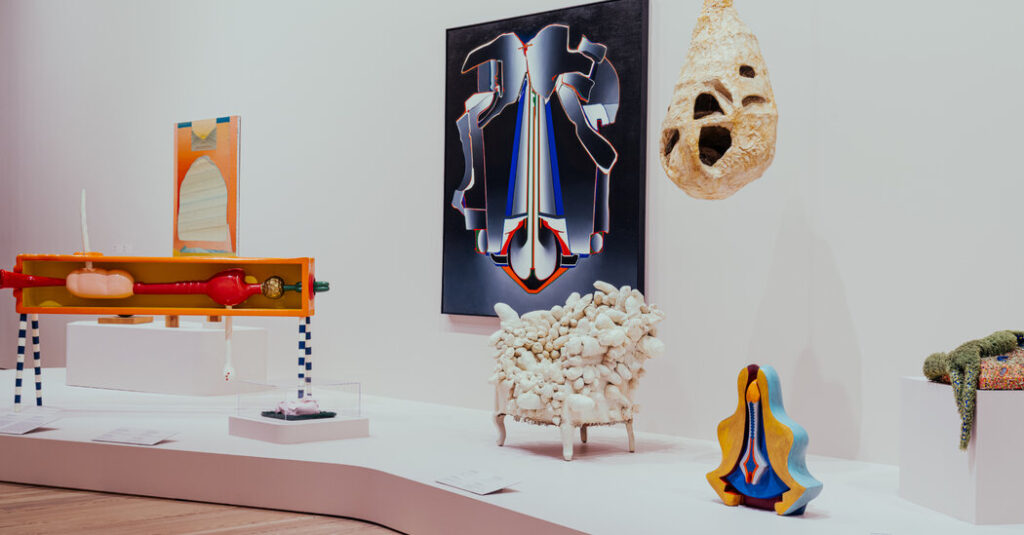
‘Sixties Surreal’
Through Jan. 19 at the Whitney Museum of American Art, Manhattan; whitney.org.
The 1960s were an era of social unrest, consciousness raising and subversive activism. Curiously, the best-known art of this decade — pop art and minimalism — reflects very little of it.
“Sixties Surreal” is a kind of course correct. In this case, the “surreal” in the title refers to 150 works of counterculture — paintings, sculptures, photography, collage and found objects, often psychosexual in nature and devoted to the human body — and less to capital “S” Surrealism. The critic Walker Mimms called the exhibition “fascinating and revisionist,” one where the viewer exits “caffeinated in a way no other show in New York currently leaves you.” More than 100 artists, many of whom were sidelined by their race, sex, sexuality or geography, finally get their due.
‘Divine Egypt’
Through Jan. 19 at the Metropolitan Museum of Art, Manhattan; metmuseum.org.
Goddesses, deities, carvings in stone and plenty of sculptures of man-animal hybrids (jackal, falcon, cobra, feline) make up the fabric of this sweeping collection of ancient Egyptian art, where divinity dominates.
The 200 objects in this once-in-a-decade exhibition, which the critic Holland Cotter called “gorgeous and seductive” and “entrancingly charismatic,” encompass more than 3,000 years. The open-plan layout features individual spaces dedicated to a single god, where, Cotter writes, “They reveal themselves fully, as personalities.” With all of these tombs, temples and shrines — considered portals to the sacred — it’s perfect for cosmic contemplation. Read the review.
‘Renoir Drawings’
Through Feb. 8 at the Morgan Library & Museum; themorgan.org.
Pierre-Auguste Renoir’s legacy sits squarely in the Impressionist movement, where his paintings of ladies and gardens and parties propelled him to fame. But drawing was also central to his artistic practice.
In collaboration with the Musée d’Orsay in Paris, “Renoir Drawings” showcases the painter’s lesser-seen works on paper. Some are sketches, test runs for larger landscape and figure paintings, but many are finished works in their own right, which took no small effort to transport and display. Pastels on paper are fragile; the medium is so delicate that it’s rare for the Musée d’Orsay to loan them out. “To have all these works gathered is an occasion we’re not likely to see again,” Paul Perrin, the museum’s chief curator and director of conservation and collections, said in an interview. “At least not anytime soon, that’s for sure.” Read the feature.
‘Syncopated Stages: Black Disruptions to the Great White Way’
Through Feb. 21 at the New York Public Library for the Performing Arts, Manhattan; nypl.org.
To understand the far-reaching influence of Black artists on New York theater, you’ll have to go back 200 years. Among the more than 270 artifacts in “Syncopated Stages” is a scale model of a 300-seat Greenwich Village theater called the African Grove, which produced works by Black artists before the full abolition of slavery in New York State. Also on display is the history of the comedic duo Flournoy Miller and Aubrey Lyles, whose 1921 “Shuffle Along” is widely credited with catapulting Black theater to mainstream recognition.
The musical was a smash hit, and made theater history as the most successful early Broadway musical by an all-Black production. The ripple effect was profound, spurring the opening of several new musicals, including “Runnin’ Wild” in 1923, starring Miller and Lyles, and “The Chocolate Dandies” in 1924, which thrust the actress Josephine Baker into stardom. It’s just one of the many histories on display, all of which laid the groundwork for generations of Black artists whose contributions have reshaped the New York stage. Read the feature.
‘Man Ray: When Objects Dream’
Through Feb. 1 at the Metropolitan Museum of Art, Manhattan; metmuseum.org.
The rayograph, an image produced by placing an object on light-sensitive paper, was a term coined by the artist Man Ray to name his version of the 19th-century technique. The discovery happened by accident in the darkroom, and then became the obsessive focus of his career.
Ray’s overexposed images are animated by a restlessness in which everyday objects appear as reversed silhouettes, and blur and pop in mysterious compositions.Arthur Lubow wrote in The New York Times that the show is “revelatory.” The magic is that “everyday objects remain identifiable yet become strange and otherworldly, transfigured by the artist’s skillful manipulations of luminescence, shadows, and gradations of gray and black,” Lubow wrote. Read the feature.
‘Ruth Asawa: A Retrospective’
Through Feb. 7 at the Museum of Modern Art, Manhattan; moma.org.
To see Ruth Asawa’s prolific body of work is to see a master of experimentation.
This sprawling retrospective — packed with 398 works and archival documents — coincides with the centennial of the artist’s birth, and places Asawa, who died in 2013, firmly in the canon after a career mostly overlooked by the art establishment. The critic Deborah Solomon called the exhibition a “must-see” and “prodigiously moving,” adding that the show is “warmly biographical” in its presentation of Asawa’s history as an art educator and cultural activist in San Francisco alongside her abounding body of work, which includes looping wire sculptures, light as air and nested within themselves, along with bronze casts and ink renderings of petunias and poppies. Read the review.
‘Anish Kapoor: Early Work’
Through Feb. 1 at the Jewish Museum, Manhattan; thejewishmuseum.org.
Before Anish Kapoor was an in-demand artist fielding calls from reporters, before he had roomy budgets for large-scale installations like “Cloud Gate” (a.k.a “The Bean”) in Chicago, before he collaborated with Greenpeace to drench a giant canvas hanging from an oil rig in red paint, he was a struggling artist working with pigment.
Those early works from the 1970s and 1980s — powders in halcyon blue, marigold and raspberry coat cones, cubes and spherical shapes — are on view in the first museum presentation in the United States dedicated to the artist’s early work. Kapoor’s pigment sculptures spill over their own edges into colorful, fragile halos, and drift off into something more amorphous. Read the profile.
‘Monet and Venice’
Through Feb. 1 at the Brooklyn Museum, Brooklyn; brooklynmuseum.org.
The painter Claude Monet had no interest in going to Venice, preferring instead to keep to his corner of Normandy, France. But he eventually relented and, just eight days after arriving, began working from early morning to sunset, the start of a fertile stretch that generated 37 paintings in less than three months.
“You’ll see that what grabbed him,” Mimms wrote in his review, “were the special density of the light there and the dreamlike supremacy of water. How could they not?” Not only did Monet capture Venetian splendor through accurate landmarks and drowsy silhouettes, but the artist’s time in the floating city refreshed his vision for the water lily paintings he’d stalled on (three are on display in Brooklyn). Mimms called the show “lush and greedy” and “a terrific buffet of salutations from the great man’s last trip.” Read the review.
‘Witnessing Humanity: The Art of John Wilson’
Through Feb. 8 at the Metropolitan Museum of Art, Manhattan; metmuseum.org.
In what is being billed as the largest exhibition of works by the American artist and social activist John Wilson (1922-2015), more than 100 paintings, prints, drawings, sculptures and illustrated children’s books showcase his figurative style and quest to portray what he called “a universal humanity.”
Images of Black Americans — rooted in dignity and beauty, in an effort to counter prejudiced depictions of Black people in popular culture — lie at the center of his work. His career took many shapes: Muralist, lithographer, art educator. Through each medium, Wilson was driven by the tumultuous political climate and racial inequities in the United States. Those themes are still palpable today in two of his most celebrated works on display: a sculpture of the Rev. Dr. Martin Luther King Jr. at the U.S. Capitol and the 600-pound-bronze sculpture, “Eternal Presence.”
Rachel Sherman reports on culture and the arts for The Times.
The post 9 Art Shows to See Before They Close This Winter appeared first on New York Times.