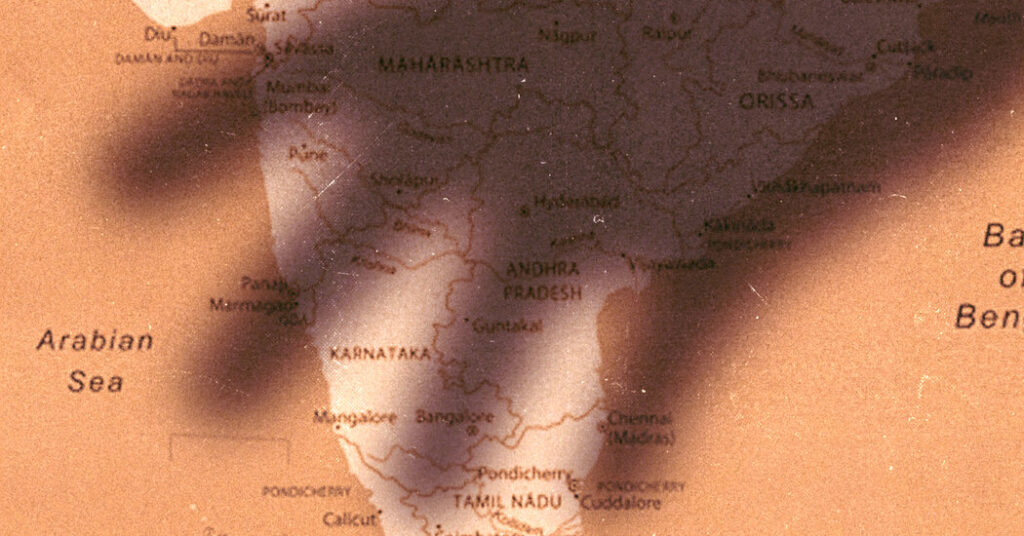
An hour’s drive north of Mumbai, India, in the middle of a swath of low green hills and small farmhouses, a large arch marks the entrance to a complex known as Keshav Srushti — or, loosely, Keshav’s Creation. Next to the arch is a tall portrait of a man with a walrus mustache and an orange blazer: Keshav Baliram Hedgewar.
Dr. Hedgewar was the founder of the Rashtriya Swayamsevak Sangh, an organization widely credited as the incubator of the Hindu far right. He started the group, better known as the R.S.S., in 1925 as a martial arts gymnasium for angry young men. The R.S.S.’s focus on Hindu man-making emerged out of an anxiety over a perceived Hindu disunity, and the organization spread rapidly in India in the 1930s and ’40s. He and his followers believed India’s Muslim minority posed a dire threat to the Hindu majority — a belief that, 100 years later, is alive and well in Hindu far-right circles.
Today the R.S.S. has grown into what is arguably the biggest and least understood far-right movement in the world, shrouded in secrecy and condemned for complicity in mass violence against India’s religious minorities, criticized for trying to rewrite Indian history by vilifying medieval Muslim rule and noted for its close relationship with the right-wing Bharatiya Janata Party, which has governed India for more than a decade.
For the past six years, I have been part of a team that has mapped thousands of organizations in 40 countries with links to the R.S.S. Our research, published this month by The Caravan in India, shows that the R.S.S. sits at the center of an international web of schools, charities, temples and think tanks that have worked in concert to embed Hindu nationalism into the fabric of Indians’ daily life, society and politics, whether at home or in the diaspora.
This picture offers insight into the social forces that propelled the Hindu far right to dominance in India. It also helps explain how, as nativist parties are in ascendance globally, a far-right movement can infiltrate the institutions of daily life to achieve political power.
One key lesson is that far-right mobilization is not natural, inevitable or simply a consequence of far-right ideology appealing to the insecurity and precariousness of our times. In India we found it emerges from a top-down, intentionally cultivated civil society network — and not, contrary to the R.S.S.’s assertions, from a bottom-up spontaneous social movement.
When I visited Keshav Srushti in 2024, I found a bucolic scene that felt a world away from the street marches and the preachers of hate that are associated with the R.S.S. and the violent Hindu nationalist movement that has grown out of it. There were no uniformed goose-stepping militias but a range of innocuous and seemingly disconnected structures — an agricultural research trust, an old-age home, a cow refuge, a school, a temple and an herbal medicine research center. It certainly was not the vision of the far right that most people have.
This cluster of institutions is symbolic of how the R.S.S. has created a vast constellation of civil society organizations like those at Keshav Srushti. Indian analysts often talk about the R.S.S.’s influence in think tanks, disaster relief, curriculum development and overseas lobbying. The R.S.S. says that this influence on such activities is exaggerated, maintaining that those groups are independent organizations that may occasionally simply be inspired by the R.S.S. Most observers both inside and outside India have only a fuzzy sense of what this network does and where. Few know where the R.S.S. starts or where it ends.
After closely studying the publications of the R.S.S. and its affiliates, we found over 2,500 organizations linked to the Sangh. Through two years of consultation with academics, journalists and activists, we measured the groups’ links to the R.S.S. across 34 patterns — for example, if they had members with known R.S.S. ties or displayed photos of R.S.S. leaders in their offices. We didn’t find hundreds of violent groups, although we found a few.
Mostly the organizations we found were like those in the shady groves of Keshav Srushti, including blood banks, publishing houses, yoga schools, private universities, sewing training centers and a cigarillo manufacturers’ union. We found a cricket tournament in the United States, a pilgrimage tour to Angkor Wat in Cambodia and a migrant services help line in Australia.
The R.S.S. has been very clear that its primary ambition has never been electoral power, though that is what the past decade has delivered. Prime Minister Narendra Modi was once an executive of the R.S.S. Nevertheless, the network has always appeared to see the ballot box as a means to an end. The organization’s goal is the transformation of Indian society in its image, one in which dominant-caste Hindu supremacy is enshrined as a core principle. Certainly, winning government control can be hugely useful in this task, but it is not essential. The Bharatiya Janata Party may lose elections, but the Sangh persists.
The organizations we mapped help give the R.S.S. the avenues to work toward the whole-of-society change it seeks. It might be by providing private alternatives to crumbling state health care, by indoctrinating children through tens of thousands of private Hindu nationalist schools or by churning out news and media content through dozens of publishing houses, websites and newspapers. Not all the groups we tracked are explicit about far-right ideas, but many of them become key vectors for legitimacy, information and often resources (financial or otherwise) that sustain the core of the R.S.S. network.
For example, our research uncovered over 400 hostels that on the surface serve mainly to shelter and educate marginalized youth — especially from India’s Indigenous, or Adivasi, communities. The hostels are seldom overt in their espousal of Hindu supremacy. However, many of the students who enter this network of hostels are eventually pushed to imbibe specific religious and political beliefs and are cultivated as foot soldiers for the expansion of the Hindu nationalist project.
India’s attention is, understandably, often captured by far-right violence and by far-right aspirations to govern in a way that portends further violence. Organizations affiliated with the R.S.S., including the Bharatiya Janata Party, have repeatedly been implicated in attempts to undermine religious minorities, whether through violence, ostracization or legal marginalization. The rhythms of this supremacist project have become central to Indian politics. What the vast network of the Sangh shows is that sometimes such violence and divisive electioneering is simply the sharp end of a long stick.
The Sangh has understood, through trial and error, that it must build public consent for the project of Hindu supremacy. Periods of naked antiminority violence and hate speech have, at times, resulted in bans on the R.S.S., a U.S. visa freeze for Mr. Modi and the breakdown of coalition governments in which the Bharatiya Janata Party took part. In this context, the R.S.S.’s civil society network allows it to offer contrasting messages to differing constituencies, giving the far right a flexibility, breadth and penetrating power that greatly exceeds what it could build if it were just a set of sword-wielding militias.
This is a pattern other far-right movements have embraced. In Myanmar, networks of Buddhist monasteries have served as key vectors for Buddhist supremacist mobilizations. The civil society networks of Viktor Orban’s Fidesz party in Hungary helped lay the foundation for its electoral support. In the United States, the organizations that coalesced around the Heritage Foundation’s Project 2025 have played key roles in advancing the MAGA movement.
Across the globe, far-right organizing threatens democratic norms. The struggle for democratic values is not a fight between progressive civil society and some nameless, shapeless far-right force that spreads as an invisible pathogen. Often, it is precisely through visible, largely legal and contestable far-right civil society organizing that antidemocratic forces mobilize.
If we grasp this, we can also take in an important corollary: that if the far right has organized itself into power, it can be organized out of it, too.
Felix Pal is a lecturer in politics and international relations at the University of Western Australia.
Source photographs by Nataliia Nikolenko and Issarawat Tattong/Getty Images
The Times is committed to publishing a diversity of letters to the editor. We’d like to hear what you think about this or any of our articles. Here are some tips. And here’s our email: [email protected].
Follow the New York Times Opinion section on Facebook, Instagram, TikTok, Bluesky, WhatsApp and Threads.
The post Youth Hostels, Blood Banks, Yoga: How One Far-Right Network Spread Across the World appeared first on New York Times.