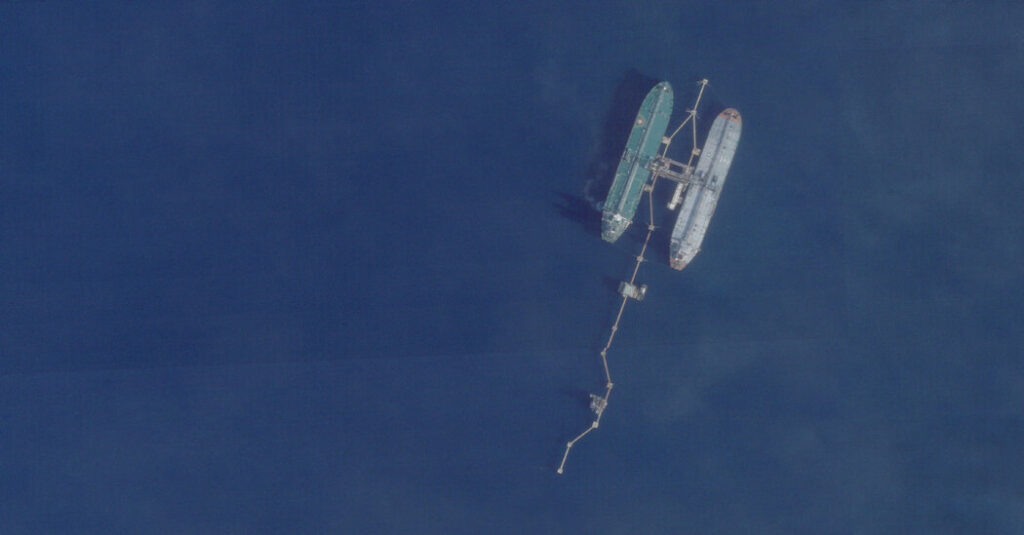
President Trump’s recent actions against tankers near Venezuela, the dramatic seizure of a vessel called Skipper and the detention of another called Centuries, appear to bend international maritime laws and customs, legal experts say.
Countries have authority to seize vessels in their territorial waters. But policing international waters can be difficult, which is why large numbers of vessels transport illicit or dubious cargo often with impunity. The United Nations has established rules for shipping under its Convention on the Law of the Sea. While the United States has adopted many of the rules in practice, it has not ratified the convention.
The Trump administration’s actions differ in crucial ways from the approach that other administrations, including Mr. Trump’s first one, took toward ships engaged in trade the government wanted to restrict. By moving so forcefully, legal experts say, the president may embolden other countries to use similar tactics when it suits them. If such seizures and detentions become more common, that could hurt the shipping industry and international trade.
Previously, the United States typically put pressure on foreign shipping companies to direct their vessels to a place where they would give up oil and other products targeted by the U.S. government. In 2020, the Trump administration used this approach to remove Iranian fuel from four Greek-owned tankers destined for Venezuela.
That method avoided the potentially provocative step of using the U.S. military to take over ships in international waters, which are supposed to be neutral.
“That’s what I think is novel about this,” said Francisco Rodríguez, a senior research fellow at the Center for Economic and Policy Research, a left-leaning research organization.
Now, some analysts fear that the recent seizure and detention will undermine the rules and customs that have for decades maintained order on the high seas.
Jennifer Kavanagh, director of military analysis at Defense Priorities, a research institute that favors restraint in foreign policy, said other countries, particularly China, might conclude that they, too, could take similar steps.
“This would be a precedent that they could fall back on,” she said, “that they were only doing what the United States had indicated was legal.”
Dozens of tankers have been carrying oil and other products in and out of Venezuela, whose main oil company has been placed under sanctions by the Treasury Department. To avoid detection, the vessels sometimes switch off location transmitters. They may also sail under a false flag. And the ships’ owners or operators have been known to take steps to hide their identities and links to the vessels.
China, the biggest importer of Venezuelan oil, has condemned the U.S. actions. On Monday, a Chinese Foreign Ministry spokesman said Beijing opposed any moves that “infringe on the sovereignty and security of other countries, or constitute acts of unilateral bullying.”
White House officials did not respond to a request for comment.
“Venezuela is completely surrounded by the largest Armada ever assembled in the History of South America,” Mr. Trump said this month on Truth Social, his social media platform. “It will only get bigger, and the shock to them will be like nothing they have ever seen before.”
The United States obtained a warrant from the U.S. District Court for the District of Columbia to seize the Skipper, which is on an American sanctions list. Legal analysts said the boarding may have been legal under international law because the tanker was apparently sailing under a flag that it was not authorized to use, a violation of U.N. maritime rules. The Skipper was using the flag of Guyana, but the Guyanese government said the vessel was not registered in the country.
Even so, some experts on sanctions said the Trump administration’s actions appeared at odds with longstanding maritime practices.
“This differs from past seizures, which generally involved the cooperation of the vessel’s owner or charterer,” said David Tannenbaum, director at Blackstone Compliance Services and a former sanctions compliance officer at the Treasury Department.
The Centuries was flying a Panamanian flag. Panama’s foreign minister later said the vessel had not respected the country’s maritime rules.
The American authorities did not have a warrant to take possession of Centuries, a U.S. official told The New York Times. It was also not on a public list of vessels under U.S. sanctions. But some lawyers said other laws allowed the United States to seize assets that were not on sanctions lists.
“The federal terrorism-related seizure statute allows extraterritorial seizures,” said Jeremy Paner, a partner specializing in sanctions law at Hughes Hubbard, a law firm.
While U.S. law authorizes the government to seize property outside American territory, the government has to go to federal court to gain ownership of the seized assets, and may face challenges from the owners of those assets.
Mr. Paner said be believed that Venezuela would challenge the latest American actions in U.S. federal court. “It’ll likely take years to resolve,” he said.
Peter Eavis reports on the business of moving stuff around the world.
The post Trump’s Seizures of Oil Tankers Challenge Maritime Rules and Customs appeared first on New York Times.