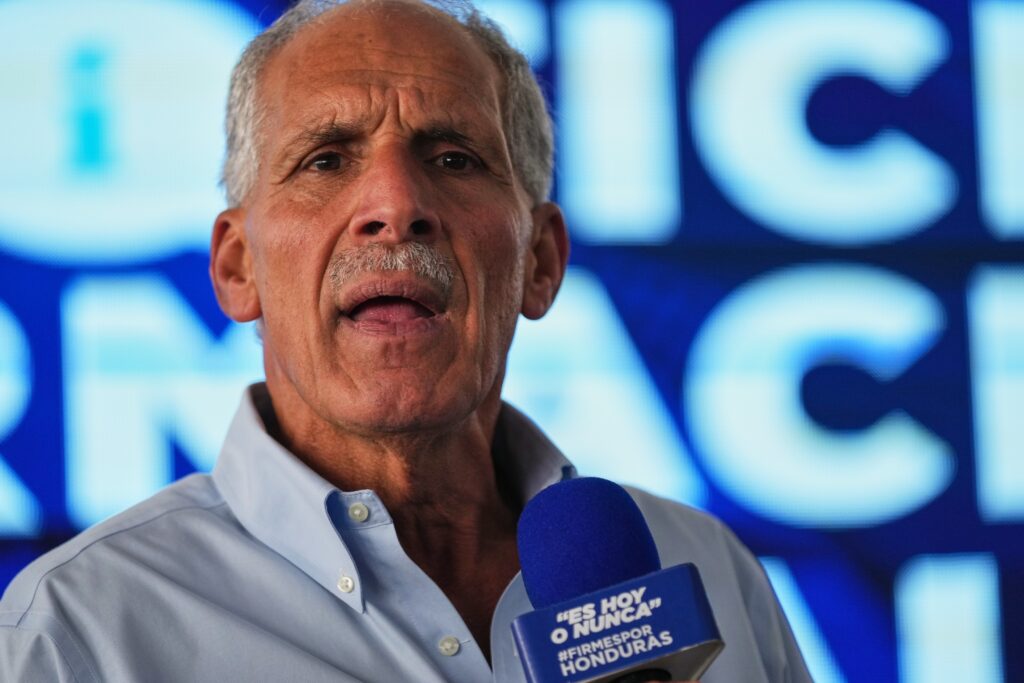
More than three weeks after Honduras held its presidential election, conservative candidate Nasry Asfura was declared the winner Wednesday. The bruising contest devolved into chaos in late November when President Donald Trump pledged his support for Asfura, threatening — two days before polls opened on Nov. 30 — to cut aid if he didn’t win the contest.
“Honduras: I am prepared to govern,” President-elect Asfura wrote in a statement on social media. “I will not fail you.”
The result comes after weeks of delays, and amid accusations of issues with vote counting, including by Asfura’s main opponent, television host Salvador Nasralla, of the centrist Liberal Party. On Wednesday, Nasralla made multiple posts on social media alleging electoral fraud and calling for intervention by international election monitors.
Secretary of State Marco Rubio congratulated Asfura in a statement. “The United States … looks forward to working with his administration to advance prosperity and security in our hemisphere.”
Trump’s comments prompted further complaints of election interference from candidates and politicians on all sides. Trump called Nasralla a “borderline Communist,” promising instead to work with Asfura, the former mayor of the Honduran capital, Tegucigalpa, to “fight the Narcocommunists.”
“There’s no doubt the timing of Trump’s statements was deliberate,” Juanita Goebertus Estrada, director of the Americas Division at Human Rights Watch, said in a statement to The Washington Post. “The immediate effect was predictable: it likely strengthened Asfura’s hand in the final stretch of the campaign.”
Trump’s words were likely at the forefront of Hondurans’ minds as they cast their votes, said Ana María Méndez Dardón, director for Central America at the Washington Office on Latin America, a D.C.-based think tank.
“I think many of the Hondurans this time casted their vote under fear and under threat. … They know that the foreign policies toward Honduras have an impact on their lives,” she said.
After election day, Trump accused the Honduran government of “trying to change the results of their Presidential Election.” In a Truth Social post, he claimed electoral authorities were “abruptly stopping” the vote count at midnight on Sunday, with 47 percent of votes counted.
Trump’s remarks injected an additional layer of insecurity about the integrity of the vote count and the potential for electoral fraud, Goebertus said. “It handed [the Liberty and Refoundation Party] a convenient pretext to dispute the preliminary results and injected even more distrust into an already discredited electoral process.”
With Asfura’s win, Honduras becomes the latest Latin American country to shift to the right. He will succeed Xiomara Castro, the country’s first female president and the wife of former Honduran president José Manuel Zelaya, who was ousted by the Honduran military in 2009.
In the lead-up to the Honduran election, Trump also granted a “full and unconditional” pardon to Juan Orlando Hernández, the Central American country’s former leader who once led the National Party. The former president was convicted by a U.S. court last year on charges that he ran the country as a “narco-state” and sentenced to 45 years in prison. He was released from a U.S. federal prison Dec. 1.
In the early years of Hernández’s presidency, U.S. administrations of both parties portrayed him as an ally against narco-trafficking and illegal immigration. In 2015, then-Vice President Joe Biden hosted him at the White House. In 2019, Trump praised him for his cooperation, saying the countries were “stopping drugs at a level that has never happened.”
But by then, the Justice Department had launched an investigation into Hernández as part of a broader probe of drug trafficking allegations against the Honduran political elite. During Trump’s first administration, prosecutors had successfully indicted former Honduran National Police chief Juan Carlos “El Tigre” Bonilla and congressman Juan Antonio “Tony” Hernández, the president’s brother. Bonilla pleaded guilty in 2019 to conspiracy to import cocaine and was sentenced to 19 years in prison. Tony Hernández was found guilty that year of conspiracy to import cocaine and weapons charges and sentenced to life.
In February 2022, weeks after he left office, Juan Orlando Hernández was arrested by Honduran police at the request of U.S. authorities and extradited to the United States. Prosecutors said he built his political career on millions of dollars in bribes from traffickers in Honduras and Mexico. As president, he helped move at least 400 tons of cocaine to the United States while protecting traffickers from extradition and prosecution, they said.
Méndez Dardón criticized Trump’s decision to pardon Hernández as being “inconsistent and incoherent” with the administration’s priorities. The Trump administration is waging what it calls a counternarcotics campaign off the coast of Venezuela. Trump has accused Nicolás Maduro, the country’s leader, of sending violent criminals and drugs to the U.S. The administration has deployed U.S. troops and warships to the region. American forces have destroyed at least 28 boats in the Caribbean Sea and Pacific Ocean that officials say were carrying drugs to the U.S. More than 100 people have been killed.
“Pardoning a top trafficker while intensifying lethal operations against alleged low-level operatives creates instability and ultimately erodes U.S. credibility in the region,” said Goebertus.
Samantha Schmidt contributed to this report.
The post Trump-backed conservative candidate wins Honduran presidential election appeared first on Washington Post.