This is the time of year when many of us hail “peace on earth” and earnestly repeat lines about “good will to all.” So maybe it’s also a moment to hold ourselves accountable for our collective failures — and, even more important, to try to do better.
It’s not just that ill will and war prevail in so many places, from Gaza to America’s own immigration detention centers. It’s also that our leaders repeat religious platitudes — or talk about winning a Nobel Peace Prize — even as they seem indifferent to grotesque atrocities.
Again, there are many examples. But the one unfolding right now in Sudan, already the world’s worst humanitarian crisis, is especially sickening. A militia long accused of genocide has seized the major city of El Fasher and is thought to have slaughtered tens of thousands of people there in recent weeks.
The atrocities were widely predicted and are the culmination of years of unremitting savagery. They were enabled by an American partner, the United Arab Emirates. Yet under both Joe Biden and Donald Trump, the United States has (along with other nations) refused to take serious steps to stop the mass killing and mass rape.
Here’s what happened. A Sudanese militia, the Rapid Support Forces, which is backed by the Emirates, seized El Fasher on Oct. 26, after more than two years of warnings that it would. Satellite imagery shows mass graves and burn piles indicating systematic slaughter, according to the Yale Humanitarian Research Lab, which analyzed the satellite photos.
Nathaniel Raymond, a public health scholar and the executive director of the lab, estimates that between 30,000 and 100,000 people may have been killed in six weeks, with 60,000 as a plausible midpoint. That pace of killing would be unrivaled since the Rwanda genocide of 1994, he told me, adding that the death toll in El Fasher in less than two months may be comparable to that in Gaza over two years.
El Fasher, which had around a quarter-million inhabitants shortly before it was overrun by the militia, remains sealed off, so it is impossible to confirm the scale of killings. But it is widely recognized that something terrible has unfolded there in recent weeks.
The attackers posted videos of themselves executing people, and the governor of the Darfur region surrounding El Fasher, Minni Minnawi, who opposes the Rapid Support Forces, estimated that 27,000 people were killed in just the first few days. The United Nations humanitarian chief, Tom Fletcher, has described El Fasher as “basically a crime scene.” A senior U.N. official warned that the “mass killing,” “sexual violence on a massive scale,” “torture” and other abuses in the region indicate possible genocide. The International Rescue Committee cited estimates of 60,000 killed in El Fasher and noted that there are risks that the massacres will be repeated in another region of Sudan, Kordofan.
All this has attracted little attention and no serious response.
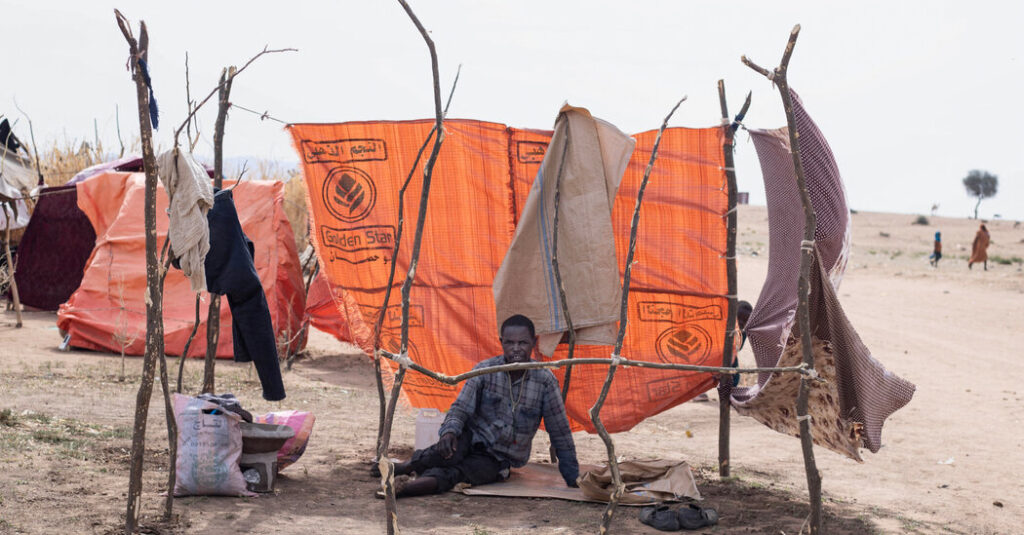
Some people have managed to flee El Fasher, and they describe killings and other atrocities. The Norwegian Refugee Council reported that some 400 children without parents arrived exhausted in the nearby town of Tawila, in many cases after days of walking across the desert.
“Many witnessed extreme violence before escaping and are showing signs of acute trauma,” said Nidaa, a teacher affiliated with the Norwegian Refugee Council. “Some of the children could not speak at all when they arrived.”
The new satellite imagery shows 150 clusters of human remains in El Fasher, along with five burn pits used to incinerate bodies, Raymond said. Even from space, blood stains are visible on the ground.
Something just as ominous emerges in the satellite photos: an absence of people. Markets are empty and overgrown, donkey carts have mostly vanished and gathering points where people normally collect water are now deserted. A major city appears from space to be a ghost town.
“If you were going to see the murder of a city, this is what it looks like,” Raymond said.
The killings in El Fasher took place in the context of a civil war in Sudan that may have taken 400,000 lives since the Sudanese Armed Forces and the Rapid Support Forces began fighting each other in 2023. But three elements stand out to me as particularly horrific about El Fasher.
First, the United States grew even closer to the United Arab Emirates as the Emirates armed and equipped the Rapid Support Forces. (The Emirates deny backing the militia, but virtually no one takes that seriously.)
Second, the militia has directed its mass murder and mass rape at members of several Black African tribes. “We don’t want to see any Black people,” a militia leader said as he rounded up all males over the age of 10 in one village and executed them, a female survivor told me last year. The Biden and Trump administrations both described what has happened in Sudan as genocide, but neither was willing to publicly call out the Emirates and apply pressure.
Trump has recently expressed interest — with the encouragement of Saudi Arabia — in trying to bring peace to Sudan. That’s welcome. But his family has started immense new business ventures with the Emirates, and I fear that these may have bought his complicity. Bravo at least to members of Congress like Senator Chris Van Hollen who are pushing to halt arms transfers to the Emirates as long as it enables atrocities.
Third, in a broader sense, the killings in El Fasher represent a collapse of the entire international system created to respond to genocide and mass atrocities. For several decades, officials have somberly said “never again” and have created principles about the “responsibility to protect” and mechanisms like “atrocity prevention boards” — yet these look to me like window dressing.
The massacres in El Fasher are among the most predicted slaughters in the history of atrocities. Yet no one, from world leaders to the United Nations secretary general, António Guterres, has made it a sufficient focus.
We may never know the exact death toll in El Fasher, but we should recognize it as a collective failure of civilization.
If you’d like to do your part, one of the three nonprofits in my 2025 holiday giving guide helps people suffering in Sudan. It’s the Mutual Aid Sudan Coalition, which supports “emergency response rooms” such as volunteer-run community kitchens. Some 26,000 Sudanese volunteers risk their lives to distribute this aid and stave off even worse catastrophe. My giving guide has raised $34 million in just a few weeks, and your contributions will be matched by Bloomberg Philanthropies. You can join us at KristofImpact.org.
The Times is committed to publishing a diversity of letters to the editor. We’d like to hear what you think about this or any of our articles. Here are some tips. And here’s our email: [email protected].
Follow the New York Times Opinion section on Facebook, Instagram, TikTok, Bluesky, WhatsApp and Threads.
The post This Is What the Murder of a Whole City Looks Like appeared first on New York Times.