The GDP number arrived just before Christmas, wrapped like good news.
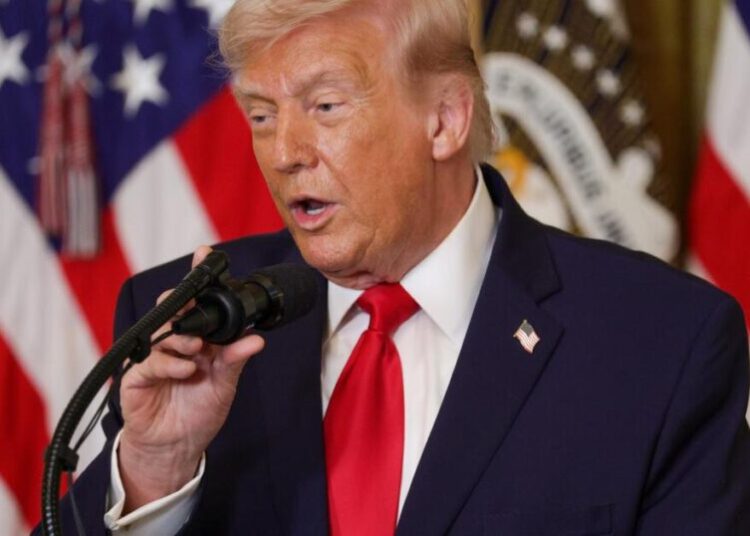
The U.S. economy grew at a 4.3% annual rate in the third quarter, blowing past economists’ expectations and delivering the kind of headline that signals strength heading into the new year. Consumers went on an unusually strong spending tear while corporations cinched $166 billion in capital gains. President Donald Trump and his team wasted no time celebrating, taking a victory lap over those dour economists who had warned of doom and gloom, declaring the “Trump economic golden age is FULL steam ahead.”
Well, slow down, those dour economists replied. There’s something missing in this boom: the jobs. Hiring this year, at best, has stalled, and at worst has collapsed: unemployment has climbed to 4.6%, and even Fed Chair Jerome Powell has warned recent data may be overstating job gains.
This is the puzzle economists are now trying to reconcile. In a typical recovery, strong GDP growth shows up first in hiring, then in paychecks, and finally in consumer spending. But in this quarter, it’s reversed: spending is here without jobs. So how does an economy grow at a 4.3% annual rate when households aren’t actually earning more, and in fact, still fighting sticky inflation?
“I’ve never seen anything like it,” KPMG’s chief economist Diane Swonk told Fortune. “To have this stagflation in the inflation and unemployment rate, and to not have it in growth is highly unusual, and something’s got to give.”
A tale of two economies
There are two parts of the story of how the economy arrived here. The first is that households are spending without income growth. Real disposable income was essentially flat in the third quarter—literally 0% growth. Americans did not gain purchasing power. Yet, they made up the difference through savings drawdowns, credit, or by absorbing costs they cannot avoid. The GDP report itself points to where that pressure is concentrated: mostly in services, and within services, healthcare was a leading driver.
Americans spent the most on healthcare last quarter since the Omicron wave of 2022, Swonk said. Outlays on outpatient care, hospital services, and nursing facilities rose at one of the fastest paces in years, reflecting aging demographics and higher medical prices, but also the growing use of costly GLP-1 weight-loss drugs, which continue to push up spending even after adjusting for inflation.
This was not a classic discretionary splurge, then. It was spending families had little ability to defer. That distinction matters, because spending driven by necessity behaves very differently from spending driven by rising paychecks. When households are paying more for healthcare, insurance, child care, or elder care, they are not signaling confidence; rather, they are absorbing pressure. And with real disposable income flat, those costs are not being met by wage growth, but by thinner savings and deferred choices elsewhere, Swonk said.
The problem, then, is when that pressure eases in early 2026 as tax refunds surge and withholding changes put more cash temporarily back into paychecks, the boost could act as a “sugar high”: a short-term lift to spending that does not fix the underlying problem of weak job creation and stagnant real income.
“We will feel more broad-based gains as we get into 2026,” Swonk said, “but at what price?”
The concern, she added, is that stimulus layered on top of already elevated service-sector inflation could make price pressures “stickier,” not relieve them.
The second part of the story—and the one most Fortune readers will already recognize—is that this economy is no longer moving as a single system. It is splitting into a “K-shape,” and what looks like resilience at the top increasingly masks fragility underneath.
The GDP report makes that divergence hard to miss. Alongside surging consumer spending, corporate profits from current production jumped by $166 billion in the third quarter, a dramatic acceleration from the prior period. At the same time, investment fell, led by a sharp drawdown in private inventories as businesses got rid of their pandemic-era hoarding. Businesses are not broadly expanding capacity, or hiring aggressively, or even hiring at all. They are extracting margins, managing costs, and in many cases waiting. They have learned how to grow without hiring, Swonk said. “We are seeing most of the productivity gains we’re seeing right now as really just the residual of companies being hesitant to hire and doing more with less,” she said. “Not necessarily AI yet.” In other words, businesses are squeezing output from a fixed or shrinking workforce, not expanding payrolls to meet new demand.
The K-shaped economy, fully matured
On one side of that K are affluent households and asset holders, whose spending continues to be supported by strong equity markets in jubilation after an historic year of AI spending, elevated home values, and corporate profit growth. On the other side are workers and lower- and middle-income households, whose spending, as already mentioned, is increasingly shaped by constraint rather than confidence, accounting for the consistent “affordability crisis.” The headline GDP number combines both groups into a single figure, but the lived economy does not.
Swonk noted that recreational services—travel, leisure, premium experiences—remain a bright spot, but are overwhelmingly carried by higher-income households. Even there, the data reveals stress beneath the surface. Vacation activity in August, she said, was the second-lowest on record for that month, trailing only August 2020. Airlines and hotels are still filling premium seats, but that demand is increasingly concentrated at the top.
The danger, Swonk argued, is that these two engines behave very differently over time. Spending supported by asset appreciation can persist as long as markets cooperate. Spending driven by necessity, however, cannot.
“When you’re carrying an economy by wealth effects and affluent households, as opposed to employment gains and generating new paychecks, you’re vulnerable if there’s any correction in equity markets,” Swonk said. She described how quickly that channel can reverse: foot traffic slows, discretionary spending pulls back, and high-end demand evaporates far faster than headline GDP data would suggest.
“When you divorce growth from employment gains, you’ve got a problem,” Swonk said. “And this is before the real effects of AI have even set in.”
The post The K-shaped economy is carrying a ticking time bomb into 2026 appeared first on Fortune.