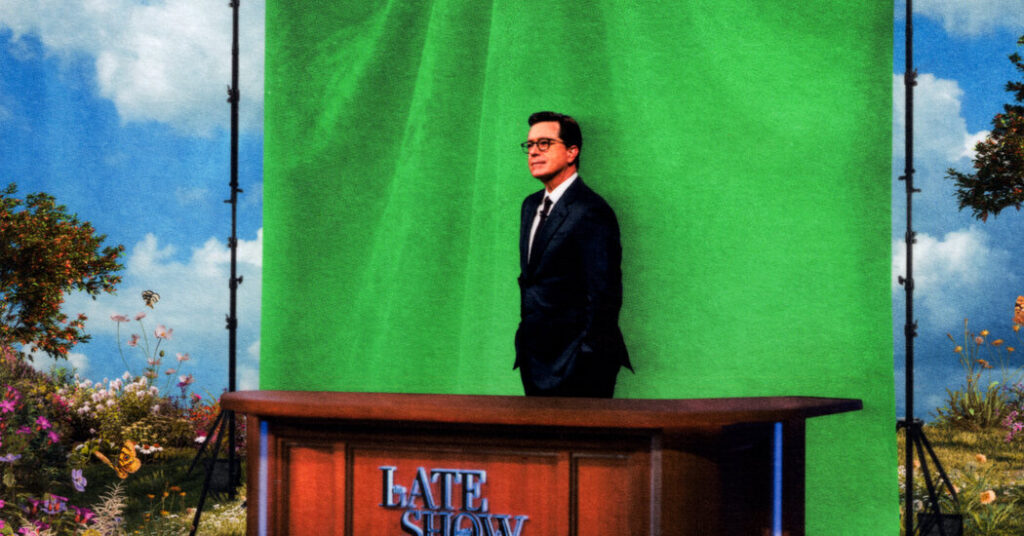
When “The Late Show With Stephen Colbert” won the Emmy for outstanding talk series in September, the host gave thanks with a short mission statement. When he first conceived his iteration of the CBS franchise, which he took over from David Letterman, Mr. Colbert had in mind a late-night comedy show “that was about love,” he explained.
“At a certain point,” he went on, “and you can guess what that point was, I realized that, in some ways, we were doing a late-night comedy show about loss. And that’s related to love, because sometimes you can only truly know how much you love something when you get a sense that you might be losing it.”
On the surface, Mr. Colbert might have been referring to the employment he and his staff of 200 will lose next year, as CBS has announced that “The Late Show” will end in May. (That announcement came while Skydance, a company headed by the Trump-adjacent David Ellison, was closing a multibillion-dollar merger with Paramount, which owns CBS.) But Mr. Colbert clearly meant something deeper. “I have never loved my country more desperately,” he said. “God bless America, stay strong, be brave, and if the elevator tries to bring you down, go crazy and punch a higher floor.”
The speech was passionate and concise. It also gave form to what those of us who have been watching “The Late Show” have been feeling through the end of the year, ever since its end was announced. Mr. Colbert had already set a high standard with his version of the familiar late-night format, and he’d been rewarded by topping the ratings. This final iteration of “The Late Show” has been nothing less than radical.
The determination with which Mr. Colbert (aided by his fine writing staff) is currently parsing love and grief under the cover of off-the-headlines jokes and celebrity interviews has been breathtaking. He’s always had acute comic aim — the cartoon persona of a bloviating right-wing pundit on Comedy Central’s “The Colbert Report” has, after all, taken over the country — but in these countdown months before his studio goes dark, we are seeing a new level of bravery that, I have a feeling, is anchored in spiritual strength.
On a typical night, Mr. Colbert delivers an opening monologue of blistering political attack. There is no mistaking the despairing rage he expresses on behalf of viewers who feel battered by the corruption and cruelty of this administration and its enablers. There is also no fear that hobbles him, even as the network that employs him and the mogul who owns the network’s parent company contort themselves into fealty. (Never mind what is already happening at CBS News.)
Mr. Colbert makes it look easy, employing a loose-limbed command of the camera first honed during his Second City improv work. When, with strategic discipline, he verbally flips the bird or otherwise chooses profanity, the effect is all the more cathartic, coming from a 61-year-old man of serious Roman Catholic commitment. His delighted, frequently declared love for his family has become, for many, its own inspirational presentation of adulthood. If Jon Stewart addresses the political situation with mordant Jewish wit and John Oliver supplies skewering British lunacy, Mr. Colbert models the kind of person we can aspire to be once the news climate hits the fan.
He and his resourceful band of producers have turned the celebrity portion of the talk-show machinery — which even in the most able hosts’ hands has always been the most tedious part of the late-night formula — into a cannily paced parade, a segment typified by rollicking camaraderie mixed with serious pastoral care. He’s elicited thoughts from Jeremy Renner on the actor’s second chance at life after a near-fatal accident, and with Michael J. Fox, Mr. Colbert talked with equal gusto about the 40th anniversary of “Back to the Future” and Fox’s life with Parkinson’s.
Emotional conversations have always felt natural under his guidance; a decade ago he and Joe Biden discussed faith and loss after the death of the then-vice president’s son Beau. Now Mr. Colbert is making those conversations central and vital nearly every night.
Not all these homilies would be suitable for cross-stitch samplers. Mr. Colbert reduced the great actor Gary Oldman to tears of laughter on the theme of flatulence. When Bette Midler went on the show, she crooned to the host just as she did, over 30 years earlier on the penultimate show of “The Tonight Show Starring Johnny Carson,” adding bespoke lyrics to “Wind Beneath My Wings”: “You never kissed the orange assssssss.”
Mr. Colbert hasn’t. And he won’t. Instead, he has turned his show’s last hurrah into a torrid victory lap, and he’s done it by manifesting the show he’d always envisioned: a show about love and a show about loss. He is putting his powers as a public entertainer, one who lives his private faith openly and fearlessly, to great use for the country he loves so desperately. It’s a remarkable thing to witness — and appointment viewing for the next five months. After that, once this remarkable run is over, the mourning period begins.
Lisa Schwarzbaum is a former film critic for Entertainment Weekly.
The Times is committed to publishing a diversity of letters to the editor. We’d like to hear what you think about this or any of our articles. Here are some tips. And here’s our email: [email protected].
Follow the New York Times Opinion section on Facebook, Instagram, TikTok, Bluesky, WhatsApp and Threads.
The post Stephen Colbert Is Finally Free appeared first on New York Times.