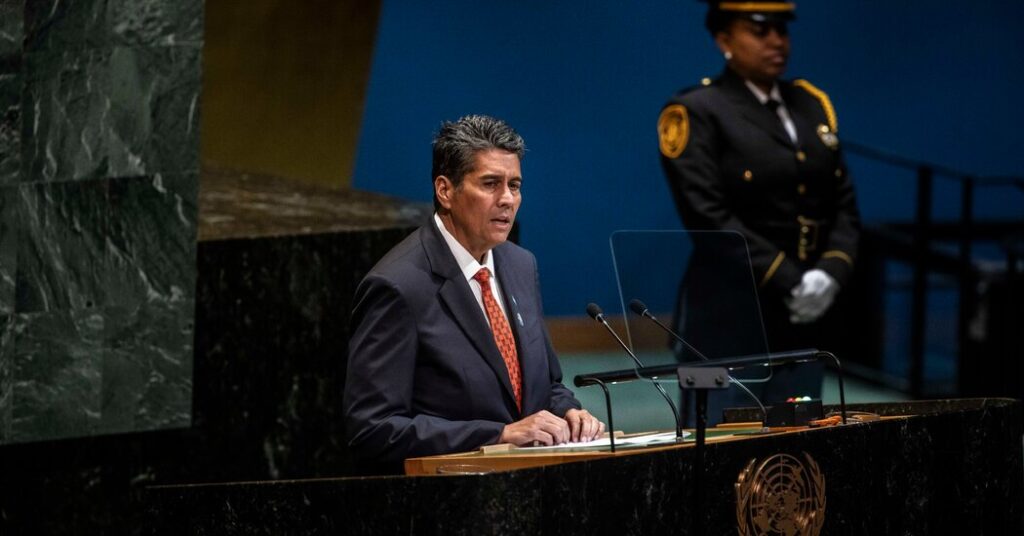
Palau, an archipelago of about 350 small islands in the Pacific Ocean, has signed a “memo of understanding” with the Trump administration to take up to 75 “third country nationals” who cannot be returned to their home nations, the office of Palau’s president said on Wednesday. In return, Palau will receive $7.5 million and other aid.
The arrangement will allow for people who have never been charged with a crime to live and work in Palau, “helping address local labor shortages in needed occupations,” according to the statement from the office of Palau’s president, Surangel Whipps Jr.
The Trump administration has been intensifying its efforts to deport people to countries where they have no connections, according to a recent analysis of public immigration court data. Last month, lawyers for the Department of Homeland Security filed almost 5,000 motions to dismiss asylum cases and force applicants to seek protection elsewhere, according to the analysis, a staggering increase from this summer.
Federal officials have been working out “safe third country” agreements with a few nations, including Honduras and Uganda.
Palau’s leaders and the Council of Chiefs, a board of 16 traditional leaders who advise Mr. Whipps, had resisted entering an agreement to take migrants. Among other concerns, they had noted that Palau did not have a refugee policy or resettlement program, and faced significant domestic challenges that left it with few resources to spare.
Palau’s minister of state, Gustav Aitaro, and the U.S. ambassador to Palau, Joel Ehrendreich, signed the agreement in a ceremony on Wednesday aimed at deepening cooperation between the two nations, which have long been closely linked.
Palau, with a population of about 18,000, was administered by the United States after World War II and became independent in 1994. But the two countries have maintained tight ties through an agreement known as “free association,” which gives Palauans the right to work, live and study in the United States, while Washington funds the local government and has military access to the archipelago. That arrangement was renewed last year under the Biden administration with a pledge of about $900 million in aid to Palau over 20 years.
The new agreement calls for the United States to provide $7.5 million to help Palau with “public service and infrastructure needs” related to the receipt of migrants and more funding and cooperation in other areas, including health care, security, pensions, disaster resilience and security, Mr. Whipps’s office said.
The State Department did not immediately respond to a request for comment on the memo of understanding or whether the agreement ensured that those sent to Palau would not eventually make their way back as Palauans under the free association arrangement.
Palau has the right to agree “on a case-by-case basis” who it will accept, the president’s office said, and prospective arrivals will be screened nationally. The statement said that the government would continue discussions with leaders and the public as the process unfolds. It was not immediately clear when the program would begin.
Mr. Whipps’s office said that Deputy Secretary of State Christopher Landau had met with national leaders and traditional chiefs in September at Palau’s international airport, after which they formed a local working group “to assess the benefits, risks, and community impacts” of taking in third country nationals “and to “ensure Palau’s security, culture and long‑term development are protected.”
The State Department said that Mr. Landau and Mr. Whipps had discussed the new understanding on Tuesday, in a conversation that “highlighted U.S. commitments to partner with Palau on strengthening the country’s health care infrastructure, increasing Palau’s capacity to combat transnational crime and drug trafficking, and bolstering Palau’s civil service pension system.”
Mr. Whipps’s office said in its statement that the United States was committed to building a new national hospital and improving Palau’s capacity to prepare for and respond to natural disasters. The United States, Mr. Whipps’s office said, had pledged $6 million, in addition to a previously granted $20 million, to help Palau prevent the collapse of the civil service pension system. The United States will also fund new law enforcement initiatives in Palau at a cost of $2 million to address critical threats, according to Palau.
The announcement on the presidential Facebook page drew mixed responses from Palauans. Some welcomed continued cooperation with the United States or seemed pleased the pension system would get a boost, while others expressed concern about letting in foreigners or protested that the United States was better equipped to deal with migration pressures than their country.
Ephrat Livni is a Times reporter covering breaking news around the world. She is based in Washington.
The post Palau Agrees to Take Up to 75 Migrants From the U.S. appeared first on New York Times.