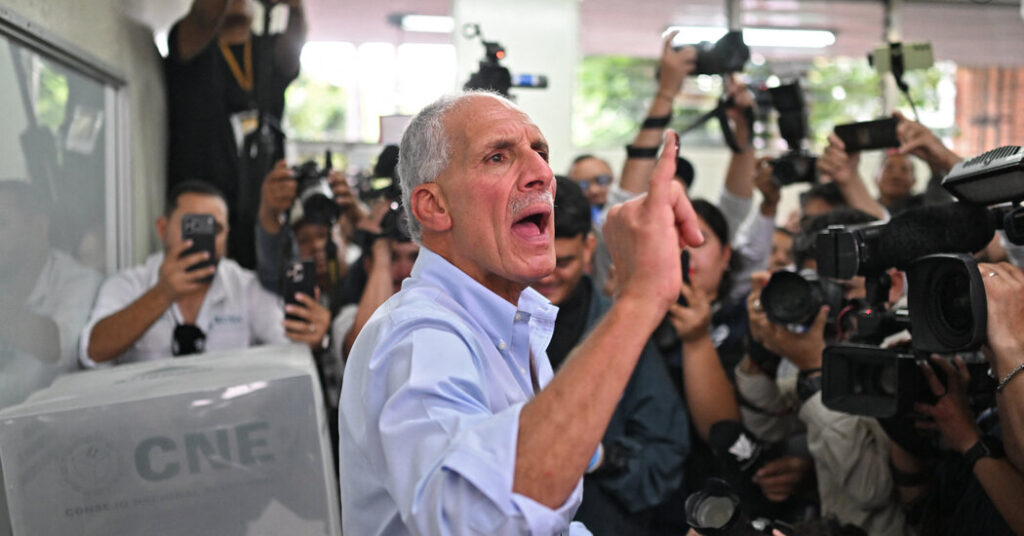
Election officials in Honduras on Wednesday declared a former mayor endorsed by President Trump as the winner of the country’s presidential election.
The former mayor, Nasry Asfura, became the Central American country’s next president by a razor-thin margin after a hard-fought contest between two right-wing candidates that was upended by Mr. Trump’s involvement, and a vote count that took over three weeks to play out.
“Honduras: I’m ready to govern,” Mr. Asfura posted on social media. “I won’t let you down.” At the party’s campaign headquarters, his supporters chanted, “Yes, we did it!” after the results were announced.
It was not immediately clear whether Mr. Asfura’s opponent, Salvador Nasralla, would concede, especially after special revisions of disputed ballot boxes and days of denouncing the counting process after months of candidates stoking fears of election interference.
Outside observers had flocked to Honduras for the election, which they said defied predictions of meddling despite the accusations thrown around by every side.
“I have not found proof of widespread or large-scale fraud,” Héctor Corrales, the director of the Honduran research institute NODO who worked for the European Union’s electoral observer mission, said on Tuesday.
If the vote results stand, they would represent a victory for Mr. Trump, who endorsed Mr. Asfura, a construction entrepreneur, days before the Nov. 30 election. He said on social media that they could work together to confront the “Narcocommunists” and bring aid to the region.
Mr. Trump had also made a vague threat, saying that if Mr. Asfura didn’t win, “the United States will not be throwing good money after bad.” Since taking office again this year, Mr. Trump has assertively backed certain Latin American leaders, as right-wing politicians gain ground around the region.
Along with endorsing Mr. Asfura, Mr. Trump announced a pardon for an unpopular Honduran ex-president, Juan Orlando Hernández, a member of Mr. Asfura’s party who in 2024 was convicted on drug-trafficking charges in the United States and sentenced to 45 years in prison.
For months before the election, the two right-wing candidates in the race had visited Washington, courted Republicans and drummed up fears about the governing left-wing party winning, claiming that Honduras could become the next Venezuela — a socialist-led authoritarian state racked by crises, and one that Mr. Trump has pressured with a military buildup in the Caribbean.
Mr. Nasralla appeared to have a lead over Mr. Asfura before Mr. Trump’s last-minute endorsement, both in some polls and according to Honduran political experts. Joaquín Mejía, a Honduran analyst, said the endorsement “awakened a dead man.”
Fearing a worse relationship with the Trump administration would hurt Honduras — one of the poorest countries in the hemisphere and one that relies heavily on money transfers from immigrants in the United States — some Hondurans admitted switching their vote to Mr. Asfura after Mr. Trump’s endorsed him.
Trump Administration: Live Updates
Updated
- The tiny Pacific nation of Palau agrees to take up to 75 migrants from the U.S.
- A million more Epstein documents have been found, the Justice Dept. says.
- New charges could carry death penalty in the attack on National Guard members in Washington.
The Asfura endorsement came after the candidate had hired consultants, including Brad Parscale, Mr. Trump’s former 2020 campaign manager.
Mr. Parscale advised Mr. Asfura’s campaign on how to use data to target voters. (He denied any role in the endorsement.) And Fernando Cerimedo, a prominent figure in Latin American right-wing circles, became the public face of the Asfura campaign’s claims of victory, even as the vote count stalled and tightened, and tried to intimidate Honduran electoral officials on social media.
Days after the vote, when the two candidates appeared to be in a virtual tie, Mr. Trump intervened once more. He said, without offering evidence, that electoral officials were trying to rig results to benefit Mr. Nasralla, his preferred candidate’s competitor, whom he had previously accused of being in league with the governing left-wing Libre party.
“If they do, there will be hell to pay!” Mr. Trump wrote online.
Last week, the Trump administration said electoral officials from the Libre party, were impeding the vote count. The State Department revoked the visa of one and refused the application of another for supposedly undermining democracy in Honduras.
Many Hondurans had been on edge this year as the election approached, with storefronts boarded up and people taking home extra groceries in preparation for possible unrest. In 2017, a disputed election involving the former leader just pardoned by Mr. Trump devolved into mass protests and a crackdown by the military, and about two dozen people died in the aftermath of the vote.
Instead, Election Day passed peacefully. It was the period after the election — when, at one point, the count stopped for a week — that paralyzed the country.
Both of the right-wing candidates had run campaigns focused on how they were different from the governing leftist Libre party, which had sailed to power in 2021 on a wave of anger at the outgoing president, Mr. Hernández, and his National Party, but which many voters said had failed to crack down on corruption and deliver on other promises. The Libre party candidate trailed far behind the two leading candidates in this year’s election results.
Though thin on concrete policy proposals, experts said, both Mr. Asfura and Mr. Nasralla vowed to address a lack of formal jobs and concerns over crime and corruption.
Before he was endorsed by Mr. Trump, Mr. Asfura was mainly known in Honduras for his infrastructure projects, including in Tegucigalpa, the capital, where he was mayor from 2014 to 2022. Nicknamed Tito and Papi, Mr. Asfura is also known as Tito Puente — a play on the Spanish word for “bridge.”
During his campaign, he projected an approachable, no-nonsense image, dancing with supporters while wearing bluejeans and shouting about how the governing party would steal the elections — a claim that proved unfounded.
Mr. Nasralla, a sportscaster and host of a long-running cash-prize show on television, had served as a vice president in the current Libre government. He broke off last year to join the right-wing Liberal Party for his fourth bid for the presidency.
His campaign, unlike Mr. Asfura’s, made flashy use of symbols connected to Mr. Trump and the global right, including a Tesla Cyber Truck. Mr. Nasralla’s wife, Iroshka Elvir, also was seen wearing a MAGA hat.
Ms. Elvir, a congresswoman and former beauty queen, became one of the most vocal critics of the electoral process after Mr. Trump endorsed Mr. Asfura.
Even though Mr. Asfura has been declared the winner, strong doubts have been cast on the election’s integrity because of the extremely thin margin and the public’s deep mistrust in the process, said Mr. Corrales, the electoral observer.
“That will have an impact on the government’s credibility,” he added, referring to Mr. Asfura’s term, which begins in late January. “And that is going to ruin his administration if he doesn’t know how to handle it.”
Reporting was contributed by Emiliano Rodríguez Mega, James Wagner, David C. Adams and Jack Nicas.
Annie Correal is a Times reporter covering Mexico, Central America and the Caribbean.
The post Honduras Declares Trump-Backed Candidate Winner of Presidential Election appeared first on New York Times.