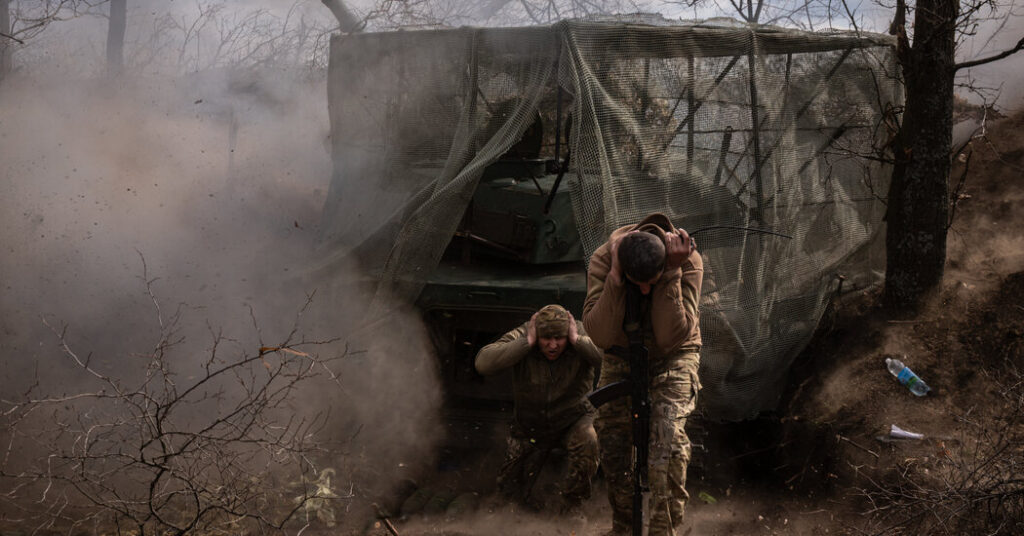
President Volodymyr Zelensky of Ukraine has unveiled a revised draft peace plan, developed with the United States, portraying it as Kyiv’s best effort to end the war with Russia.
The 20 points included in the plan cover a broad range of issues, from the security guarantees Kyiv wants to prevent future Russian aggression to commitments to rebuild the war-ravaged nation. Mr. Zelensky acknowledged that Ukraine and the United States had yet to reach full agreement on territorial questions that have been the biggest sticking point in peace talks.
Mr. Zelensky said the new draft was being presented by the United States to Russia. It remained unclear how proposed compromises offered by Ukraine on the sticking points would be communicated to Moscow, which has shown little indication that it is willing to end the war.
Here’s what we know about the 20 points, which Mr. Zelensky described in detail to reporters in Kyiv on Tuesday.
What have Ukraine and the United States agreed on?
Most of the points, according to Mr. Zelensky.
The Ukrainian leader said he was especially pleased that Kyiv and Washington were largely in agreement on security guarantees to ensure that Russia does not invade Ukraine again. These guarantees would include maintaining a peacetime army of 800,000 troops funded by Western partners, as well as Ukraine’s membership in the European Union.
Mr. Zelensky wants the peace deal to include a precise date for Ukraine’s entry into the European Union, to make it a firm and concrete guarantee. But it remains uncertain whether the bloc will agree to identify such a date, given the complexity of its membership negotiations.
The guarantees would also include a bilateral security agreement with the United States, voted on by Congress, as well as European military support to Ukraine’s defenses in the air, on land and at sea. Some European countries have said they are ready to deploy forces in Ukraine as part of this support package, though Russia has said it opposes any such troop presence.
Ukraine and the United States also agreed on a number of provisions to avoid a resumption of hostilities, such as a mechanism to monitor the line of contact. The draft plan also includes a commitment to release all prisoners of war and detained civilians, as well as to organize elections in Ukraine as soon as possible after a peace deal is signed.
What are the remaining sticking points?
The fate of Ukrainian-held territory in the eastern Donetsk region remains “the most complex point,” Mr. Zelensky said.
Trump Administration: Live Updates
Updated
- The Justice Department sues Illinois over a law limiting immigration enforcement.
- Trump administration orders nearly 30 U.S. ambassadors to leave their posts.
- White House invitees are asked about donations to Trump’s ballroom.
A previous peace proposal drafted by Russia and the United States called for Ukrainian forces to withdraw from the areas of Donetsk they currently hold and turn them into a neutral demilitarized zone. Kyiv rejected that option, saying it could not unilaterally cede land that Moscow had not captured.
The compromise Mr. Zelensky outlined builds on the idea of creating a demilitarized zone in Donetsk but expands it to include not only areas vacated by Ukrainian forces but also Russian-controlled areas from which Moscow would pull its troops. A buffer zone overseen by international forces would separate the two sides within the demilitarized area.
“The Americans are trying to find a way for this to be ‘not a withdrawal,’ because we are against withdrawal,” Mr. Zelensky said. “They are looking for a demilitarized zone or a ‘free economic zone,’ meaning a format that could satisfy both sides.”
Another sticking point revolves around a Russian-occupied nuclear power plant in the southern Zaporizhzhia region of Ukraine. It is Europe’s largest such plant, with a generation capacity of six gigawatts, and Kyiv says it needs it for its postwar reconstruction.
Mr. Zelensky said the United States had proposed that Washington, Kyiv and Moscow share control and profits from the plant. But he said Kyiv could not agree to trade energy with Moscow. He suggested a compromise in which the plant would operate as a joint venture between Kyiv and Washington, with the United States allowed to share its profits however it pleased. That suggested that Washington could separately strike a deal with Moscow.
How could the United States profit?
Several points in the plan deal directly with America’s economic interests as part of a postwar settlement.
It envisions the creation of a “Ukraine Development Fund to invest in high-growth sectors, including technology, data centers and artificial intelligence.” U.S. and Ukrainian companies would cooperate to support reconstruction projects, in areas including the energy sector.
The plan mentions the “extraction of minerals and natural resources” in Ukraine, something the Trump administration has made a priority for its economic interests in Ukraine.
The plan says that “several funds will be established” to address Ukraine’s postwar recovery and reconstruction, with the ultimate goal of raising up to $800 billion. It says that “a leading global financial leader” will be appointed “to organize the implementation of the strategic recovery plan and to maximize opportunities for future prosperity.” That is most likely a reference to the American firm BlackRock, the world’s largest asset manager, which has recently been brought into the peace talks by the American side.
What has Russia said?
The Kremlin said that President Vladimir V. Putin of Russia had been briefed about the negotiations. “We aim to formulate our future stance and resume our contacts shortly via the established channels currently in use,” the Kremlin spokesman, Dmitri S. Peskov, said on Wednesday.
Over the weekend, Moscow poured cold water on the idea that a deal could be within reach. The Kremlin’s top foreign policy aide, Yuri Ushakov, called the latest U.S.-Ukrainian peace talks “rather unconstructive.”
The compromises offered by Ukraine on territorial arrangements and control of the nuclear plant are likely to be rejected by Russia. The Kremlin has repeatedly said that it aims for a full military takeover of Donetsk — whether achieved on the battlefield or at the negotiating table — and has dismissed any notion of returning the nuclear plant to Ukrainian control.
Constant Méheut reports on the war in Ukraine, including battlefield developments, attacks on civilian centers and how the war is affecting its people.
The post Here’s What Is in the 20-Point Peace Plan for Ukraine appeared first on New York Times.