BEIRUT — For the first time in three years, the Gaza Strip’s tiny Christian community is celebrating Christmas without the immediate threat of war.
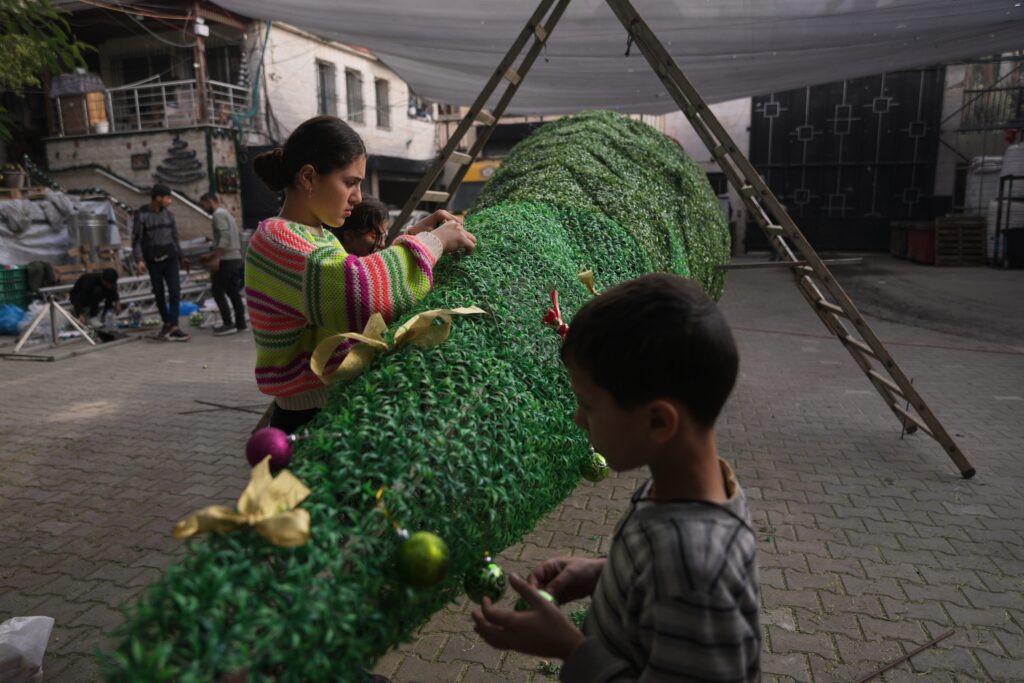
A ceasefire has brought the enclave a measure of calm, and over the past few weeks, Christians there have embraced the holiday spirit, lighting up trees and passing out sweets.
On Sunday, the Latin patriarch of Jerusalem, Cardinal Pierbattista Pizzaballa, led a Christmas Eve Mass at Holy Family Church in Gaza City, where he baptized the newest member of the community, a baby named Marco Nader Habshi.
“It will not be full of joy, but it is an attempt to renew life,” Elias al-Jilda, 59, a prominent member of Gaza’s Orthodox population, said of this season’s holiday celebration. He said he remembers the days when Christmas in Gaza meant citywide festivities, with Muslims and Christians coming together. “It was a special occasion,” he added, “an opportunity for us to breathe.”
But while the holidays have long brought a sense of relief, the Christian community in Gaza — one of the world’s oldest — was already in decline. Now, with the devastating conflict between Hamas and Israel, the population has further diminished, and church leaders warn that postwar deprivation could push more people to leave.
Like most Palestinians in Gaza, Christians’ “houses were destroyed, their businesses were destroyed, their living conditions are difficult,” said Archbishop Atallah Hanna, head of the Sebastia diocese of the Greek Orthodox Church in Jerusalem.
According to Hanna and Jilda, who serves on the council of the Arab Orthodox Church in Gaza, the territory’s total Christian population has fallen from about 1,000 members before the war to almost half of that today. It’s a drop that reflects, in part, a long-term trend of Christian emigration from the Palestinian territories — only in Gaza, the number of Christians is so small that any loss feels like a substantial blow.
At the same time, Israel’s military actions in Gaza have accelerated Christian flight from the enclave. Residents began leaving at a steady clip, either with help from family members abroad or in medical evacuations. Jilda described the departures as “an attempt to survive,” while those who stayed in Gaza “survived by what can only be described as a miracle,” he said.
At least 44 Palestinian Christians have been killed in the conflict, according to a committee overseen by the Palestinian government. Some were killed in Israeli sniper or artillery attacks that hit Gazan churches, the committee said, while others died of illness, injury or malnutrition because of a lack of food or medical care.
According to the Gaza Health Ministry, more than 70,000 Palestinians have been killed in Israel’s military campaign, which began after the Hamas-led attacks on Israeli communities on Oct. 7, 2023. The ministry does not distinguish between civilians and combatants but says a majority of the dead are women and children. Around 1,200 people were killed in the Hamas assault, and some 250 others were taken into Gaza as hostages.
Nearly all of Gaza’s 2.1 million residents have been displaced, the United Nations says, and wide swaths of the enclave, including houses, farmland and infrastructure, are destroyed.
The fighting forced Gaza’s Christians — the majority of whom are Greek Orthodox or Catholic — to take refuge in its two main churches. Most sheltered in Holy Family Church in the Rimal neighborhood of Gaza City. The church, which is Catholic, has much more space for accommodating the displaced. Others huddled about 1.5 miles away in the Greek Orthodox Church of St. Porphyrius, established in the year 425.
“There is an assumption that Gaza has no Christian population, or no Christian history,” said Yousef AlKhouri, a Gaza native and dean at Bethlehem Bible College in the West Bank. “And that’s not true.”
He said that Gaza, despite its size, has produced many Christian theologians, politicians and scholars over the years. Jesus, Mary and Joseph are also believed to have passed through the territory on their way to Egypt, AlKhouri said — a story that, according to him, gave Holy Family Church its name.
For Jilda and his family, Holy Family Church served as a sanctuary after their home in Gaza City’s Tel al-Hawa neighborhood was destroyed one month into the war. After the ceasefire began, they moved into a rental home in the city but are still trying to furnish it.
Today, most of the region’s Palestinian Christians are still sheltering at the churches, as reconstruction has yet to begin and a rainy winter season has inundated the tents in which displaced residents live.
Like Jilda, AlKhouri, who grew up in Gaza in the 1990s, said he remembers a time when Christian life there was not just about survival. “The celebrations of Christian and Muslim festivals were shared,” he said, adding that there was always a sense of solidarity among “Palestinian Christians and Muslims in Gaza: going to school together, playing together, going to the YMCA.”
But over time, as the peace process with Israel collapsed and hopes for a Palestinian state dimmed, the conflict began tearing at the community. In Gaza, Hamas and its secular rival, Fatah, fought a brief but bloody civil war that saw the Islamists take control. Since then, Christmas celebrations have been largely private and subdued.
Still, as Pizzaballa held a high-profile Mass this week, he urged Christians in Gaza to hold on.
“We are called not only to survive, but to rebuild life. We must bring the spirit of Christmas — the spirit of light, tenderness and love. It may seem impossible,” he said, “but after two years of terrible war, we are still here.”
Shamalakh reported from Cairo.
The post Gaza’s Christians, battered by war, celebrate first Christmas in 3 years appeared first on Washington Post.