Milly Rodríguez’s recipe came from her grandmother, who she said patented it in Puerto Rico in the 1940s. Minerva Minaya is known for a blend she has named Nostalgia.
They sat side by side in a Spanish Harlem apartment complex, two of seven finalists in Coquito Masters, which has been crowning the best bottles of the Puerto Rican holiday drink in New York City for nearly 25 years.
Both women have entered the contest many times, but neither has won first place. “I’m always the bridesmaid,” said Ms. Minaya, 66, “never the bride.”
The ingredients in coquito are fairly straightforward — canned milk, cream of coconut, rum, and generous amounts of cinnamon and other spices — so the variation in measurements is what sets each bottle apart.
For generations, families developed recipes and kept them top-secret, some so protective that they wouldn’t write them down for fear of leaks. But in recent years, because of social media and competitions like Coquito Masters, the drink has not been so locked down.
At 787 Coffee, a Puerto Rican chain with locations around the city, New Yorkers can order a coquito latte with rum-infused espresso beans. This fall, the tea shop Matchaful rolled out a coquito matcha in a partnership with the indie group The Marías. Jimmy Fallon has even released a musical ode to the drink, called, simply, “Coquito.”
This is “the Bad Bunny-fication of Puerto Rican culture,” said Aníbal Arocho, the head librarian at the Center for Puerto Rican Studies at Hunter College. He was referring to a spike in interest in Puerto Rico and its traditions owing to the popularity of the rapper Bad Bunny, who will be performing at the Super Bowl in February.
“He’s made it OK for people to want to learn more about Puerto Rico and want to involve themselves in our traditions,” Mr. Arocho said. “But I’m a little bit wary when I see too much corporate co-opting of Puerto Rican culture.”
Debbie Quiñones started Coquito Masters as a kind of dinner-party contest at her apartment, back in 2001, but quickly realized it had the potential to be bigger. “I had this goal of, like, let’s take coquito to the moon,” she said.
Puerto Rican New Yorkers began selling the drink as early as 1935, if not earlier, according to Mr. Arocho. Since then, coquito has served as one of the Nuyorican community’s informal economies, a way for the diaspora to stay connected to its roots while generating economic opportunities within the community. Bottles generally go for $30 to $50.
For years, the face of coquito-selling in the city was that of a community elder, who made the drink to be shared only with close friends, family and neighbors, and usually on a need-to-know basis.
“We all grew up knowing one,” said Irma Cádiz, 49, who makes coquito in Harlem under her trademarked nickname, Coquito Lady. “There was always that woman in the building, your abuela, your aunt who taught you.”
In the days leading up to Christmas and New Year’s Eve, there is a frenzy to bottle and sell as much coquito as possible.
Posts advertising the drink abound on Instagram, Facebook and TikTok, displaying prices, flavors and pickup rules. Posters are tacked up on beauty salon and barbershop walls, and there are seemingly endless flavors to choose from: pistachio, amaretto, cheesecake (Ms. Rodríguez’s specialty), sweet potato pie (an original by Ms. Cádiz).
“This was always at the back of my mind: At one point, it will be discovered and mainstreamed,” said Ms. Quiñones, who created Coquito Masters. “So that kind of charged me to be more authentic and committed to promoting what we do.”
For many of the city’s coquito sellers, the drink is just a side hustle to make some extra cash during the holidays. But making a profit at the prices customers have come to expect is becoming harder as grocery prices have increased.
“Not only is there so much competition, but it’s so much more expensive,” said Jamil Jimenez, 33, who makes coquito at her home in South Jamaica, Queens. She said she goes to a warehouse to get bottles at wholesale prices and shops around at five different grocery stores for ingredients.
“It’s much more time-consuming now to find a deal,” she said.
The woes of Ms. Rodríguez, who lives in East New York, boil down to how much she is paying for cream of coconut, the heart of traditional coquito’s flavor. She will only buy the Coco López brand but she’s noticed the price creep up recently, from a dollar a can to almost $4.
“I’m telling you, from the bottom of my heart,” she said, “Coco López is killing me.”
And yet, there she was on Saturday, a finalist in Coquito Masters.
She was complimentary of her challenger, saying that Ms. Minaya’s Nostalgia was as silky as tembleque, a coconut custard that is popular in Puerto Rico.
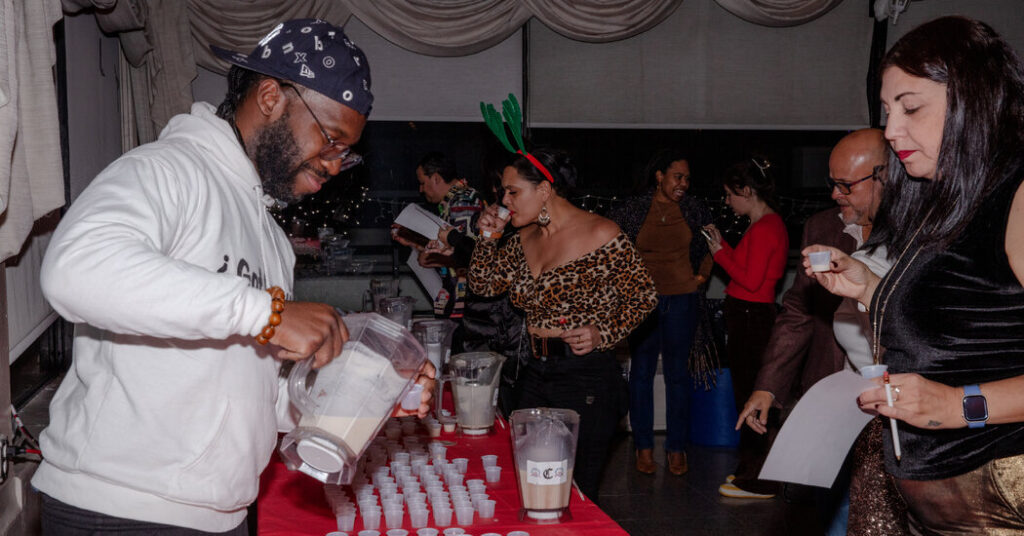
As they waited to find out who won, attendees milled around, assessing shot glasses of coquito for taste, consistency and authenticity before casting their votes. A local band, Yotoco, played caroling music as people twirled on the dance floor, bumping hips and clapping to the rhythm of the congas.
Ms. Quiñones, who had indulged in the occasional dance break when a song came on that she liked, took the microphone to announce the winner. It was, at last, Ms. Minaya.
She smiled, seemingly unaware that her name had been read. Slowly, it dawned on her.
“Oh, my God!” she said. “It’s my time!”
Ms. Minaya looped an arm around her trophy and did laps around the room. Ms. Rodríguez came running over to embrace her.
Cecil Brooks, a volunteer and longtime attendee, rushed over, too, wearing a sweatshirt that read, “Got coquito?” He was smiling ear to ear.
“We have all these people now coming from New Jersey, from all over the city, which is amazing,” Mr. Brooks told Ms. Minaya, who is from Spanish Harlem. “But I’m so glad someone won who’s from our neighborhood.”
Taylor Robinson is a Times reporter covering the New York City metro area.
The post Coquito Was Once a Puerto Rican Secret. Now Everybody Knows. appeared first on New York Times.