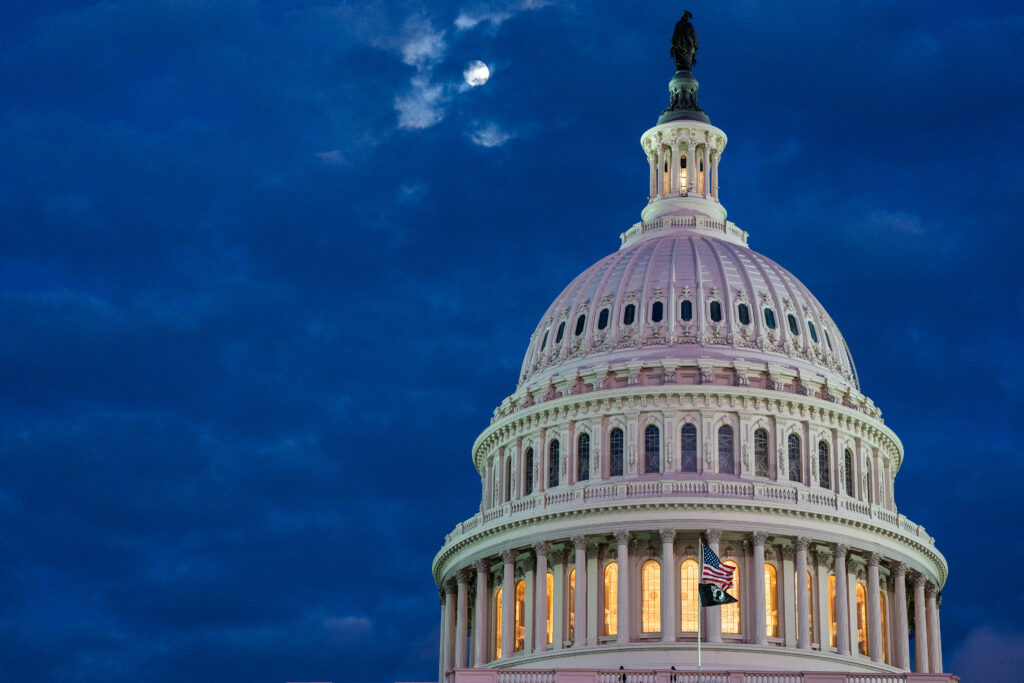
The Republican-led Congress managed to land quite a few achievements in 2025, but not necessarily the ones that lawmakers consider commendable.
With fewer than 40 bills signed into law as of Monday, the House and Senate set a modern record for lowest legislative output in the first year of a new presidency, according to data maintained by C-SPAN and Purdue University.
Despite that lack of productivity, the Senate held more roll-call votes (659) than any odd-numbered year of this century, with almost 60 percent of them focused on advancing President Donald Trump’s nominations to the executive and judicial branches.
The House, meanwhile, set a 21st-century record for fewest votes cast (362) in the first session of a two-year Congress. It held barely half as many votes as in 2017, which was Trump’s first year in office and when Republicans held the majority.
Perhaps not surprisingly, an unusually large number of House members — 24 Republicans and 19 Democrats — have decided to leave the chamber either to retire or run for other office. That places the chamber on pace to set a 21st-century record for retirements in one Congress, according to C-SPAN and Purdue.
Interviews with a cross section of Republicans produced a mixed verdict, at best, for the year. Some defended their overall record, particularly on actions taken by the Trump administration.
“We did what we said we would do. You know, the ’24 election was about securing the border, cutting taxes,” said Ohio Rep. Jim Jordan. The staunch Trump supporter pointed to the contents of the midsummer domestic policy bill that tried to meet those goals, along with many other side issues tucked into its almost 900 pages.
Many other Republicans suggested it was a wasted year that didn’t meet the hype beyond that one piece of legislation.
“I guess we got the big, beautiful bill done,” Ohio Rep. David Joyce said. The 13-year veteran from the party’s establishment wing paused for five seconds thinking about 2025.
“Other than that,” Joyce finally said, “I really can’t point to much that we got accomplished.”
Missouri Sen. Josh Hawley gave the Congress an “incomplete” grade because so much overall policy got dictated by the record number of executive orders signed by Trump, all of which can be wiped away by the next president.
“He has signed every executive order he could possibly think of on this. And there just comes a point at which it’s like, Congress sooner or later has to legislate. I mean, you can sign EOs, but he needs somebody to codify those,” Hawley said.
Other Republicans feel that the overall political environment, from violence toward public officials to angry daily interactions among lawmakers in the Capitol, left the institution reeling.
“We have some real accomplishments, but it also has been a year of polarization and divisiveness, unlike any other in the time that I’ve served in Washington,” said Maine Sen. Susan Collins, who first took office in 1997.
For more than a decade, the Senate has been consumed by the confirmation process on its so-called executive calendar, with little time to consider legislation unless it’s of the must-pass variety to keep some government function from shuttering.
In the House, Speaker Mike Johnson repeatedly shut down the chamber prematurely because of gridlock, including an inability in July to overcome demands from the GOP rank-and-file to vote on legislation to compel the Justice Department to release its files on the investigation of convicted sex offender Jeffrey Epstein. In late September, Johnson shuttered the House for seven weeks to try to force Senate Democrats to agree to a temporary funding bill for federal agencies — a stalemate caught up in a 43-day government shutdown, another dubious record.
During that period, Republicans never came up with a plan to deal with the expiring health care tax credits that Democrats had approved early in the Biden administration. That left the GOP divided heading into 2026, with some moderate Republicans ready to join forces with Democrats to push the issue to the Senate.
“We dropped the ball miserably by not doing something on health care all year long, knowing that the subsidy issue was going to be here at the end of the year,” Joyce said. “We didn’t do a damn thing about it.”
Johnson regularly defends the year’s overall output by saying Republicans packed Trump’s self-proclaimed One Big Beautiful Bill with many provisions that the public doesn’t even know about and that will take time to go into effect and be credited by voters.
“It takes some time to implement new policies and root out the bad things, and that’s what’s happening,” Johnson told reporters at a mid-December news conference.
Such strategy has accelerated with each new president and his congressional majority. In 2001, George W. Bush and his GOP allies pushed through a massive tax cut on the fast-track process known as reconciliation, averting a potential filibuster in the Senate. Still, the Congress managed to send 107 other laws to the president’s desk for his signature that year.
In 2017, Republicans passed a massive tax cut through reconciliation plus sent an additional 75 pieces of legislation to Trump’s desk before Christmas.
This year’s Congress also has a massive policy bill but otherwise only about half the output of Trump’s first term. Only in 2023, with a split Congress and the Biden-Harris White House already focused on a presidential election, were fewer laws passed in the first year of a Congress, according to 32 years of data kept by C-SPAN and Purdue.
Other data, compiled by Thomas Wickham, the former House parliamentarian now working at the U.S. Chamber of Commerce, paint a picture of a Congress that is steadily doing less legislative work and ceding greater powers to presidents.
All the numbers that should be going up, in a healthy and productive balance between Congress and the president, are instead going down. And the numbers that should be falling are instead on the rise.
Trump has already issued more executive orders in 11 months than he did in all four years of his first term. He is more than 70 percent of the way to matching the combined 12-year EO total of the presidencies of Joe Biden and Barack Obama, according to Wickham.
Jordan defended Trump’s pace by recalling his speech to Congress in March.
“Remember that great line he had in the joint address, when he said people said you needed a new law to secure the border. Turns out all you needed was a new president. So he secured the border, no doubt about it,” Jordan said.
One area in which Republicans became more productive was in eliminating federal regulations via the Congressional Review Act, which allows Congress a certain amount of time to consider new regulations and, with fast-track procedures, vote to eliminate them.
The act rarely had been used since its passage in 1996, but recent Republican majorities have relied on it.
The process, of course, takes time away from legislation that could be considered on the House and Senate floors.
Republicans remain divided about what to do next with their tenuous majorities. The party holds the House by less than a handful of votes and is nervous that its 53-47 edge in the Senate could be in jeopardy in November’s elections.
There’s a more traditional faction of conservatives, small in number but increasingly vocal, who fear that the $38 trillion national debt will only grow because of another legislative sleight of hand included in the 2025 big policy bill.
“It depends on whether you want to call that an accomplishment. I would call it historic in that we raised the debt ceiling $5 trillion with one vote. We’ve never ever come close to that. So as far as records being set, this Congress will be remembered in history,” Kentucky Sen. Rand Paul said.
Hawley wants Republicans to push a new agenda for the working class — one without as much fear of debts and deficits — to boost those Americans who used to regularly vote for Democrats but now embrace Trump.
“We need to lower the cost of health care, as quickly as possible, on every front … premiums, deductibles, out-of-pocket expenses,” he said, uttering “urgent” three times to describe needed actions like raising the minimum wage. “There’s a lot to do.”
The post Congress set records in 2025, some more dubious than others appeared first on Washington Post.