China has been growing its stockpile of nuclear warheads by about 100 a year as its top leader, Xi Jinping, pushes to expand his nuclear options. But its production of warheads slowed last year, the Pentagon said, without specifying a cause.
The U.S. Department of Defense’s latest annual report on China’s armed forces estimated that its warhead count was in the “low 600s” by the end of 2024, “reflecting a slower rate of production.” That count is roughly the same as the Pentagon’s last estimate that China had around 600 warheads as of mid-2024.
Nonetheless, the latest report, released late on Tuesday, says Beijing is on track to have about 1,000 nuclear warheads by 2030, giving Mr. Xi a larger and more diverse range of those highly destructive weapons on missiles, submarines and bombers. In a crisis or war, he could use them to warn and deter — and in the ultimate extreme, strike — enemies.
Perhaps just as important, the report says that even if China slowed its output of nuclear warheads, Mr. Xi and his commanders appear to be seeking to shorten the time it would take to launch a nuclear counterattack, if China’s nuclear forces came under fire. The shift to what Chinese military planners call an “early-warning counterstrike” is intended to warn potential enemies not to underestimate China’s nuclear readiness and resolve.
With this hair-trigger posture, the “warning of a missile strike enables a counterstrike launch before an enemy first strike can detonate,” the Pentagon report says. “China likely will continue to refine and train on this capability throughout the rest of the decade.”
Overall, the report says, “China’s historic military buildup has made the U.S. homeland increasingly vulnerable.”
The Department of Defense’s annual report on the People’s Liberation Army is widely read by policymakers and experts as a benchmark for assessing and debating China’s capabilities, especially in the nuclear weapons realm.
The new report — the first of its kind during President Trump’s second term — amplifies a finding in the 2024 report that China was preparing to adopt early-warning counterstrike capabilities, which nuclear planners also call “launch on warning.” Its findings also echo recent studies by experts.
Mr. Trump and Mr. Xi have been trying to improve relations, pulling back partly from a trade and tariff war. But military tensions persist, and China’s emergence as a nuclear power has become a source of anxiety in Washington, especially while Russia also makes threatening nuclear moves.
The growing evidence that China is shifting to a higher degree of readiness for nuclear retaliation may add to debate about how the United States should respond to two big nuclear rivals, with fielding more nuclear weapons as one option.
“Such a change in China’s nuclear posture would have significant implications for U.S. national security, U.S.-China relations, and stability and security in East Asia,” David C. Logan of Tufts University and Phillip C. Saunders of the National Defense University in Washington wrote in a study of China and “launch on warning” that was published last month.
Mr. Xi “may be the only one with the authority to decide not to execute a pre-planned nuclear response to an accidental or limited nuclear attack,” they wrote.
The United States and Russia still have much larger nuclear arsenals than China has. Russia has about 5,459 warheads, including 1,718 that are deployed, while the United States has 5,177, with about 1,770 deployed, according to experts from the Federation of American Scientists. And both Washington and Moscow have long kept some nuclear missiles on high alert to launch within minutes if ordered.
The addition of China into this mix could make it harder to avoid dangerous miscalculations in a crisis, said Tong Zhao, an expert on China’s nuclear weapons strategy at the Carnegie Endowment for International Peace.
“Today, with China moving to ‘launch on warning,’ it’s happening in a much more technologically challenging environment,” Mr. Zhao said in an interview before the release of the Pentagon report. He cited the potentially destabilizing effects of A.I. and increasingly maneuverable missiles, which could magnify the risks of misunderstanding an enemy’s moves.
China does not disclose how many nuclear weapons it has, and for decades it has declared that it would never be the first country in a war to launch them. The new Pentagon report cites several developments to argue that China’s shift to a more attack-ready nuclear force is well underway.
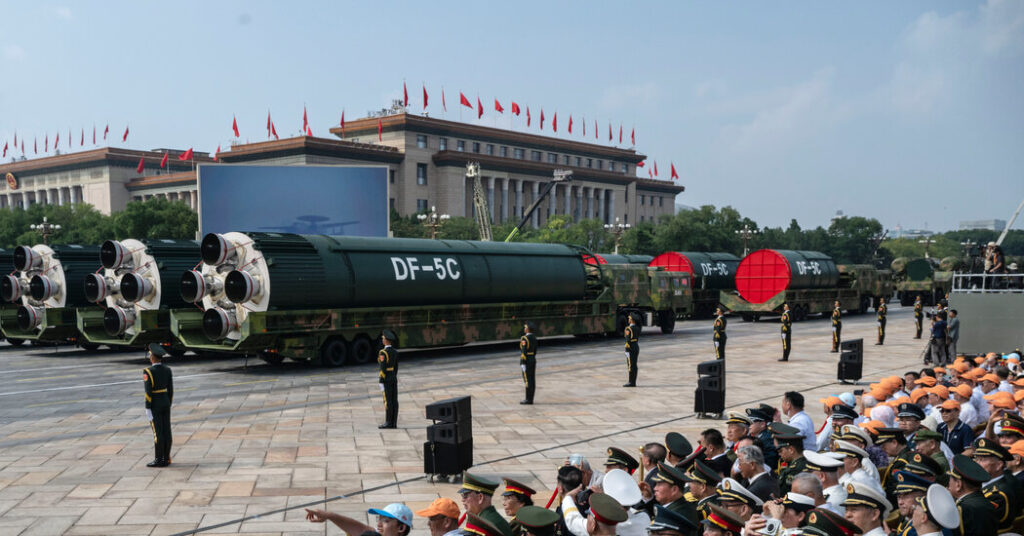
Above all, the People’s Liberation Army Rocket Force has been installing intercontinental ballistic missiles in launch silos across three fields in arid northern China. The fields have a total of about 320 silos, and probably more than 100 have been loaded with DF-31 intercontinental ballistic missiles, the report says. In September 2024, China test-launched a road-mobile variant of the DF-31, which flew roughly 7,000 miles across the Pacific Ocean.
China has also been putting into orbit more early-warning satellites that can detect intercontinental ballistic missiles heading its way, and installing more land-based radars that can detect incoming missiles while they are still thousands of miles away, the Pentagon report says.
Still, China’s move to its new nuclear posture could take some time, said Mr. Zhao of Carnegie. “China needs a well-developed command-and-control communication system to connect all the different sensors, and it needs to develop the capability to integrate all the data seamlessly into a central system,” he said. “That is not easy.”
The Pentagon report also says Beijing is not fully confident that it could invade and take control of Taiwan, the island democracy that rejects Beijing’s claims that it is Chinese territory.
The United States could intervene to support Taiwan if it were attacked, and Chinese leaders “remain unsure of the P.L.A.’s readiness to successfully seize Taiwan while countering U.S. involvement,” the report said. Still, China “continues to refine multiple military options to force Taiwan unification by brute force,” it said.
Last year, the report said, China “tested essential components of these options, including through exercises to strike sea and land targets, strike U.S. forces in the Pacific and block access to key ports.”
Chris Buckley, the chief China correspondent for The Times, reports on China and Taiwan from Taipei, focused on politics, social change and security and military issues.
The post China Is Shifting Its Nuclear Forces to Swifter Footing, Pentagon Says appeared first on New York Times.