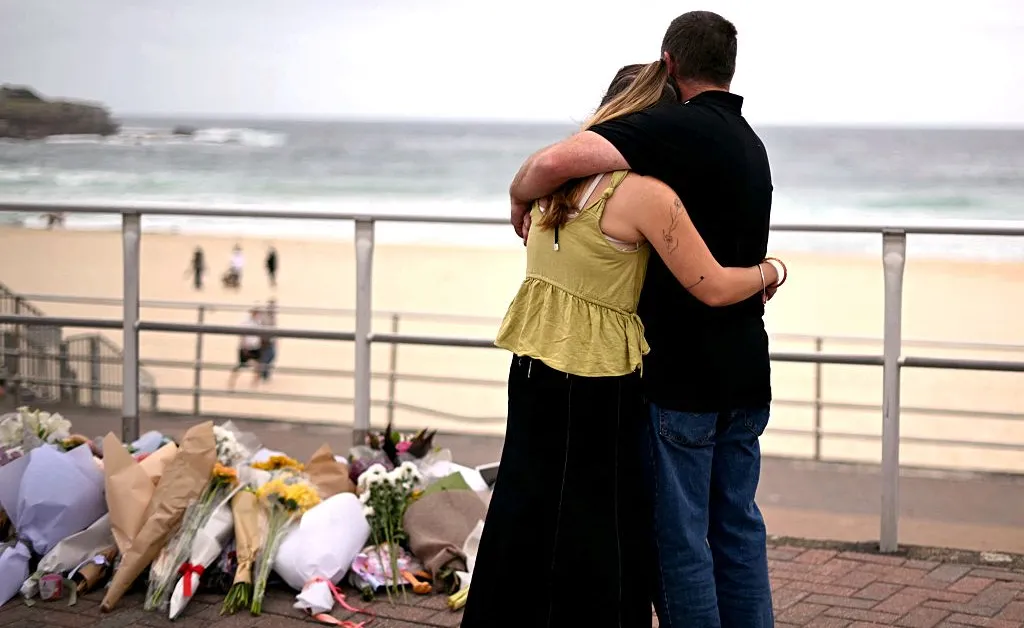
On Dec. 14 when two gunmen targeted a public celebration of the first night of Hanukkah at Bondi Beach in the Australian city of Sydney and killed 15 people, it was the worst mass shooting in Australia since the 1996 Port Aurther massacre in Tasmania.
[time-brightcove not-tgx=”true”]
The Bondi Beach massacre also became the deadliest terrorist attack on Australian soil. It occurred amidst a tide of rising antisemitism and a sharp increase in threats and attacks against Jewish people by a range of actors, from individual bigots, extremists, and even state sponsors since the Hamas attack against Israel on Oct. 7, 2023 and the subsequent Israeli military campaign in Gaza.
The police found two homemade black flags in the car used by the two perpetrators—Sajid Akram, 50, and his son, Naveed Akram, 24—suggesting that they are either conducting this attack on behalf of the Islamic State, or at the least inspired by Islamic State ideology. The two men travelled to the Philippines prior to the attack—a visit the police are investigating.
Whether they were enabled by a regional affiliate of the Islamic State in the Philippines or self-radicalized and acting completely of their own volition is not yet clear. But the nature of their assault and their use of the terrorist group’s black flags demonstrates that even though it is much diminished from the height of its caliphate era, Islamic State continues to be a powerful brand and persistent motivating force, able to marshal and exploit societal fault lines in the West to radicalize adherents.
Terrorism in Australia
Terrorism and violent extremism threats in Australia diversified and grew more complicated and diffuse over the past decade. There is a growing and more organised neo-Nazi movement galvanised by the National Socialist Network that has not only motivated lone actor violence and plots but is seeking to mainstream their hateful ideology through a new political party and exploiting grievances among young men.
Online nihilistic and accelerationist violent movements are spreading online and preying on young people. After the Covid-19 pandemic, Australia witnessed the rise of grievance and conspiracy fuelled anti-government movements such as the Sovereign Citizen movement, which experienced dramatic growth after the country’s long pandemic lockdowns.
Australian counterterrorism officials have been fighting multiple extremist threats in a way they haven’t had to before. National security agencies also had to diversify their attention to address other pressing challenges such as foreign interference, global strategic competition and its consequences. Since its territorial defeat in Iraq and Syria, it has been tempting to regard the Islamic State through the rear view mirror. Yet the menace of violence inspired by the terrorist group persists: violent jihadist groups, including the Islamic State, continue to inspire and motivate violence in Australia.
Despite being a world away from Iraq and Syria, Australian citizens were prominent and influential figures in the Islamic State. Khaled Sharrouf and Mohamed Elomar were high profile propagandists and recruiters for the group. Around 500 Australians travelled or attempted to travel to the Islamic State, including women and children. They also plotted and committed many attacks within Australia, during the height of the caliphate, and after its defeat in the Middle East. In the following years, the Islamic State faded from public consciousness but it continued to inspire violence among a fringe cohort.
Four Corners, an investigative journalism show on Australian Broadcasting Corporation, revealed how the Islamic State maintained its influence in the country through its online presence, and through a network of extremist preachers. One prominent extremist preacher, Wisam Haddad, is alleged to be responsible for radicalizing a number of young men using Islamic State materials, and believed to have influenced Naveed Akram, the 24-year-old responsible for the Bondi beach attack. Another Australian, Radwan Dakkak, was a key figure in the Ahlut Tawid Publications, one of the most important post-caliphate online networks and publications of the Islamic State.
In 2019, Australian authorities arrested three members of an Islamic State inspired cell for planning and advocating for a terrorist attack and membership of a terrorist organization. The Islamic State cell was reportedly planning an insurgent-like attack strategy targeting police stations, defence establishments, embassies, councils, courts and places of worship in Australia. Among the arrested was Isaak el Matari, the self-declared head of Islamic State in Australia, who also planned to create an Islamic State base in the Blue Mountains near Sydney.
In 2022, investigators identified a WhatsApp chat group called the “Brotherhood” many of whose members expressed sympathy for the Islamic State and advocated the killing of Australia based Bishop Mar Mari Emmanuel for his sermons criticising the Prophet Muhammad. Two years later, a 15-year-old boy linked to that network stabbed Bishop Mar Mari Emmanuel during a church service in a suburb of Sydney. The Islamic State’s influence in Australia has endured all along and up to the Bondi beach attack.
Antisemitism after Oct.7, 2023
The appeal of the Islamic State has also intersected with rising community tensions and antisemitism in Australia in the aftermath of Hamas’s Oct. 7, 2023 terrorist attacks. In August 2025, as more than 100,000 people marched across the Sydney Harbor Bridge in protest against the war in Gaza, a man, his face wrapped in a keffiyeh, climbed above the crowd and waved the black flag of the Islamic State.
Australian media later identified the man as Youssef Uweinat, 27, who spent around four years in prison after beingconvicted for being a recruiter for the Islamic State. Haddad, the extremist preacher, posted an approving message on social media with a photo of Uweinat on the Sydney Harbor Bridge. Haddad and his associates are believed to have been targeting the pro-Palestine demonstrations for potential recruits and hoping to rebuild support for the extremist group. In September, a federal court in Australia ordered Haddad to remove a series of online lectures after the Executive Council of Australian Jewry sued him for inciting violence against Jews.
The Bondi Beach attackers were motivated by broader Islamic State ideology, and potentially radicalized for some time. One of the Bondi beach assailants, Naveed Akram, was investigated by the Australian Security Intelligence Organization in 2019 because of his association with Haddad and other known Islamic State sympathisers but was assessed to pose no ongoing threat. It is a decision that has prompted Prime Minister Anthony Albanese to call for a snap review of intelligence and law enforcement procedures.
To be sure, individuals who have been radicalized may never commit a violent act or they might wait discretely for years for the right opportunity. However, Australia witnessed intense political polarization in the aftermath of Oct. 7, 2023. The charged political climate and heightened sectarian tensions seemed to have influenced the attackers’ choice of target and timing of their attack. Their decision to strike a gathering of Jewish people and a Jewish celebration was likely influenced by a broader environment of growing antisemitism in Australia.
The Bondi attack is a reminder that Islamic State’s current footprint is not confined to its regional affiliates in Africa or Asia. It can still inspire attacks in the West. True to its strategy and slogan, the Islamic State “endures and remains.” It is a highly resilient and adaptable organization. The Salafi-jihadist ideology that animated the Islamic State long predates the group itself and has coursed through numerous movements and militant groups for decades. Even after its defeat in Iraq and Syria, the Islamic State has left an enduring mark on the jihadist imagination by being the first modern Islamic movement to resurrect the caliphate.
Its longevity demonstrates the power of a clear and coherent ideology—one that is supple enough to adeptly pivot toward exploiting whatever grievances, divisions, and hatreds are roiling a particular place and time. The group’s flexible organizational model is elastic and capable of morphing into regional affiliates, loose networks, and online subcultures.
Since Oct. 2023, there have been numerous direct attacks against Jewish people around the world and law enforcement agencies have thwarted several plots, including plans for mass shootings. There have been multiple warnings from the Australian Jewish community about rising antisemitism. The Bondi attack is precisely what the Jewish community feared would happen and Islamic State delivered it. The current febrile environment that has brought a resurgence of antisemitism reveals how central hatred and vilification of Jews is to the movement.
Australia is reckoning with its antisemitism problem in the wake of Oct. 7, and the Albanese government is under immense scrutiny for not having done enough to address it. The government will also institute a review into national security and intelligence agencies. The Bondi attack sits at the center of the Venn diagram of growing antisemitism, fractured social cohesion, the enduring influence of Islamic State ideology, and government mishandling.
The attack shook Australia’s self-perception as a laid back, imperfect but largely cohesive multicultural society. In the midst of this reckoning, Australia seeks solace and inspiration from the selfless and heroic examples of bystanders like Ahmad al Ahmed—a Syrian refugee—who fought off the perpetrators at Bondi beach and saved many lives.
The post Bondi Beach and the Shadow of the Islamic State appeared first on TIME.