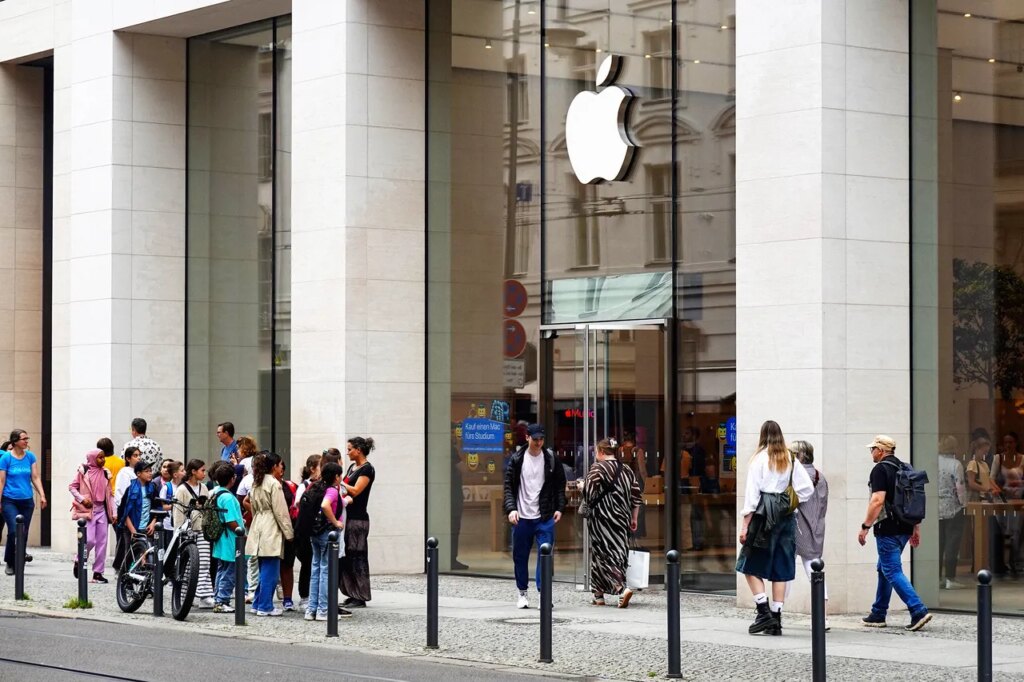
Two years ago, Lizmary Fernandez took a detour from studying to be an immigration attorney to join a free Apple course for making iPhone apps. The Apple Developer Academy in Detroit launched as part of the company’s $200 million response to the Black Lives Matter protests and aims to expand opportunities for people of color in the country’s poorest big city.
But Fernandez found the program’s cost-of-living stipend lacking—“A lot of us got on food stamps,” she says—and the coursework insufficient for landing a coding job. “I didn’t have the experience or portfolio,” says the 25-year-old, who is now a flight attendant and preparing to apply to law school. “Coding is not something I got back to.”
Since 2021, the academy has welcomed over 1,700 students, a racially diverse mix with varying levels of tech literacy and financial flexibility. About 600 students, including Fernandez, have completed its 10-month course of half-days at Michigan State University, which cosponsors the Apple-branded and Apple-focused program.
WIRED reviewed contracts and budgets and spoke with officials and graduates for the first in-depth examination of the nearly $30 million invested in the academy over the past four years—almost 30 percent of which came from Michigan taxpayers and the university’s regular students. As tech giants begin pouring billions of dollars into AI-related job training courses across the country, the Apple academy offers lessons on the challenges of uplifting diverse communities.
Measuring Success
Seven graduates who spoke with WIRED said they had good experiences at the academy, citing benefits such as receiving mentorship from past students. Fernandez says she was impressed by a focus on developing inclusive apps and a series of speakers from Apple who were genuinely willing to help and share frank lessons. “Their heart was in the right place,” she says.
The program does expose people of color to new possibilities. “It changed my life,” says Min Thu Khine, who’s now mentoring coding students and working at an Apple Store Genius Bar. “My dream is to be a software engineer at Apple.”
The academy also draws positive grades from some researchers who study tech education, such as Quinn Burke. He says its fully subsidized in-person instruction surpasses the quality of many coding bootcamps, which proliferated over the past decade and sometimes left students in debt and with narrow skills.
But the academy being open to all can complicate instruction and how to measure success. One entire family attended together, and at least two mothers have come with their daughters. Students on average are in their 30s, ranging from 18-year-olds to, for example, a grandfather in his 70s who wanted to develop a photo app for his grandchild, according to Sarah Gretter, the academy leader for Michigan State.
On the other end are students such as Joey Brinker, a 20-year-old also taking a full course load at University of Michigan-Dearborn. “I found my grades improved,” he says, crediting the academy.
The program gives out iPhones and MacBooks and spends an estimated $20,000 per student, nearly twice as much as state and local governments budget for community colleges. Even so, Fernandez says, she leaned on waitressing shifts and government food aid to supplement the provided stipend and make it through the tuition-free academy.
Gordon Shukwit, a senior director at Apple overseeing the program in Detroit and 17 other Apple academies abroad that have been opened since 2013, says increasing student aid is a constant focus. The university declined to comment on cost per student estimates and comparisons to community college spending, saying that the academy offers an unparalleled experience.
About 70 percent of students graduate, which Gretter describes as higher than typical for adult education. She says the goal is for them to take “a next step,” whether a job or more courses.
Roughly a third of participants are under 25, and virtually all of them pursue further schooling. “I went in with zero coding experience or knowledge,” says Dayan Abdulla, 22, who graduated from the main program in June and works in quality assurance at a software startup while studying computer science at Henry Ford College. “I’m on a good trajectory,” he says.
About 71 percent of graduates from the last two years went onto full-time jobs across a variety of industries, according to academy officials. Amy J. Ko, a University of Washington computer scientist who researches computing education, calls under 80 percent typical for the coding schools she has studied but notes that one of her department’s own undergraduate programs has a 95 percent job placement rate.
The academy also takes credit for spawning 62 apps and 13 businesses, such as an animation workshop for kids and a captioning tool for conferences. But Apple, the university, and another major funder—the Gilbert Family Foundation—declined to disclose the graduate-by-graduate employment data that the foundation requires the program to collect and share.
In response to a public records request, the university told WIRED in July that no such reports exist. On Tuesday, the university provided reports for some years, but they did not allow for a comprehensive analysis.
Susan Prescott, Apple’s vice president of worldwide developer relations, says most graduates take on roles that involve coding, design, project management, and marketing skills honed at the academy. In the company’s view, alumni success isn’t fully captured in statistics. “We’re excited to continue our partnership with Michigan State University and partners across the state to build on this success,” Prescott says.
Shukwit adds that the academy’s primary goal is teaching teamwork, research, and technology skills relevant to any career students choose to pursue in the future. But the academy still carries risks for students. The emphasis is on learning Apple operating systems like iOS, and two graduates said their limited proficiency in competing platforms such as Android hurt their ability to find jobs.
The broader reality facing students is the global mobile app economy is growing more slowly than in the past and generative AI coding tools are threatening to wipe out some entry-level software engineering jobs. Underwriting a program built around iOS development may no longer be sensible in the years to come.
“The job market for junior developers and graduating computer science majors is certainly the worst it’s been in some time,” says Ashley Rea Maharaj, an assistant professor in technical communication at University of North Texas.
Businesses have long funded and shaped training programs in fields like nursing and construction in the hopes of creating a workforce that benefits them. Last year, industry accounted for about $7.6 billion of voluntary support for US higher education, a small percentage of overall college and university budgets, according to the nonprofit Council for Advancement and Support of Education.
But now, tech companies are spending big on education, betting that the rise of AI will muddy traditional career paths. This year, Google committed to spending $1 billion over the next three years on AI education and job training programs in the US. Microsoft plans to outlay $4 billion in the next five years worldwide. A few months ago, Apple and Michigan State began putting millions of dollars a year into a separate program, the Apple Manufacturing Academy, to train small businesses on using AI in their factories.
The question looming over the developer academy and the other initiatives is whether they can keep pace with technologies that are evolving every few months and equip students with the resilience to navigate a rapidly shifting job market.
State Subsidies
The Detroit academy, Apple’s first and only in the US, was founded after CEO Tim Cook said the company must play a role in advancing racial equity. Michigan State was a natural partner because Apple had already agreed to support a separate undergraduate app design program at the university.
Public records show Apple signed a 3-year “scientific and technological cooperation agreement” with Michigan State in May 2021—several months after the initial announcement of the academy.
That announcement said Apple expected to help about 1,000 students each year “cultivate the skills necessary for jobs in the rapidly growing iOS app economy.” Though thousands now apply annually, the academy averages just a few hundred attendees each year across a four-week introductory program and a months-long intensive course.
Under the agreement, Apple provides the curriculum, devices, and some funding, while Michigan State handles instructors, classrooms, and recruitment. Use of any non-Apple software requires Apple’s approval, the agreement states. In practice, officials say students are free to use and explore competing systems.
The contract allows for up to 200 students annually in the longer program, in which teams of students develop apps for Apple’s App Store. About 50 graduates are invited for a second year, during which teams learn about client relations by developing apps for local organizations, such as the Detroit Historical Museum and the Michigan Black Business Alliance.
Funding is largely split between the university, Apple, and the Gilbert Family Foundation, the philanthropic organization of Michigan billionaire Dan Gilbert of Quicken Loans and Rocket Mortgage. The foundation committed to $11 million over five years.
Darnell Adams, a foundation vice president, says the Gilberts wanted to build ties to the Detroit community that Apple or the university—based 90 miles away in Lansing—could not as easily forge. “We needed to make sure Detroiters were equipped with the right skills to compete for tech jobs,” he says. The university’s Gretter adds the funding arrangement has worked well.
Pete Lasher, a principal at management consultancy Huron who advises higher education institutions on fundraising, says he’s encouraged by the university’s “skin” in the deal because it typically leads to healthy alignment.
Previously unreported funding records for the academy’s first four years show Apple contributed about $11.6 million. Gifts from the foundation and the university’s credit union accounted for over $9.4 million. Nearly $2.6 million came from the state and non-academy students’ tuition.
An additional $6 million from the state, effectively from taxpayers, helped cover the cost of living checks. The agreement between Apple and Michigan State requires the university to offer stipends “to ensure equal opportunities.”
Several graduates say they received about $800 to $1,500 a month, and while Fernandez found it insufficient, some viewed the money as transformative. “It helped me get out of debt, get my first car, and move out of my parents’,” says Tyson Walker II, who acknowledges that making coding “his main thing” remains a distant dream.
Work In Progress
Some current students are receiving less financial support than they expected, which Shukwit attributed to an unspecified new Michigan rule that he claims restricted access to state funding.
A current second-year student in their 20s, who declined to be named out of fear of retaliation, says the stipend for second-year students was cut to $800 from $1,500, amounting to about $9 an hour and forcing them to hold three side jobs. In addition, they say free parking passes, sick days, remote working, and collaboration spaces were also limited. “It makes it hard to just focus on school,” they say.
But they allege the biggest challenge is that many current second-year projects are for small businesses that are unclear about their goals for an app and seem unlikely to hire the students when they finish. “I was feeling hopeful about moving into the tech world, and it just feels like that isn’t really going to be possible because I am not getting the experience,” the student says. “It creates a big uncertainty for us.”
By the time Fernandez graduated, she had been inspired: Coding was no longer “rocket science” to her. The politics undergrad was eager to break into software development, but she recognized that she wasn’t the best coder.
Her team’s final project, which was a drawing app, wasn’t functional and never made it onto the App Store. Upon leaving, Fernandez wanted to develop a diet tracking app. She also hoped to take on freelance projects. None of it materialized. She never felt equipped and secure enough to fully abandon her dream of going to law school.
Fernandez wishes everyone could attend for two years, which is the case at some academies. “It was only halfway through that I started understanding concepts,” she says.
Apple’s Shukwit says he loves that students want more, and adjustments are possible. The academy reworks its curriculum every few weeks. For example, when students wanted to develop apps for Apple Vision Pro headsets and Apple TV boxes, the academy added relevant workshops.
More recently, students have been using AI to auto-generate code, but they must be able to explain it all. AI can’t be a shortcut to avoid learning, Shukwit says. Alumni can also access virtual lessons on generative AI.
Four years in, the academy has made a small dent in a big problem. The tech industry still has a massive lack of diversity and, in some cases, it has become less transparent about it. Apple’s own data shows that its US tech workforce went from 6 percent Black before the Detroit academy opened to about 3 percent this year.
For some alums, their experiences at the academy and their unfulfilled dreams are constantly at their fingertips. “I use the MacBook all the time,” Fernandez says.
The post Apple’s App Course Runs $20,000 a Student. Is It Really Worth It? appeared first on Wired.