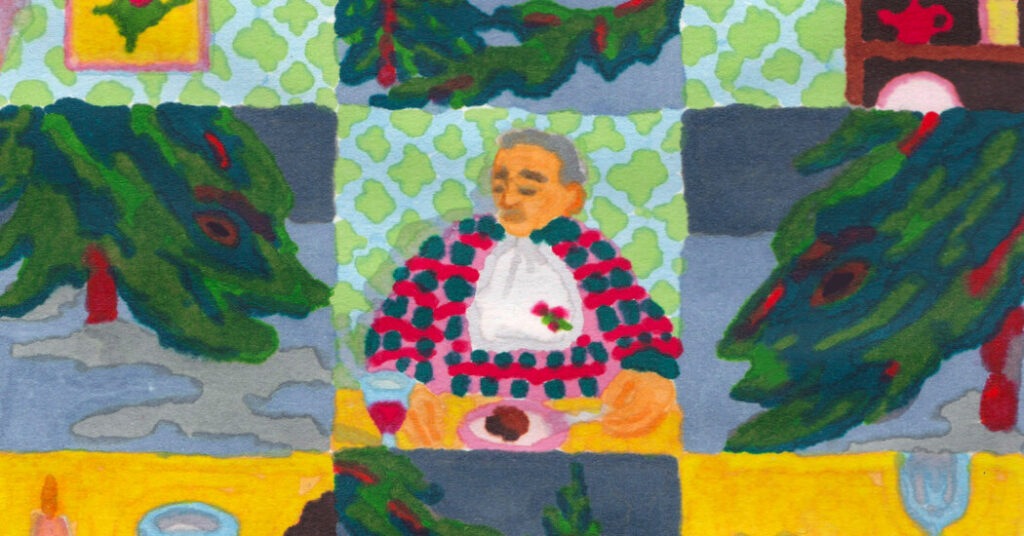
In the photograph I’m sitting beside my father, a decorated Christmas tree behind us, as he looks at a picture book of horses. I had given it to him as a Christmas present, knowing that by his stage of Alzheimer’s, words got lost but images still made an impact. What you don’t see in the photo is that the rest of my relatives were there too, which was unusual for our fractured family. It would be the last time we spent a holiday together. I don’t remember who snapped the picture, but I’m glad they did.
Moments later, my father turned and looked at the tree. He had a puzzled look on his face when he turned back around. “Why is there a tree in the living room?” he asked. A perfectly understandable question from someone with Alzheimer’s, for whom time and the markers of a holiday are a blank screen. I remember several of us scrambling to explain Christmas and the decorations that go along with it. He listened and then repeated, “But why is there a tree in the living room?” It occurred to me that explanations were not going to work, but a simple description might. I said something like, “It’s so pretty to have a tree inside sometimes. People do that at this time of year, and it’s so nice to look at.” The puzzled look went away; he nodded and returned to the picture book of horses.
Through the holiday season, there will be many families who share a table with someone who has Alzheimer’s or some other version of dementia, who might not grasp what the holiday is. They see people around them and a table laden with food, but they don’t know why everyone is there and, frankly, they don’t care what the reason is. What they do pick up on are the emotional currents that drift around many holiday tables. That will be especially true now that political divisions have intensified enough to make many people dread family get-togethers.
When a person’s cognition is splintered or absent, they are absorbing the emotions around them with no filter to protect them. They can’t tell themselves, “Well, these two love each other but they disagree politically,” or “There is messy family history between those relatives.” Please don’t tell yourself you can say whatever you want around them because they don’t understand. They may not understand the content, but they very much understand the emotion, and it can be scary.
Sometimes the saddest passages of our lives are the most instructive. As hard as it is to watch a loved one drift away to another world where you can’t follow, as much as the grief can feel overwhelming, dementia has important lessons to teach us all. One is to not take for granted that you understand what your loved one is feeling or absorbing. So assume that everything that radiates from you is sinking into them, and adjust accordingly. Another lesson is that we are all perfectly capable of stepping away from the sternness of our opinions and viewpoints, choosing instead to be calm, receptive and gracious.
In the 10 years of my father’s Alzheimer’s, I knew I was being presented with lessons that could serve me in every aspect of my life. I’ve told many people that, after the journey of dementia with a loved one, you won’t be the same. How you change is a choice. You’ll either be more open and more gracious or harder and more closed off. The holiday season, when sensitivity runs high, is a good time to reflect on that.
The poet Rumi wrote: “Out beyond ideas of wrongdoing and rightdoing, there is a field. I’ll meet you there.” Maybe our holiday gatherings this year, regardless of whether they include someone with dementia, but particularly if they do, can be that field.
Patti Davis is the author of “Floating in the Deep End: How Caregivers Can See Beyond Alzheimer’s.”
The Times is committed to publishing a diversity of letters to the editor. We’d like to hear what you think about this or any of our articles. Here are some tips. And here’s our email: [email protected].
Follow the New York Times Opinion section on Facebook, Instagram, TikTok, Bluesky, WhatsApp and Threads.
The post When Dementia Has a Seat at the Holiday Table appeared first on New York Times.