American politics has begun to remind Gray Sutanto of home — not in a good way. He grew up in Jakarta, Indonesia, and some American Christians’ comments on politics “sound a lot like Islamic nationalism to me,” Dr. Sutanto, who teaches theology at Reformed Theological Seminary in Washington, told me. “The only times I’ve had to defend democracy are in America, not Indonesia.” But, he added, secular journalists usually get this story wrong. “They confuse any desire to influence society by way of Christian values with ‘Christian nationalism,’ ” he said. “If that’s your definition, then everyone who is a Christian is a Christian nationalist.”
I’ve spent a lot of time over the past year talking to frustrated conservative Christians. They complain about their fellow believers’ tendency to make idols out of political power. But they also criticize the media’s simplistic depictions, especially in stories about Christian nationalism and a movement known as the New Apostolic Reformation. Journalists and scholars paid little attention to this movement until recently, when they realized that some of its members had rallied to President Trump — and that they are charismatic Christians with an ostentatious interest in the supernatural. Leaders in this subculture have made public displays of casting out demons from Capitol Hill. Four of the six protest permits issued at the Stop the Steal rally on Jan. 6, 2021, went to charismatic groups. Journalists have warned that today they comprise an “army of God” with “tens of millions” aiming to “destroy the secular state.”
But if this is an army, it is a poorly organized one that spends a lot of time fighting within its own ranks. The term “New Apostolic Reformation” describes loose networks of churches that all emphasize the Holy Spirit and expect God to act in miraculous ways. But they disagree profoundly on the implications for politics. Yes, some prominent leaders are Prosperity Gospel grifters who blame political opposition on witchcraft. That’s all the more reason to pay attention to those charismatic Christians who do not make a living on incendiary sound bites, and who are leaning into the elements of their faith that may help rescue traditional Christianity from partisan political capture. A lot depends on who wins this argument over what Jesus meant when he said that “all authority in heaven and on earth has been given to me.”
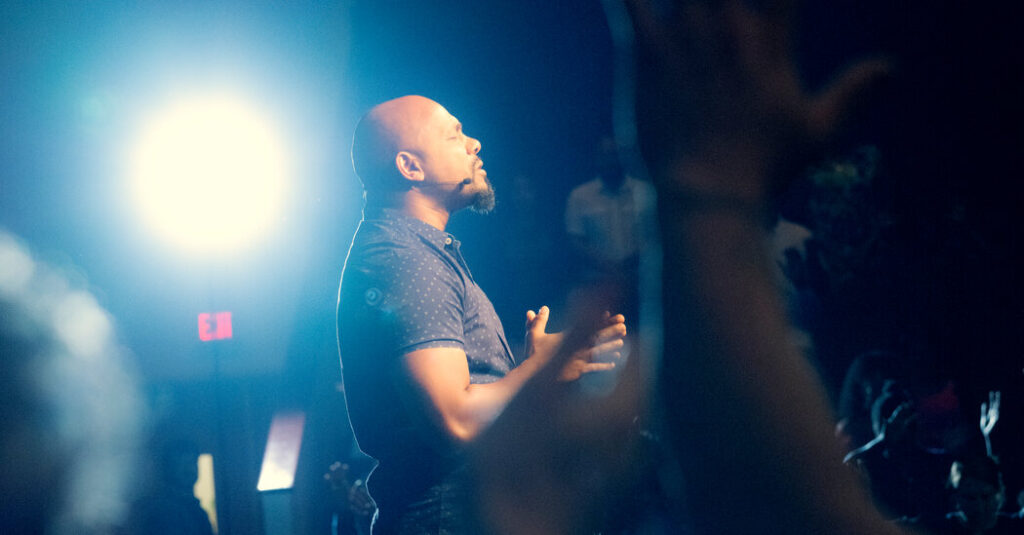
I got a taste of this variety and disagreement when I visited King’s Park International Church in Durham, N.C. Christians there look for God to heal the sick, reveal prophetic messages and perform other signs and wonders. The stranger thing, perhaps, is that both Republicans and Democrats attend. The church’s 120 elders, deacons and employees are split “about half and half, Republican and Democrat,” Reggie Roberson, the pastor, told me. The several hundred people who worship at King’s Park on an average Sunday are a mix of races, national backgrounds, ages and income levels. That’s how it should be, Bomi Roberson, who is married to Reggie and helps lead the church, said. She recalled a dream she had early in their ministry. She was flying over “a sea of people from all over the world, wearing their garb from all over the world,” she said. “I remember waking up and feeling that God gave me a glimpse of what heaven looks like.”
The New Apostolic Reformation is a movement of rapidly growing global networks, not a single hierarchy or conventional denomination. King’s Park’s network, Every Nation, includes more than 700 churches in 84 countries. Member churches share a focus on worldwide evangelism and faith that the kinds of miracles recounted in the Book of Acts still happen today. (The label “charismatic” comes from “charisma,” the Greek term for God’s gift of grace.)
Mr. Roberson sees “some good things and some difficult things” in the New Apostolic Reformation, but he emphasized that his own network “does not agree with the excesses and abuses that have come out of it.” The point is global revival, not domestic politics. “We believe if we, as leaders, align ourselves with a political party, we will most likely lose our prophetic voice,” Mr. Roberson said. His church is a clue to how commentators have misunderstood this movement, especially when they cast it as a conspiracy focused on a right-wing, racist domestic agenda. “The Gospel is not just for a particular group of people, but for everybody,” said Bomi Roberson.
Early in Mr. Trump’s first presidential campaign in 2016, when many white evangelical Christians were skeptical of him, he gained support from charismatic leaders who operated outside traditional denominations. Some declared themselves latter-day apostles, specially tasked by God to lead a revival in these last days before Christ returns. They included Mr. Trump’s longtime friend Paula White-Cain, who led a series of large, racially mixed churches in Florida and built a diverse following on TV and the internet through a mix of Prosperity Gospel peddling, lifestyle advice and humanitarian service. This blend of snake oil and Sermon on the Mount perplexes outsiders, but is not unusual in this corner of American religion — and offers another clue that independent charismatic churches contain both the best and the worst of the faith.
Another early Trump supporter, Ché Ahn, leads Harvest Rock Church in Pasadena, Calif., and an apostolic network called Harvest International Ministry, a federation of churches around the world. Member churches convene for an annual conference, give financially to Dr. Ahn’s network, and view him as their apostle, guide and mentor — although how authority works in these networks varies widely. “I’m there to serve them,” Dr. Ahn told me. “I feel that’s why I have thousands of churches looking to me for leadership. I don’t believe in control. We keep churches autonomous.”
Christians have been collaborating across geographic boundaries for centuries. But the scale and influence of these apostolic networks are new, and the trend mirrors developments in economics and geopolitics. For the past two decades social scientists have tracked the rise of “network states”: globally dispersed communities that connect online, pool resources and may eventually demand recognition from traditional nation-states. Likewise, charismatic church networks have been quietly expanding since the 1970s, and some have grown larger than traditional denominations. With more than 25,000 churches in 72 countries, Harvest International Ministry “might well be the largest apostolic network in the world, but because it doesn’t fit most people’s categories, it operates off the books of official evangelicalism,” Matthew Taylor writes in “The Violent Take It by Force,” his study of independent charismatic churches and Christian nationalism.
Dr. Ahn was born in Korea. His father, also a pastor, spent time in a North Korean prison camp. “Everyone has a divine assignment,” he said. “I do feel God wants me to be a voice because of my background.” Dr. Ahn has been involved in politics for decades, but stepped things up during the Covid-19 pandemic, when he and other churches sued Gov. Gavin Newsom of California over the state ban on in-person worship during the lockdown — and won. He preached at the Stop the Steal rally in Washington on Jan. 6, although he did not take part in storming the Capitol. He stopped at his hotel room after the rally and inadvertently slept “through the whole thing,” he said. He told me that he “was shocked watching the news. This was not the crowd I was with. I think there was some fake news involved. These are evangelicals. They were there to pray.” In August, he announced his candidacy in the 2026 California governor’s race.
I heard Dr. Ahn speak last year at a conference marking the 30th anniversary of the Toronto Blessing, a revival that began in 1994 and fueled an explosion of charismatic networks like his. Onstage, he blended a call to vote for Mr. Trump with predictions of revival. “We’re on the verge of seeing a billion-soul harvest and the transformation of the nations,” he told the crowd. The “discipling” of the nations, he said, required Christian transformation of every part of American society. He rejected the “dualism of the separation of church and state, which is not biblical. Jesus is king and lord over all, including every mountain, the church mountain, the business mountain, the government mountain, the family mountain,” he said.
His language paraphrased a slogan known as the Seven Mountain Mandate, a call by evangelical leaders in the 1970s for Christians to influence the “seven mountains” of family, religion, education, media, the entertainment industry, the business world and government. The phrase has become notorious in the secular press as shorthand for a plan to infiltrate centers of power and advance an aggressive culture war vision.
The straightforward meaning of this slogan, though, is not radical. Commentators have pointed out that any mainstream Christian could affirm many of the statements on surveys meant to ferret out Christian nationalists based on belief in the possibility of prophecy, God’s control over events and other uncontroversial Christian claims. The Seven Mountain Mandate fits a long tradition of political theology urging Christians to bring their faith to bear on all aspects of life.
What is alarming, however, is how activists sometimes wrench this mandate away from the moderating influence of traditions and institutions. They disrupt one of the paradoxes at the core of Christianity: the balance between stoic skepticism of worldly power and, on the other hand, confidence that God does intervene in human affairs, and expects the faithful to call on him.
Bethel Church in Redding, Calif., runs a School of Supernatural Ministry that trains students from around the world (many from Bethel’s apostolic network) to pray for everything from the resurrection of a dead child to a new Honda. This audacity has a basis in scripture — one that, perhaps, many Christians don’t take seriously enough. In the Gospels, Jesus urges his disciples to “ask, and it will be given to you” and compares God to a generous father who is eager to “give good gifts” to his children when they ask. But some charismatic churches untether this teaching from other biblical passages that prescribe a life of patient suffering. They turn God into a divine vending machine. “They think that once they’ve been empowered by the spirit of God, they’re little gods on earth who can name it and claim it,’ ” Daniel Álvarez, who teaches theology at Pentecostal Theological Seminary in Cleveland, Tenn., told me.
This theology has dangerous implications for politics, especially when combined with the conviction that God calls Christians into spiritual warfare against demonic forces. During Mekenzie Barnes’s childhood, she said, her family was deeply involved in Bethel Church, where she heard the message that “there is good and evil in this world, and our job as soldiers of God and Jesus is to fight against the evil,” she told me. (Ms. Barnes left the church in 2016 when she finished high school, but she still follows Bethel’s online media.) “Growing up in that church, you learn to demonize secular people who don’t believe in God. They would tell us that Satan was constantly trying to sabotage us.” But she rejected the notion that Bethel members embraced white supremacy. “The church accepted people from anywhere. They were totally open, with a really diverse following,” she said. “They never focused on skin color or race.” Researchers have found that charismatic Christians are younger and more racially diverse than non-charismatic Christians; one survey that oversampled Latino and Asian charismatics found that they are more conservative on sex and gender, yet much more likely to identify as Democrats.
This is an international — even cosmic — mind-set, not a narrowly racial or nationalist ideology. It does not align with either mainstream political party. Yet observers are right to worry about the power of this highly supernatural, urgent worldview in Washington’s current moment of institutional vulnerability. The second Trump administration has spent much of its first year testing legal limits on presidential power. “Instead of saying: How can Christians play a better role in our democratic society? These Christian activists are saying: Maybe it’s time for the liberal political project to be overturned, and the only way to apply that is to adopt a revolutionary mind-set,” Dr. Sutanto, the professor at Reformed Theological Seminary, told me.
Matthew Kaemingk, a political theologian at the Center for Public Justice in Washington, worries that some activists see America’s political institutions “as so lost, so decrepit, that as an emergency measure they’ve been forced to centralize power in the hands of the president. The only way to restore America’s institutions, so the logic goes, is to empower a strongman who will smash them,” he said. One can find this “postliberal” authoritarian impulse across the Christian spectrum, including the Catholic, Eastern Orthodox and Reformed Protestant traditions. But charismatic Christians have been the most numerous and visible allies of Mr. Trump’s message: His ends justify almost any means.
Their sense of personal empowerment by the Holy Spirit can make them vulnerable to “the theological mistake that they control the Spirit or that they can direct the Spirit to empower the president, filling and moving through him in a unique way. Since they see this as a season of spiritual warfare, they believe Trump has to be as strong as possible,” Dr. Kaemingk said. Although these activists talk a lot about God’s power, they commit “an underlying theological error, which is that God is weak — that he needs Christians to take America back for him.”
There’s an important caveat: the one I encountered at that politically and ethnically mixed church in Durham. The same emphasis on supernatural power that makes these churches prey for radical activists also equips them to coax Americans out of a narrow, partisan perspective. “I’m always encouraging our congregation to remember that although you may have this political affiliation, your ultimate citizenship is in heaven,” Reggie Roberson said. A few years ago, debates about the pandemic and George Floyd’s murder forced the church’s leaders to figure out how to manage political tensions in the congregation. “We were already doing it, but the pandemic forced us to make it programmatic,” Mr. Roberson said. “We now have a class we call Love Better, where we are talking about these things culturally, where we are coming from, sharing our stories. It’s one thing to be integrated; it’s another thing to be reconciled.”
He pointed out that this approach follows from charismatic Christians’ emphasis on Pentecost, when the Holy Spirit fell on Christ’s apostles and equipped them to speak foreign languages and spread the Gospel to all nations. “That Pentecostal charismatic theology says the power of the Holy Spirit enables you to reach everyone, so you can’t see people as your enemy. Everyone becomes someone God is trying to reach, to share his love with. That is the bedrock.”
Every believer struggles to keep the paradoxes of Christianity in balance. Charismatic Christians are no different. It’s exciting to feel oneself filled with spiritual power. But God is sovereign, and his intentions are not the same as ours. Many charismatic Christians have mistakenly adopted “the idea that if we pray hard enough, we can change God’s mind,” Mr. Roberson said. At his church, however, “we are constantly reinforcing the idea that when you’re praying and the Holy Spirit is speaking to you, you are aligning with God.” He pointed out the political implications: “Maybe you were praying against this person getting elected. Once they got elected, you understand: ‘OK, God, you must have a plan that you’re working through this particular situation. I’m going to trust you in that.’”
The irony of our secular age is that theology is more powerful than ever.
Molly Worthen, a professor of history at the University of North Carolina, Chapel Hill, is the author, most recently, of “Spellbound: How Charisma Shaped American History From the Puritans to Donald Trump.”
The Times is committed to publishing a diversity of letters to the editor. We’d like to hear what you think about this or any of our articles. Here are some tips. And here’s our email: [email protected].
Follow the New York Times Opinion section on Facebook, Instagram, TikTok, Bluesky, WhatsApp and Threads.
The post What We Get Wrong About Christian Nationalism appeared first on New York Times.