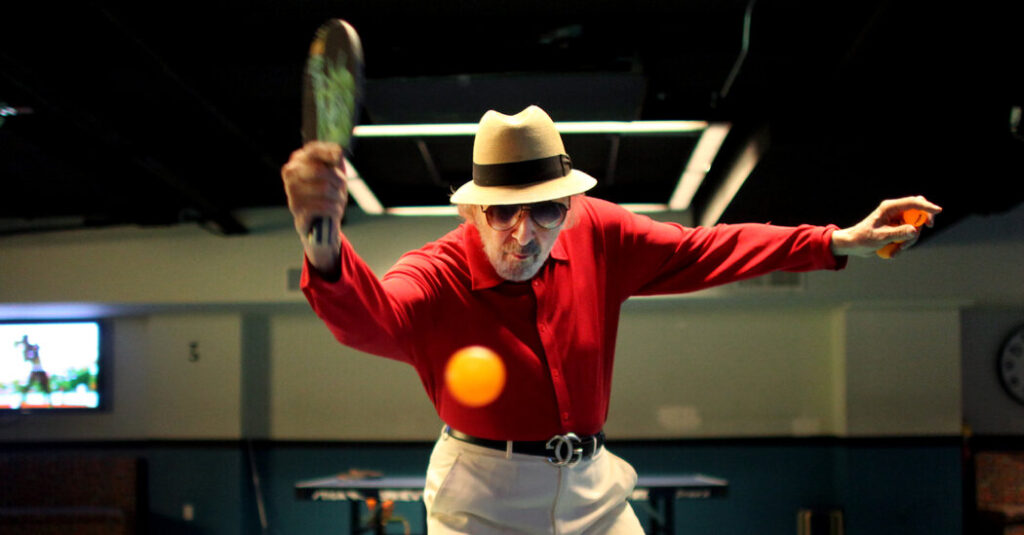
Back in 2005, when I was recently out of college and new to New York, one of my closest friends was a 75-year-old self-declared con man named Marty Reisman. Twenty years later, he’s the clear inspiration for the maddening, morally bankrupt, wildly entertaining Ping-Pong prodigy played by Timothée Chalamet in “Marty Supreme.”
We were an odd pair, Marty and me, orbiting each other that humid summer. I’d recently moved from Texas hoping to become a writer and instead found work as an assistant to a literary agent. I hardly knew anyone and almost rented a room in a NoLIta walk-up from a man on Craigslist who, as he toured me past the bathroom, reassured me, “I’m not a pervert or nothin’, but if I happen to catch a glance, I’d rather it be a girl.” I still smiled at people on the F train.
I met Mr. Reisman when I read the manuscript for his memoir, which I unsuccessfully championed. He cut a distinctive figure, walking around the Lower East Side in vintage Panama hats, tinted aviators and custom-made pastel pants. He always had a cigarette hanging out of his mouth.
I hesitate to call him a mentor. After all, Mr. Reisman was, by his own account, friends with members of Meyer Lansky’s Murder Incorporated gang, a self-declared Ping-Pong hustler who, paddle in hand, had, he told me, taken money off everyone from Montgomery Clift to the president of the Philippines.
I remain useless at table tennis and lose bets to my 7-year-old, but Mr. Reisman taught me that if I wanted to make it, I’d need to cultivate my own kind of con. He showed me how to reinvent. To self-mythologize. To stop apologizing and start throwing elbows at the Barneys Warehouse Sale. To order an off-menu roast duck bowl at Mee Noodle Shop.
It’s easy to feel as if you’re going to get eaten alive when you first step out into the world, especially in a place like New York City. It’s a fake-it-till-you-make-it kind of place, where it seems as if most of the people you meet were born on third base. Anyone who’s ever tried to weasel inside or work her way above her station knows that a certain amount of hustle — even con — is required. It’s why we love Jay Gatsby and Don Draper and have welcomed the woman known as Anna Delvey back to Fashion Week.
Mr. Reisman did this in the most florid way. Known as the Needle because of his slim physique, he was born in New York in 1930 and grew up on the Lower East Side. He told me he picked up table tennis in Bellevue Hospital after he had a nervous breakdown at age 9. And damn, if Mr. Reisman didn’t cultivate his talent and the Reisman myth to travel the world and get into rooms he was never meant to be in.
“There was a point when you couldn’t name a maharajah that I hadn’t played table tennis for,” he told me.
Mr. Reisman died in 2012 — and now he’s come back to vivid life in “Marty Supreme,” the gritty, kinetic, awards-season catnip from the director Josh Safdie and A24, the studio known as the arbiter of Hollywood hip.
“Marty Supreme” isn’t a biopic, and nowhere do the words “inspired by” — much less the more legally risky “based on” — appear in the credits. The film is positioned as fiction: an homage, not a portrait.
But by Mr. Safdie’s account, the idea began when his wife, Sara Rossein, found Mr. Reisman’s 1974 autobiography, “The Money Player,” in a dollar bin of books at a thrift store. (The memoir Mr. Reisman was trying to pitch when I met him was to be its sequel.)
“It had this kind of funky-looking guy on the cover,” Mr. Safdie, who co-wrote the script with Ronald Bronstein, told The Hollywood Reporter. “I showed it to Timmy [Chalamet] because he and I were talking at the very beginning of all of this. I said to him, ‘I want to do a movie in this world. Check out what this player looks like.’” The actor told the director, “that looks like me,” adding an expletive.
Mr. Safdie, a childhood Ping-Pong fanatic, went down a rabbit hole of 1950s table-tennis subculture in New York — and the “eccentric Jewish immigrant Lower East Side characters” who dominated the game in smoky backrooms and penthouses. The whole ecosystem informed the fictional character of Marty Mauser.
“The people who excelled at table tennis were often people who didn’t fit anywhere else,” Mr. Safdie said. “It wasn’t respected, so naturally it attracted weirdos, purists, obsessives.”
Mr. Reisman used to tell me about the characters who frequented his splendid Gothic establishment, Riverside Table Tennis, on 96th and Broadway: Freddie the Fence, Herbie the Nuclear Physicist, Betty the Monkey Lady, Tony the Arm, Dustin Hoffman, David Mamet and a group of violinists from the Metropolitan Opera. “No one knows why,” he said.
“Marty Supreme” is a Safdie film, so it’s not a spoiler to say Mr. Chalamet’s Marty is a scalawag with almost no redeemable qualities. Marty Mauser is abrasive and obsessive — an unhinged avatar of midcentury Jewish male ambition and mythmaking. I can safely say that Mr. Reisman would have loved it. It was his literal dream to become a pop culture icon. It felt thrilling, surreal and a little sad to sit in a packed early screening of one of the most anticipated movies of the holiday season as if Marty were a brand-new phenomenon.
And a branded one: Now there’s a Marty Supreme Invitational table-tennis tournament, sponsored by Airbnb. The special edition “Marty Supreme” Windbreakers. Fans in Marty’s signature orange beanies waited more than three hours in 20-degree temperatures outside the glitzy New York premiere. Guests included Anna Wintour, Julia Fox and mayor-elect Zohran Mamdani. The billboards. The Wheaties box. Mr. Reisman’s downtown scrappiness and desperation have been merchandised as the epitome of cool to help sell a movie.
After my agency passed on Mr. Reisman’s sequel to his out-of-print original memoir, we started to hang out. I’d tag along to watch him play weekly table tennis with the journalist and literary powerhouse Harold Evans in the basement of the house he shared with his wife, Tina Brown, the magazine editor. Mr. Evans first met Mr. Reisman in 1948, when they competed in the British Open. Mr. Evans lost in an early round. The following year, Mr. Reisman won. Mr. Evans became fascinated with Mr. Reisman’s career and antics, writing about him in a Ping-Pong column for The Manchester Evening News. Mr. Reisman won 22 major table-tennis titles and had a drop shot that clocked 115 miles per hour, faster than Nolan Ryan’s fastball. He always gave Mr. Evans at least a 12-point handicap to keep things interesting.
I vented to Mr. Reisman that I needed clips to get a job in journalism. He proposed that I profile him. I sold the idea to Forbes. I credit that article with my getting a job at The Wall Street Journal, where I spent eight years, followed by a decade at The New York Times.
I didn’t have Mr. Reisman’s fast-talking hustle or sense of style, but in his singular focus to become the world’s best table-tennis player I recognized my own drive. Mr. Reisman often reminded me that he wasn’t much good at anything else, so he had to make it big at this very specific thing.
“I could tell at a very young age that I was gifted, and that because of that gift I would be able to carve a very interesting life out of table tennis,” he said.
A lot of “Marty Supreme” is Mr. Safdie’s signature brand of pure, adrenaline-fueled fun. I don’t know whether Mr. Reisman ever came crashing through a motel bathroom floor, nearly crushing a gangster’s arm, or slipped a necklace off a starlet in the shower to pawn it later. It’s possible.
Other moments made me smile with recognition. The movie opens with Marty conning a woman into buying pricier shoes; Mr. Reisman’s only real job was a brief stint selling shoes at B. Altman. “No one has ever been less suited for regular employment than I was,” he told me.
And Mr. Reisman’s favorite grievance — that the Japanese “ruined” Ping-Pong with the sponge paddle — becomes a plot engine, as Marty battles Koto Endo (played by the real-life champion Koto Kawaguchi).
The Marty I knew could be exhausting, vain and unreliable. But he was also kind. He carried a sadness that seeped out when the facade fell: a broken boy beneath the bravado, still trying to outrun the squalor of the Lower East Side, the depression, the father who never loved him.
Jackie Mason, the comedian and Mr. Reisman’s childhood friend, told me he thought of Mr. Reisman as “an armchair philosopher” — a man who talked about a fortune he didn’t have and times that had gone by.
If Mr. Reisman could see how his legend outlived him and then slipped free of his name, I think he’d nod and say: Fair. A clean hustle. They got him on a technicality.
Watching Mr. Chalamet’s Marty, a feral street cretin willing to crush anyone in his way, part of me wondered if that’s who Mr. Reisman really was when he was young, when Ping-Pong still filled stadiums overseas, when his neighborhood was not known as Dimes Square. Maybe age softened him. Maybe the film had omitted the core wound that made Marty Marty.
Or maybe — maybe? — he’d been hustling me the whole time. After all, he did get a sweet spread in Forbes out of it.
Amy Chozick, a screenwriter and former New York Times reporter, is the author of “Chasing Hillary,” which she adapted into the HBO Max series “The Girls on the Bus.” Her debut novel, “With Friends Like You,” is forthcoming.
The Times is committed to publishing a diversity of letters to the editor. We’d like to hear what you think about this or any of our articles. Here are some tips. And here’s our email: [email protected].
Follow the New York Times Opinion section on Facebook, Instagram, TikTok, Bluesky, WhatsApp and Threads.
The post What the Real-Life Marty Supreme Taught Me appeared first on New York Times.