President Trump’s geopolitical ambitions have almost been harder to follow than his other policies, encompassing as they have the annexation of Greenland, the conversion of Canada into the 51st state and the retaking of the Panama Canal.
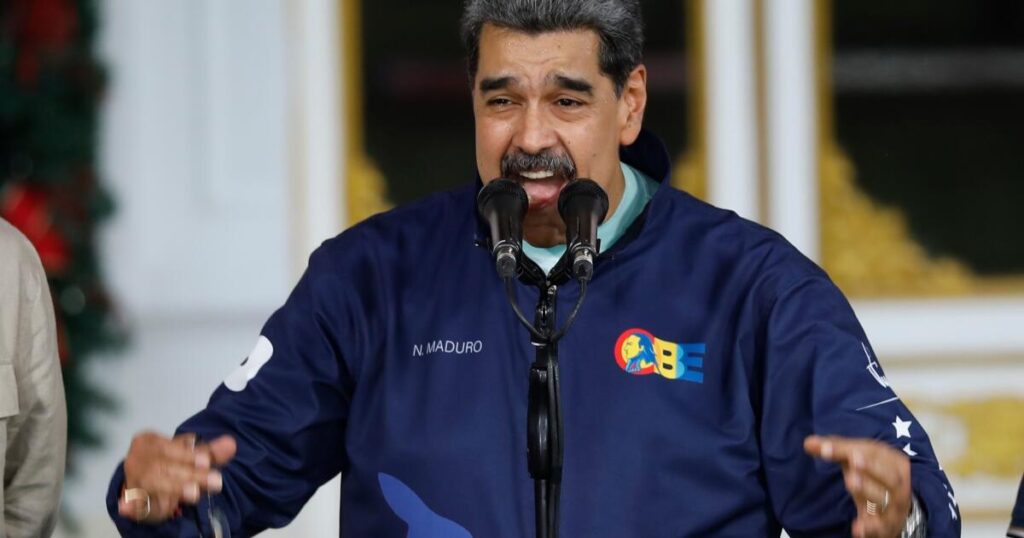
Trump’s current focus is on Venezuela, which has been led by the dictator Nicolás Maduro since 2013. Trump’s moves against Maduro have been more aggressive than those against any other foreign target. They’ve encompassed attacks on Venezuelan boats in the Caribbean purportedly carrying drugs destined for the U.S., tankers carrying oil to China and other countries ostensibly in violation of international sanctions and the threat of military action.
Yet what has remained murky is what Trump views as the chief rationale for these actions. Over time, he has blamed Maduro for encouraging the flow of immigrants, including criminals, to the U.S. and for flooding the U.S. with narcotics. Last week, via his TruthSocial online platform he demanded “the return to the United States of America all of the Oil, Land, and other Assets that they previously stole from us.”
Meanwhile, according to Trump’s chief of staff, Susie Wiles (in a series of interviews with Vanity Fair), Trump’s real goal is regime change in Caracas.
“The President has been clear in his message to Maduro,” White House spokeswoman Anna Kelly told me by email: “Stop sending drugs and criminals into our country.”
A couple of points about Trump’s claims: The oil and land he refers to have always been Venezuelan assets. The assertion that they were “stolen” from the U.S. is “baseless,” as economist Francisco Rodríguez of the University of Denver told the Washington Post. American and other foreign companies operated in the Venezuelan oil fields as concessionaires, granted rights to extract, refine and ship oil that was a Venezuela-owned resources.
Those companies sought compensation for Venezuela’s seizure of facilities they had built for those purposes. Several won arbitration awards from international panels, but not all those awards have been paid.
Trump’s saber-rattling over Maduro echoes U.S. interventions in Latin American states dating back more than a century, including efforts to unseat leftist governments in Guatemala, Nicaragua, the Dominican Republic, Chile and, perhaps most embarrassingly, through the misbegotten Bay of Pigs invasion of Fidel Castro’s Cuba in 1961.
Trump’s allusions to the economic pressure imposed on the Maduro regime via the shipping blockade evokes President Nixon’s 1970 directive to the CIA to “make the economy scream” in Chile to forestall the election of Salvador Allende, a socialist. Allende was elected in 1970, but died by his own hand in 1973 during a coup led by Augusto Pinochet.
(For a fictionaized but compelling treatment of the history of American imperialism in Latin America, one can hardly do better than Gabriel García Márquez’s novel “One Hundred Years of Solitude.”)
U.S. relations with Venezuela have been as volatile and troubled as those with other countries in the region. The country was seen as a beacon of political stability — and a bulwark against the Soviet Union — during the 1950s. In 1958, however, during his goodwill tour of the region, then-Vice President Richard Nixon’s motorcade was attacked by an anti-America crowd in Caracas. As he wrote in his memoir “Six Crises,” the thought occurred to him that “We might be killed.” As it happened, he was able to leave the country the next day without further trouble.
Petropolitics have been at the center of U.S.-Venezuelan relations since 1922, when a massive oil strike revealed the presence of the Maracaibo Basin. Today, its reserves of about 300 billion barrels of oil are counted as the largest in the world, outstripping even those of Saudi Arabia.
Within a few years, 98% of the Venezuelan export market was controlled by just three foreign companies — Royal Dutch Shell and two American corporations, Gulf (a precursor to Chevron) and Standard Oil. During the subsequent decades, Venezuela’s economy rode the boom-and-bust cycles of the oil market.
In 1960, it was one of the founding members of OPEC, the Organization of the Petroleum Exporting Countries; in 1973, OPEC’s oil embargo, which pushed prices to a record, gave it the highest per-capita income in Latin America, according to Diana Roy and Amelia Cheatham of the Council on Foreign Relations.
The boom soon faded. Oil prices plunged, taking the Venezuelan economy with them. In 1989, the country had to be bailed out by the International Monetary Fund, which demanded an austerity budget and brought socialist Hugo Chávez to power in 1998.
By then, the consequences of the country’s reliance on oil exports to underpin its economy and budget became evident. Other economic sectors such as agriculture and manufacturing were starved of resources. The flow of billions of dollars into government accounts produced “rampant graft and mismanagement,” Roy and Cheatham observe. One independent Caracas think tank estimated in 1997 that $100 billion in oil income had been embezzled or wasted during the previous 25 years.
In the meantime, successive regimes moved to recapture control of the nation’s exports from Chevron and Standard Oil. In 1943, a new law required that half of the profits gleaned by foreign concessionaires go to the government, but also established a long-term development horizon that encouraged the foreign companies to expand production and establish Venezuela-based refineries. Production and exports more than doubled through 1958.
In 1976, while the oil market was booming, Venezuela nationalized its oil industry. Refineries and other assets of foreign companies were seized; the government paid Exxon, Mobil, Gulf and Shell $1 billion each for the expropriation, well below the value of their holdings.
Some companies turned to international tribunals and arbitrators to extract higher payments. The newly merged ExxonMobil received $908 million from arbitrators in 2012. In 2018, arbitrators awarded ConocoPhillips $2 billion, and a second arbitration panel awarded the company an additional $8.7 billion in 2019.
How much has actually been paid is unclear. In 2014, an oil glut sent prices crashing, hollowing out the Venezuelan economy again.
While Venezuela was suffering through the ups and downs of the oil market, the U.S. and other countries were imposing economic and political sanctions on successive regimes. The sequence began in 2006, when George W. Bush banned U.S. commercial arms sales to the Chávez regime, citing its lack of cooperation with U.S. anti-terrorism and anti-narcotics efforts. The determination has been renewed annually.
In 2014, Congress ordered sanctions to be imposed because of election violence and human rights violations. (Maduro had assumed the presidency in 2013, upon the death of Chávez.) In 2017, Trump blocked access to U.S. financial markets by the Venezuelan government, including the privatized national oil company, and followed up with further financial restrictions.
How the sanctions have affected Venezuela is a matter of debate. “The sanctions reduced the public’s caloric intake, increased disease and mortality (for both adults and infants), and displaced millions of Venezuelans who fled the country as a result of the worsening economic depression and hyperinflation,” Jeffrey Sachs of Columbia and Mark Weisbrot of the Center for Economic and Policy Research concluded in 2019. “They exacerbated Venezuela’s economic crisis and made it nearly impossible to stabilize the economy, contributing further to excess deaths.”
But those consequences struck most directly at “the poorest and most vulnerable Venezuelans,” they wrote, not the Maduro regime.
Others have found that sanctions on Venezuela’s oil exports and mismanagement of its industry may have had an even greater effect — and one that began even before the 2017 sanctions. Oil output began falling sharply in 2015, though the decline picked up steam after Trump’s sanctions.
At this writing, Trump’s path forward on Venezuela remains murky. He appears intent to continue attacks on Venezuelan boats, despite increasing questions in Congress about the legality of those attacks. The blockade of Venezuelan oil tankers continues. The administration said Sunday that the Coast Guard was pursuing a tanker off the Venezuelan coast, though it did not say the U.S. forces had boarded the vessel.
That would be the third tanker subject to interception under the blockade. U.S. forces seized one tanker last week and boarded a second one on Saturday. If the blockade continues or intensifies, the economic impact on Venezuela would be severe, as its sales of oil are virtually all that are propping up the economy.
The blockade, however, threatens to expand the geopolitical ramifications of Trump’s policies beyond a bilateral conflict between the U.S. and Venezuela. China, the main destination of Venezuelan oil, said Monday that “the US practice of arbitrarily seizing other countries’ vessels grossly violates international law,” Chinese Foreign Ministry spokesman Lin Jian said at a regular news briefing in Beijing on Monday, according to Bloomberg.
The political maelstrom surrounding Maduro, along with the low price of oil, has kept foreign interest low in reengaging with Venezuela. Currently, Chevron is the only U.S. company operating in Venezuela — indeed, it’s the largest foreign investor in the country. Chevron received a license from the Biden administration to continue its Venezuela operations. Trump revoked that license in June but restored it on a limited basis in July, after jawboning by Chevron Chief Executive Mike Wirth.
Chevron told me by email that its Venezuela operations are “in full compliance with laws and regulations applicable to its business,” as well as U.S. sanctions.
“Chevron has operated in Venezuela for over a century,” the company said, “and we believe our presence continues to be a stabilizing force for the local economy, the region and U.S. energy security.”
The post What does Trump have against Venezuela? His explanations keep changing appeared first on Los Angeles Times.