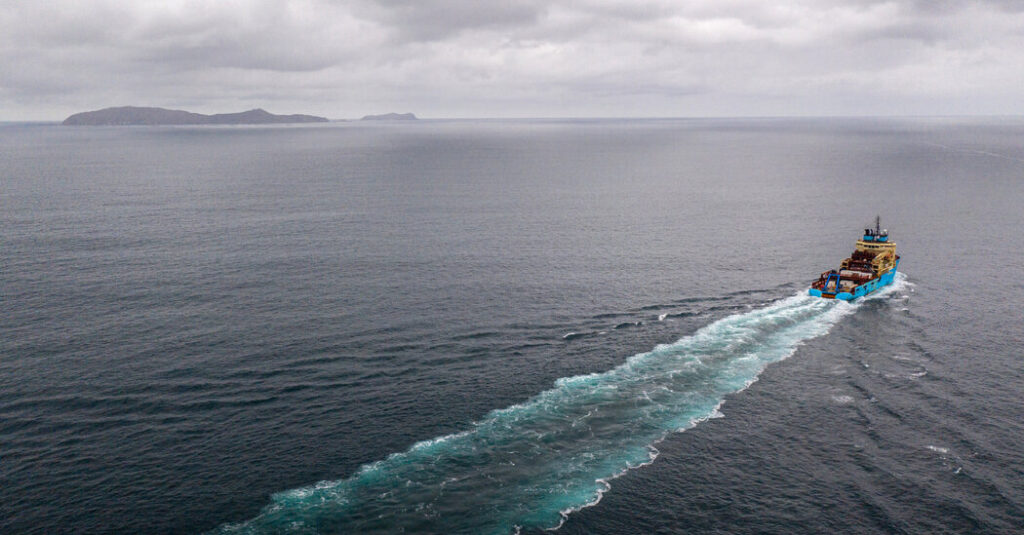
The Trump administration said on Tuesday that it had received an application for seabed mining exploration in international waters, the first in its effort to encourage the controversial industry.
The federal government said it was formally considering the first permit applications from the Metals Company, which has become a forerunner in the race to mine the deep ocean for precious minerals. The company has said publicly that it hopes to start commercial mining operations in the Pacific Ocean in 2027.
Parts of the ocean floor are covered with fist-size nodules that contain nickel, cobalt, manganese and copper. For decades, a United Nations organization, the International Seabed Authority, has been trying to negotiate rules to regulate mining in international waters. The United States isn’t a member of that effort.
President Trump has made seabed mining a priority. In April he signed an executive order calling for permits in both U.S. and international waters, and a week later the Metals Company filed its applications.
Along with Tuesday’s notice, the National Oceanic and Atmospheric Administration posted the mining applications for public comment and scheduled public hearings for late January. NOAA is “working to ensure that the review of the applications goes forward without undue delays,” according to Alison Gillespie, a spokeswoman for the agency.
The Metals Company declined to comment.
The depths of the ocean have never been commercially mined, and overcoming the technological hurdles to doing so is costly. The minerals found there are used in clean-energy technologies such as batteries for electric vehicles, but the Trump administration has emphasized their importance for national security.
The Metals Company’s proposal to begin mining by 2027 is ambitious, said Lori Osmundsen, an environmental lawyer who specializes in ocean law. Although pressure from the Trump administration, along with NOAA’s efforts to streamline the process, means that this speedy timeline isn’t impossible, broad opposition to seabed mining makes it likely that the company will face court challenges that may set it back.
Further complicating matters, the U.S. permit process essentially sidesteps the International Seabed Authority, which, under a 1994 international agreement known as the Law of the Seas, regulates mineral extraction from the seafloor. The Seabed Authority hasn’t yet approved activity beyond exploring potential mining zones. The United States hasn’t ratified the Law of the Seas.
The Metals Company, based in Canada, already holds active exploration permits through the U.N. authority, sponsored by countries that have agreed to follow its rules. In 2022, under these permits, the company conducted a mining test in the Clarion-Clipperton Zone, a region of the Pacific Ocean between Hawaii and Mexico.
The areas outlined in the company’s U.S. mining application overlap substantially with its existing ones. In June, the company updated its agreement with Naru, one of its sponsor countries, to allow for the conflicting permits.
If the United States approves the company’s applications, this jurisdictional tangle will put it on untested legal ground, Ms. Osmundsen said. “It’s a complete gray area,” she said, adding that the fallout could result in international conflict or litigation.
The prospect of mining the deep ocean has prompted worldwide environmental concern. Nearly 40 countries have called for a moratorium or ban on seabed mining, including Germany, France and New Zealand. Polynesian leadership in American Samoa has maintained a moratorium against mining despite the Trump administration’s recent push to expand the industry’s access to its waters.
In August, 130 scientists signed a letter opposing mining, saying that not enough is known about the biodiversity-rich habitats at the depths of the ocean. If the Metals Company’s application process with the United States moves forward, it will be required to submit an environmental-impact statement.
In anticipation of that step, the company has spent years and millions of dollars funding research. Some of the studies it has funded have been independently published in peer-reviewed journals and detail the damage mining could cause the seafloor ecosystem.
Michael Clarke, the company’s environmental manager, said the data for the environmental report was “ready to go,” and that the company was waiting to format it for regulators.
The application outlines some of these findings, addressing issues of particular concern to environmentalists, such as the spread of sediment plumes from mining and the effects on commercial fisheries and animals on the seafloor.
There are economic questions as well. The market demand for the metals found in the seabed may not grow as strongly as some have predicted, said Lyle Trytten, an independent mining consultant for copper and nickel companies.
Mr. Trytten recently co-wrote an analysis for the National Ocean Protection Coalition, a partnership of environmental organizations. It found commercial success was “highly unlikely” within the next 15 years, in part because demand for the metals would be outpaced by current supply. “It really hinges a lot on future trends in electric-vehicle and grid-storage batteries,” he said. China, for example, is a leader in renewable energy technologies but has stepped away from using cobalt and nickel in its batteries. And the world’s main cobalt producer, the Democratic Republic of Congo, has imposed export restrictions in response to a market glut and falling prices.
Max Bearak contributed reporting.
Sachi Kitajima Mulkey covers climate and the environment for The Times.
The post U.S. Takes a Step Toward Approving Seabed Mining in International Waters appeared first on New York Times.