The United States’ aggressive campaign against tankers carrying Venezuelan crude has thrown the country’s oil industry into disarray, jeopardizing its government’s main source of revenue.
President Nicolás Maduro of Venezuela has been struggling to adjust to President Trump’s dramatic escalation of pressure against his government, which has seen U.S. law enforcement agents taking action against three tankers involved in the export of Venezuelan crude, according to people close to the Venezuelan oil industry. They spoke on condition of anonymity to discuss sensitive matters.
Venezuela’s ports are piling up with tankers filled with oil, as officials fear releasing them into international waters and into the cross hairs of the United States. Tankers bound for Venezuela have turned around midway, shipping data shows. And shipowners are canceling contracts to load crude, the people said.
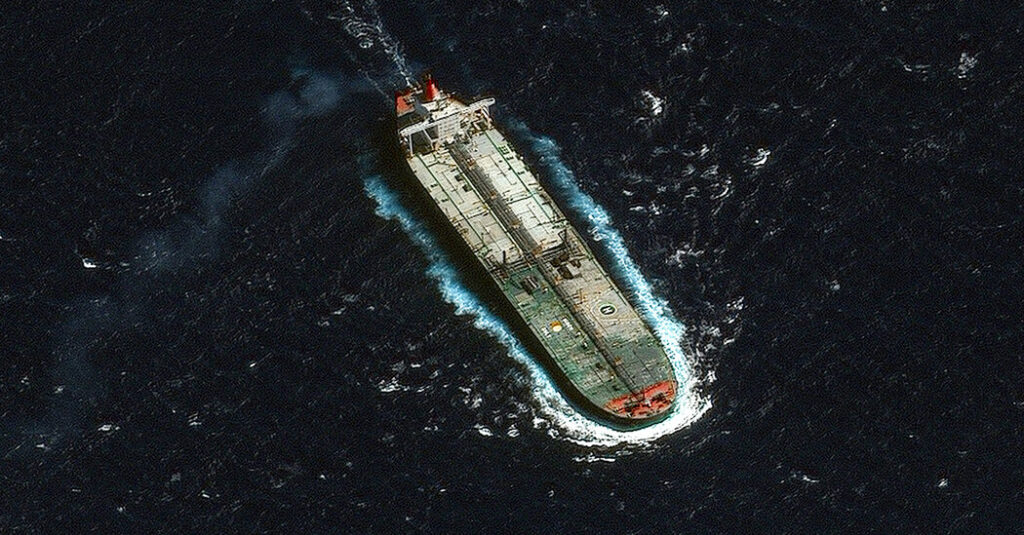
In the past two weeks, the United States seized one sanctioned tanker carrying oil as it sailed from Venezuela toward Asia. It intercepted another oil vessel that was not under U.S. sanctions. And the U.S. Coast Guard tried to board a third tanker as it was on the way to Venezuela to pick up cargo.
The measures have paralyzed Venezuela’s oil export industry, according to the people and shipping data. Oil accounts for a vast majority of the country’s foreign currency earnings.
To keep the country’s oil wells pumping, the Maduro government is considering borrowing privately owned tanker ships to store the crude until it figures out how to sell the resource, the people said. But that would only go so far.
“This can’t go on for months on end,” said Jim Burkhard, global head of oil crude research for S&P Global Energy, a research firm.
Mr. Maduro is also weighing a more forceful response, the people close to the industry said.
Venezuelan gunboats have started accompanying ships carrying Venezuelan oil and oil-based products, but the escorts appear to stop at the limits of the country’s territorial waters.
The government is considering going further and putting armed soldiers on tankers bound for China, the main importer of Venezuelan oil. Such a move would complicate the U.S. Coast Guard’s attempts to interdict them, but it could also draw Mr. Maduro into a military conflict against an armada of U.S. Navy warships that Mr. Trump has assembled in the Caribbean in recent months.
Mr. Trump has accused Mr. Maduro, without providing evidence, of flooding the United States with drugs and of stealing oil from American firms.
Some industry insiders have described the obstacles facing the Venezuelan oil industry as critical. These challenges are threatening to snuff out its modest recovery after years of economic crisis.
In recent years, Mr. Maduro has quietly abandoned the resource nationalism at the heart of his socialist movement. His officials have handed over oil concessions to dozens of private companies and ceded operational control in joint projects between the state oil company and multinational firms.
These overhauls bore fruit, with oil production ticking up to about 1.1 million barrels per day this year, from about 360,000 barrels in the second half of 2020.
Mr. Trump’s surprise move against Venezuela’s tanker fleet has ended this uptick. Only two tankers carrying crude sold by the Venezuelan state oil company appear to have tried to sail beyond the country’s waters since the seizure of the first vessel, called Skipper, on Dec. 10, according to TankerTrackers.com, which monitors global shipping.
One of those tankers, called Centuries, was flying under the Panamanian flag and was intercepted by the U.S. Coast Guard on Saturday, despite the lack of a seizure warrant. U.S. officials are now evaluating if the tanker, whose cargo belongs to an established Chinese trader, has a valid registration in Panama. The whereabouts of the other vessel that TankerTrackers.com identified was unclear on Tuesday.
The Skipper was taken to Texas as the next legal steps were being determined. The Coast Guard tried to intercept another tanker on Saturday, Bella 1, after determining it was not flying a valid national flag. The vessel did not comply and continued sailing.
Ships working in industries under sanctions often use tricks to hide their locations.
Several more tankers have loaded Venezuelan crude in recent weeks, according to people close to the industry. These vessels, however, have been loitering in Venezuelan waters, they said.
The country’s largest private oil operator, Chevron in the United States, has been the exception. The company continued exporting oil from Venezuela in recent weeks under a unique permit that it had obtained from the Trump administration.
Mr. Maduro has pointed to Chevron’s exports to try to claim that the country’s oil industry remains open for business. On Sunday, Venezuelan state television broadcast the departure of Canopus Voyager, the latest tanker carrying crude produced by Chevron to Texas.
“We’re serious people,” Mr. Maduro said in a televised address on Monday. “When we sign a contract in accordance with the Constitution and the law, it is carried out — in rain, thunder and lighting — as is happening with Chevron.”
But Mr. Maduro’s government receives only marginal financial benefit from Chevron’s direct exports. Under the terms of the company’s contract in Venezuela, Chevron keeps half of the roughly 240,000 barrels per day it helps produce in the country, exporting it to refiners on the U.S. Gulf Coast.
The Venezuelan government receives the other half. That oil is becoming increasingly difficult to sell.
Anatoly Kurmanaev covers Russia and its transformation following the invasion of Ukraine.
The post Trump’s Tanker Crackdown Paralyzes Venezuelan Oil Exports appeared first on New York Times.