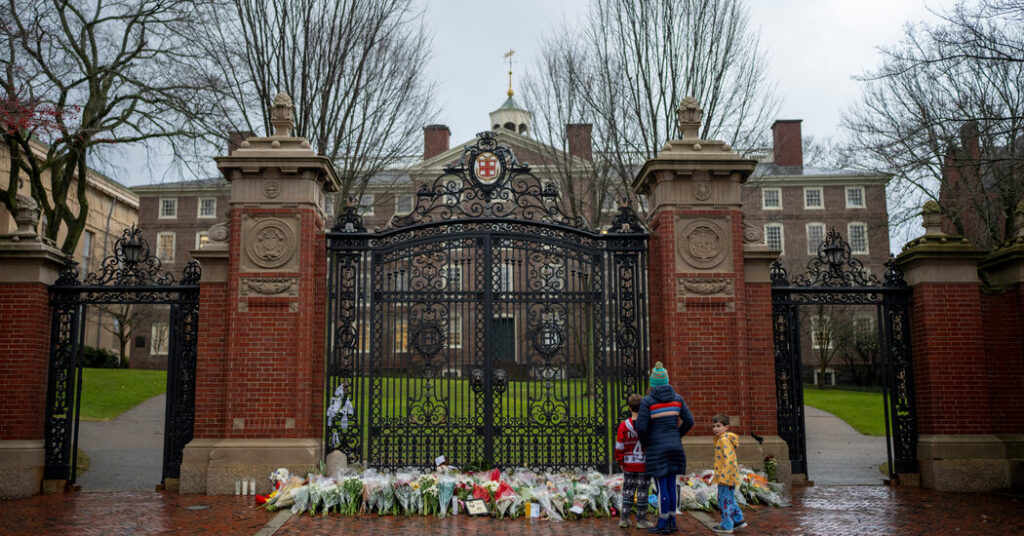
The Department of Education said Monday that it would investigate whether Brown University violated the law by failing to provide proper campus safety before and immediately after a fatal shooting killed two students earlier this month.
The department’s Office of Federal Student Aid will investigate whether the Ivy League school violated the Jeanne Clery Campus Safety Act, which requires colleges to meet “certain campus safety and security-related requirements” in order to receive federal student aid, according to a statement from the Department of Education.
Shortly after the department announced its investigation, Brown University’s president, Christina Paxson, announced new security-related measures at the school. Her statement did not refer to the federal investigation.
Brown also placed its vice president for public safety and emergency management, Rodney Chatman, on administrative leave while the school commissions an “after action review” of the shooting, Dr. Paxson said in the statement.
Hugh T. Clements, former chief of police of the Providence Police Department, will take over the role on an interim basis, Dr. Paxson said.
The shooting took place around 4 p.m. on Dec. 13 in Brown’s Barus and Holley building during a review session for exams. After spraying a lecture hall with bullets, killing two and wounding nine others, the gunman managed to get away ahead of a huge police dragnet.
The suspect in the shooting was later identified as Claudio Neves Valente, a Portuguese native who briefly studied at Brown in the early 2000s. Officials said that two days after the attack, Mr. Neves Valente killed Nuno F.G. Loureiro, an M.I.T. professor of nuclear science and engineering and of physics, in Brookline, Mass.
After an intense manhunt, the police found Mr. Neves Valente’s body in a storage unit in Salem, N.H., last Thursday. He had died by suicide, officials said.
The Education Department cited public reporting after the shooting that appeared to show that “Brown’s campus surveillance and security system” may not have been up to standards. Investigators had said there was no video inside the Barus and Holley building that would have been useful in identifying the gunman. Investigators found images of him by canvassing the surrounding neighborhood for video from home security and doorbell cameras.
Dr. Paxson was pressed about cameras at news conferences after the shooting. She said there were 1,200 cameras on campus, though parts of the building where the shooting occurred had none.
“I do not think a lack of cameras in the building had anything to do with what happened there,” she said during a news conference last week.
Dr. Paxson said the building was unlocked the day of the shooting for exams.
Also, the department said, many students and staff members reported that the school’s emergency notifications of an active shooter on campus were delayed. The first 911 call about the shooting went out at about 4:05 p.m. Brown’s first emergency alert was sent at 4:22 p.m.
“Students deserve to feel safe at school, and every university across this nation must protect their students and be equipped with adequate resources to aid law enforcement,” Secretary of Education Linda McMahon said in the statement on Monday.
In addition to the after-action review, the security steps Brown announced Monday included “prioritizing immediate safety and security measures” to ensure a secure campus over winter break and the spring semester, Brown officials said.
The university will also conduct a security review of its campus, which will study things such as policies and training, as well as the physical security of buildings, access points, cameras and technology. The university had already announced it would increase the presence of officers on campus and install more cameras.
The post Trump Administration Will Investigate Brown’s Security After Shooting appeared first on New York Times.