The Supreme Court said Tuesday that it would not allow President Donald Trump to deploy the National Guard in the Chicago area for now, a significant setback for his campaign to push troops into cities across the country over the objections of local and state leaders.
The president’s ability to federalize the National Guard likely only applies “exceptional” circumstances, the court’s unsigned order said.
“At this preliminary stage, the Government has failed to identify a source of authority that would allow the military to execute the laws in Illinois,” it added.
Justices Samuel Alito, Clarence Thomas, and Neil M. Gorsuch dissented. Justice Brett M. Kavanaugh filed a separate concurrence.
The decision, while temporary, could have far-reaching effects by repudiating Trump’s efforts to mobilize and deploy troops he says are necessary to fight crime and protect immigration enforcement officers.
Trump has sent or threatened to dispatch troops to cities including Los Angeles, Portland, Ore., Washington, San Francisco and Baltimore, sparking several legal challenges. Many local and state officials across the country have denounced Trump’s attempted deployments, saying the move inflames tensions, breaks the law and intrudes on their sovereignty.
In D.C., the National Guard deployment was struck by tragedy when an attacker shot two members on Nov. 26, killing one. A federal judge had said in November that the D.C. deployment was unlawful, but did not immediately order troops removed from the city. Instead, she paused her ruling from taking effect to give the administration time to appeal.An appeals court panel on Dec. 17 said troops could remain in D.C. while litigation in the case continued.
Since early October, judges have blocked Trump’s bids to deploy troops in Chicago and Portland. Some of the troops sent to these cities have since returned home amid the court battles, while others remained in place, effectively awaiting word on whether they would be deployed on the streets or left idle.
The Chicago case is the first time the Supreme Court has weighed in on one of Trump’s attempted deployments.
The high court, which is dominated by a 6-3 conservative majority, has repeatedly approved of Trump’s actions this year, allowing his administration to freeze billions in foreign aid, gut the Education Department, strip temporary protections from hundreds of thousands of Venezuelan immigrants and make other changes.
The Trump administration said troops are needed in Chicago to safeguard personnel and property, writing in court filings that “conditions for federal immigration agents on the streets of Chicago remain dangerous and chaotic.”
In early September, the administration launched an immigration enforcement action in Chicago that it called “Operation Midway Blitz.” The Department of Homeland Security has boasted that the operation reduced crime and said local officials failed to accomplish this for decades, even though violent crimes — including murders and shootings — were already down significantly before the federal action began.
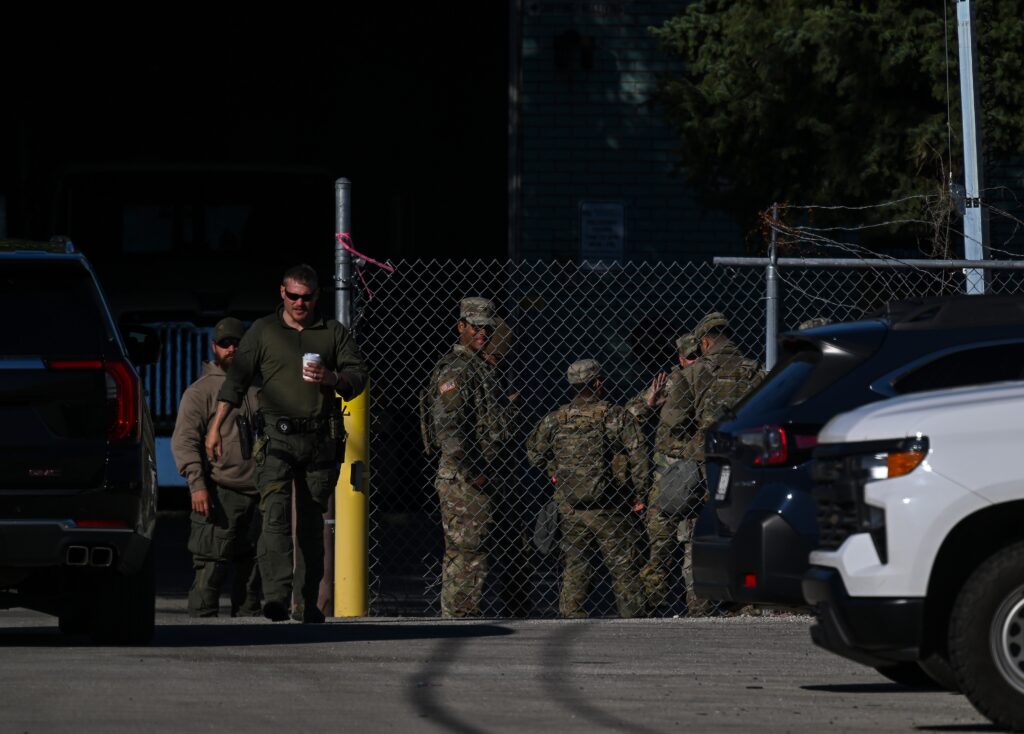
The immigration enforcement effort has fueled intense protests around Chicago, with many demonstrations centering on an Immigration and Customs Enforcement facility in Broadview, a suburb west of the city.
The Justice Department said in court papers that the situation in the Chicago area was tantamount to “a rebellion against federal authority” necessitating the National Guard. DHS officers have had to “operate in a climate of constant fear for their lives and safety, which significantly impedes their enforcement of the law,” the Justice Department said.
Illinois officials, who sued to stop Trump from sending in troops, told the Supreme Court that the Trump administration was mischaracterizing the facts in the case.
In their court filings, Illinois authorities said protests and unrest have not prevented the Trump administration from carrying out federal law. Troops were not needed, they said, because “state and local law enforcement officers have handled isolated protest activities in Illinois, and there is no credible evidence to the contrary.”
The legal dispute has lingered for weeks, leaving Trump’s proposed deployment in the country’s third-largest city indefinitely postponed.
U.S. District Judge April M. Perry on Oct. 9 first blocked Trump from deploying the National Guard anywhere in Illinois. Perry, who was appointed by President Joe Biden, expressed skepticism of the Trump administration’s credibility and wrote that federal officials’ declarations in the case demonstrated “a troubling trend of … equating protests with riots.”
After the Trump administration appealed, a three-judge panel with the U.S. Court of Appeals for the 7th Circuit allowed Trump to federalize the National Guard within Illinois but left in place Perry’s prohibitionon those troops actually being deployed.
The panel disagreed with the administration’s assertion that the government was facing a rebellion in the Chicago area. Instead, the panel wrote, “spirited, sustained, and occasionally violent actions of demonstrators in protest of the federal government’s immigration policies and actions, without more, does not give rise to a danger of rebellion against the government’s authority.”
The panel’s members were appointed to the circuit court by Presidents George H.W. Bush, Barack Obama and Trump.
On Oct. 17, the Trump administration asked the Supreme Court to pause Perry’s order pending appeal, writing in its filing that she imposed her “own authority into the military chain of command” and had endangered federal personnel.
The Supreme Court initially asked for filings to be submitted quickly, signaling that the justices could rule soon after. But in late October, the court asked for additional information to be submitted by Nov. 17, extending the pause on the troop deployment.
The Justice Department wrote in a filing that “this case falls in the heartland of unreviewable presidential discretion.” If Trump’s determination that troops are needed can be reviewed by the courts, the agency said, “such review must be extremely deferential.”
Trump had concluded it was “unsustainably dangerous for federal agents” in Chicago, the Justice Department wrote, leading to the deployment of National Guard members. Troops “will be deployed solely in a protective capacity — not to engage in civilian law enforcement functions,” the agency added.
Illinois authorities, though, told the Supreme Court that there was no rebellion afoot and that the demonstrations in Broadview “never hindered the continued operation of the ICE facility there.”
The state wrote that it was challenging the deployment “to protect its sovereignty, retain control over local policing, and protect the basic structure of American federalism from unprecedented intrusion.”
While the Trump administration pushed to deploy troops in Chicago, it waged a parallel — and, so far, unsuccessful — effort to do the same in Portland.
U.S. District Judge Karin J. Immergut temporarily blocked Trump’s effort to deploy troops in Oregon in early October, then issued a Nov. 7 ruling making her prohibition permanent.
Immergut, who was appointed to the bench by Trump during his first term, said Trump “did not have a lawful basis to federalize the National Guard.” The Trump administration is appealing her ruling.
Trump’s proposed deployments, which began in Los Angeles over the summer, have proved generally unpopular with the public.
More than half of U.S. adults said Trump was going too far in sending the National Guard to cities, while about 1 in 3 said he was handling the issue about right, according to a Washington Post-ABC News-Ipsos poll conducted in October. One in 10 people said he was not going far enough, the poll found.
The post Supreme Court hands Trump a major defeat on National Guard deployment appeared first on Washington Post.