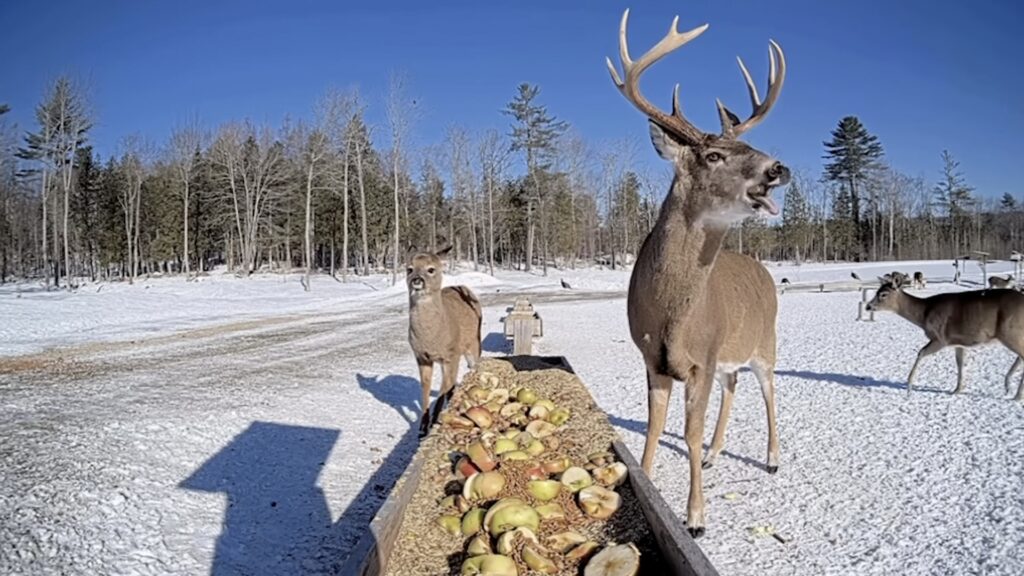
Every winter day in a Maine backyard, dozens of deer eat oats, apples and acorns from wooden troughs. Unbeknownst to the deer, four cameras live-stream their every move to thousands of people. Fans have given them nicknames and developed favorites.
There’s Lefty, a longtime visitor who got his name from the large nick in the middle of his left ear. Big G, another crowd pleaser, has large antler tines that hunters call “G’s.” And Shaggy was named for the deer’s messy fur.
The videos have reached people across the United States and the world. Some devotees watch the hungry deer with their morning coffee. Others unwind with the animals in the evening.
“They become your family,” said Betty Sullivan, 72, who admires Lefty and dozens of other deer for hours daily on the live stream.
Sullivan’s San Francisco apartment doesn’t offer scenic views, she said, so the videos have become her “window into the natural world.”
The deer feeders are a father and son who have set out food for decades to help the animals survive the harsh Maine winter. The deer turned into internet darlings in recent years through the duo’s YouTube page, Brownville’s Food Pantry For Deer.
Each morning between mid-December and early April, Richard and Randy McMahon distribute about 1,000 pounds of food into the eight troughs they built in their backyard. Then the McMahons — and their 157,000 subscribers — watch from various camera angles while the white-tailed deer enjoy the food.
The troughs feed between 200 and 250 deer each winter, Richard and Randy said.
“When they leave here, they’re healthy, fat and sassy,” Richard, 78, told The Washington Post.
Richard said he grew up in a hunting family that ate the venison they killed multiple times per week; his mom made venison stew with potatoes, carrots and turnips. But in the past few decades, Richard said instead of hunting, he has worked to protect the deer.
“They fed me for years,” he said, “and now I’m going to feed them.”
Nearly four decades ago in the backyard of their Medford, Maine, home, Richard and his three children dumped oats on the ground for deer. As about 10 deer feasted, the family watched from the sliding-glass doors in their living room.
After he built a house in Brownville, Maine, in 2007, Randy placed deer feed in his five-acre backyard — and his father soon joined him.
Randy upgraded the feeding system around 2012, when he built a roughly eight-foot-long trough with wood from a spruce tree. The 125 pounds of food he and Richard placed in there each morning went fast.
They built more troughs and arranged them into the shape of a “V.” The duo collected hundreds of pounds of acorns from under trees and bought apples and oats from local farms and stores.
But feeding deer their recommended 2 to 5 pounds of food per day can be expensive. After a few years of feeding, they weren’t sure if they could continue because of the estimated $15,000 they spent annually.
In hopes of reaching more people and receiving donations, Richard and Randy set up a camera near the troughs around 2016 and streamed the deer eating for a few hours on Facebook. Around 2018, they began streaming all day on YouTube. Their new fans donated thousands of dollars that covered the pantry’s expenses. Plus, Richard and Randy earned thousands of dollars in ad revenue from YouTube.
Now, cameras stream from a dirt trail, a trough, a nearby pond and outside Richard’s apartment. Local restaurants, bars and hospitals play the live feeds on their TVs. Fans get excited to see the deer that are frequent visitors, like the pair they named Vincent and Longhorn.
Ellen Phaneuf, a kindergarten teacher in San Diego, said she shows the videos in her classroom to teach students about animals and weather.
“My students can tell you what the terms ‘buck,’ ‘doe,’ and ‘fawn’ mean,” Phaneuf said in an email to The Post. “They start caring about wildlife and ways to preserve it.”
Richard and Randy, 42, began their live streams for this winter last week. There have already been new developments: Lefty, who fans worried might not return for his 10th or 11th winter, walked out of the woods and toward the troughs on the first day of feeding.
Maine allows people to feed deer between mid-December and the end of May, when the deer’s natural food sources, including grass, mushrooms, fruit, acorns and nuts, are less abundant and can become covered by snow. However, the Maine Department of Inland Fisheries and Wildlife (MDIFW) discourages people from feeding deer, citing risks like disrupting deer migration, increasing the chances of deer spreading contagious diseases and making deer dependent on people for food.
Richard and Randy said they understand feeding deer can be harmful, but the father and son said after seeing deer die of starvation in the winter, they’re now helping deer survive.
White-tailed deer can live up to 20 years, according to the MDIFW, but few live that long. While deer always have predators, including coyotes and bobcats, their population can plummet in the winter due to malnourishment, the MDIFW said.
That can be a problem in northern areas of the state, where there are between one and five deer per square mile. Southern Maine can see as much as 15 times that population, according to the MDIFW. Brownville is in north-central Maine.
Randy, who owns a storage business, said the food pantry has saved thousands of deer. Nathan Webb, wildlife division director for the MDIFW, couldn’t confirm that but said feeding deer in the winter can help them survive if the feeders minimize risks to the animals’ health and safety.
Richard and Randy typically feed the deer about 40 tons of oats, 14,000 pounds of apples and 1,500 pounds of acorns annually. This year poses a new problem: Maine’s oak trees might have produced fewer and smaller acorns this fall due to a drought, Webb said.
If the lack of acorns increases the demand for food, Richard and Randy said they’ll be prepared. Plus, more demand might mean more deer for fans to meet.
“We’re anticipating a record season,” Randy said.
Already, a new deer with an injured front leg came to the trough Monday; live stream viewers named the deer Champ. All afternoon, commenters sent wishes for a quick recovery.
The post Maine deer eat from trough on live stream, have become internet darlings appeared first on Washington Post.