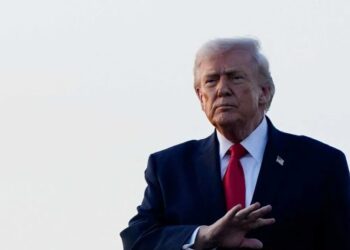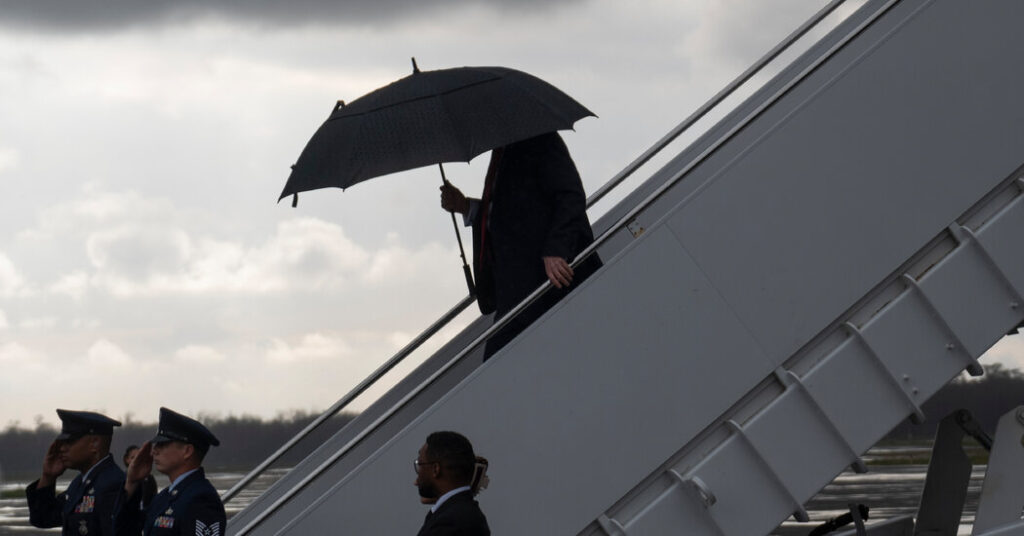
From the moment President Trump won re-election last year, it was clear that major upheavals were coming for the nation’s climate and energy policies. Few could have predicted just how sweeping the overhauls would be.
Yesterday, my colleagues published an article detailing many of the changes. Here is a partial tally of the major environmental policy moves enacted by the Trump administration.
International Diplomacy
On his first day in office, President Trump signed an executive order to withdraw the United States from the Paris Agreement, the pact among almost all nations to fight climate change.
Weeks later, he said the United States would not be contributing a $4 billion donation to the Green Climate Fund, which helps poor countries adapt to climate change.
The administration dismantled the U.S. Agency for International Development, which funded a range of climate programs around the globe.
It has pressured other companies to buy American oil and gas as part of trade negotiations.
And last month, the Trump administration did not send any representatives to COP30, the United Nations climate summit in Brazil.
Environmental Regulations
In March, Lee Zeldin, the administrator of the Environmental Protection Agency, reframed the mission of the agency to focus on promoting economic activity rather than regulating pollution. Since then, the E.P.A. has unleashed changes that have curtailed the government’s ability to limit dangerous pollutants.
It said it would revoke the scientific determination that underpins the government’s legal authority to combat climate change.
It moved to repeal a Biden-era regulation that required coal-burning power plants to cut emissions of mercury, a neurotoxin.
It proposed freezing anti-pollution and fuel-efficiency standards for cars, setting up a clash with California, which has set more stringent standards.
The E.P.A. said it would strip federal protections from millions of acres of wetlands and streams, a move made easier by a recent Supreme Court ruling.
The agency also intends to give utilities an additional year to begin cleaning up coal ash landfills, which can leach toxic metals into nearby waterways.
And it said it would delay deadlines to meet drinking water standards for two harmful “forever chemicals” and roll back limits on four other related chemicals.
Energy
On his first day in office, Trump signed an executive order declaring an “energy emergency” and calling on the government to expand support for fossil fuels while curtailing support for clean energy.
Since then, his administration has opened up more than one billion acres of federal lands and waters for oil and gas drilling.
The E.P.A. has revoked regulations that would have made it more difficult to build natural gas-fired power plants.
And the Energy Department has intervened to stop aging coal plants from being shut down.
At the same time, Trump and his allies in Congress have repealed subsidies for solar panels, wind turbines and electric vehicles.
Trump Administration: Live Updates
Updated
- The Justice Department sues Illinois over a law limiting immigration enforcement.
- Trump administration orders nearly 30 U.S. ambassadors to leave their posts.
- White House invitees are asked about donations to Trump’s ballroom.
Agencies have slowed or stopped federal approvals for new wind and solar projects.
And the administration has repealed or blocked vehicle efficiency standards that would have pushed automakers to shift away from gasoline-burning cars.
All told, companies canceled more than $32 billion in planned clean energy investments in 2025.
Climate science
The Trump administration has defunded climate research, erased scientific data and removed terms like “climate change” from federal websites.
It closed the independent research arm of the E.P.A. and assigned remaining employees the task of approving the use of new chemicals.
It proposed to erase money for climate science in next year’s budget of the National Oceanic and Atmospheric Administration, while eliminating climate laboratories and research on severe storms.
It slashed funding and staffing for the National Climate Assessment, the federal government’s premier report on how global warming is affecting the country. Instead, Chris Wright, the energy secretary, selected five skeptics of climate science to write their own assessment of global warming, which was criticized by dozens of climate researchers who accused them of mischaracterizing scientific findings.
And the administration also said it would break up the National Center for Atmospheric Research in Colorado, a world-leading Earth science research institution.
That’s just a snapshot of the changes we covered this year. We’ll keep reporting on this consequential story in 2026.
Power  ︎ Moves
Chinese batteries, U.S. national security
In Northern Virginia’s Data Center Alley, windowless buildings the size of aircraft hangars are powering America’s artificial intelligence industry, which is locked in a race against China.
Yet these data centers are increasingly reliant on China, America’s geopolitical rival, for a vital technology: batteries.
These facilities can use as much electricity as a small city, straining local power grids. Even flickers can have cascading effects, corrupting sensitive A.I. computer coding.
To cope, tech giants are looking to buy billions of dollars of large lithium-ion batteries, a field in which “China is leading in almost every industrial component,” said Dan Wang, an expert on China’s technology sector at the Hoover Institution, a public policy think tank at Stanford. “They’re ahead, both technologically and in terms of scale.”
A short drive from the data centers, at the Pentagon, military officials are sounding similar warnings, for different reasons. Military strategists, watching as modern warfare is reinvented in Ukraine, say the armed forces will need millions of batteries to power drones, lasers and countless other weapons of the future.
Many of those batteries, too, come from China.
Chinese battery dominance has long been a problem for industries like auto manufacturing, but now is increasingly being viewed as a national security threat. — Hiroko Tabuchi, Brad Plumer and Harry Stevens
And read other articles in our Power Moves series on the battle between the United States and China for the energy future.
Read past editions of the newsletter here.
If you’re enjoying what you’re reading, please consider recommending it to others. They can sign up here.
Follow The New York Times on Instagram, Threads, Facebook and TikTok at @nytimes.
Reach us at [email protected]. We read every message, and reply to many!
David Gelles reports on climate change and leads The Times’s Climate Forward newsletter and events series.
The post Looking Back at a Historic Year of Dismantling Climate Policies appeared first on New York Times.