In ancient times, travelers in Norway avoided paths thought to be inhabited by trolls. According to Nordic folklore, these fearsome creatures lived in the mountains and threatened and harassed humans.
But the Troll Trail, or Trolloypa in Norwegian, is a 100-mile cross-country skiing journey through the Rondane Mountains that finishes in Lillehammer. The route passes through a region laced by over 1,500 miles of perfectly groomed ski trails, a veritable El Dorado of cross-country skiing.
The Troll Trail begins in the town of Hovringen. In 1842, the Norwegian author Peter Christen Asbjornsen visited Hovringen and recorded a fairy tale about Per Gynt, a peasant who confronts menacing trolls in an effort to rescue dairy maids. This inspired Henrik Ibsen’s drama “Peer Gynt” and Edvard Grieg’s Peer Gynt Suites.
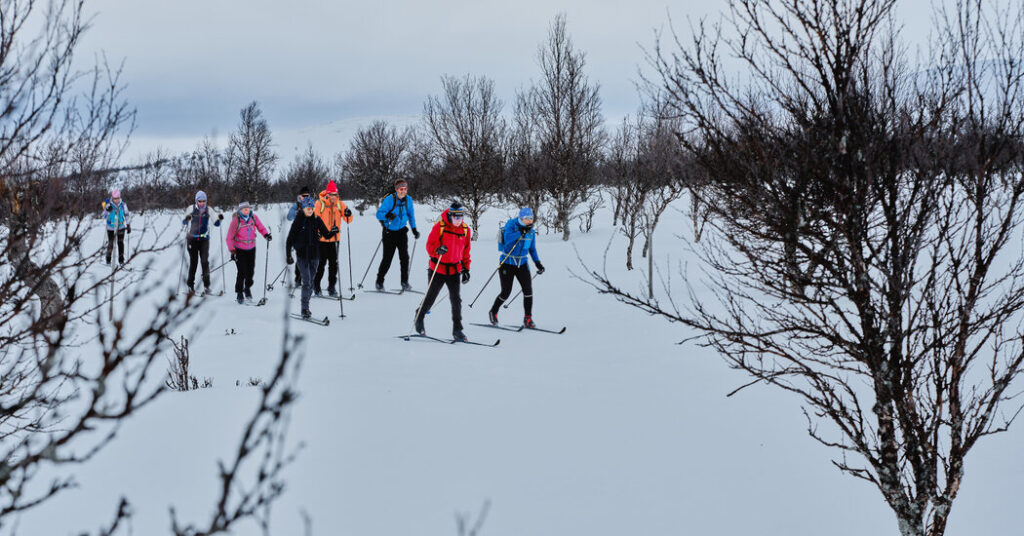
I came to ski the Troll Trail over the course of a week, along with my wife and a group of friends from Vermont, all of us avid cross-country skiers. We booked a self-guided trip with Discover Norway, an adventure travel agency whose founder, Borghild Krossli, conceived of the Troll Trail. Around the time of the 1994 Winter Olympics in Lillehammer, Ms. Krossli worked with local tourism officials to showcase skiing town to town.
We stayed in local hotels for all but one night, which we spent in a cabin. Our luggage was shuttled daily, enabling us to carry light packs containing minimal clothing and food as we skied anywhere from 12 to 23 miles. The Troll Trail is challenging and intended for experienced cross-country skiers, but Discover Norway also offers more moderate tours, such as the Peer Gynt Trail. Other outfitters offer guided trips on the Troll Trail, and you can also make your own arrangements.
After a shakedown day around Hovringen spent testing our rental gear — lightweight metal-edged cross-country skis with a short strip of climbing skins on the base for traction — we settled down to dinner at the Rondane Haukliseter Fjellhotell, a comfortable mountain lodge perched at 3,300 feet overlooking snowcapped mountains. We quickly learned that Norwegians value the gastronomic experience almost as much as the skiing. We were greeted by a long central buffet featuring salmon in just about every form: baked, poached, smoked, grilled, herb encrusted, rolled, lox and gravlax.
“What hamburger is to Americans, salmon is to Norwegians,” the hotel’s owner, Tore Lyftingsmo, said. “We like it a lot.” Following dinner, he offered me a shot of herb-infused aquavit, the gin-like spirit that flows freely throughout Scandinavia. After a day of skiing, I appreciated its warm tingle.
But first, waffles
We headed out the next morning on the trail, which conveniently started at our hotel. The snow-covered Rondane Mountains rose up around us, resembling a landscape of soft vanilla ice cream. My body fell into the familiar cadence of cross-country skiing, arms and legs moving in rhythm to propel me forward. I was in a snowy reverie — until waffles snapped me out of it.
An hour into our ski tour, we stopped at Smuksjoseter, a snowbound mountain lodge alongside the trail. Inside, I was greeted by the smell of coffee and fresh vafler, the traditional heart-shaped Norwegian waffles served with a dollop of cream and lingonberry jam. Waffles here are more than food: They are an expression of kos, the Norwegian notion of simple pleasure. The collective will of our die-hard crew of nine skiers melted like butter on a warm waffle as we all indulged.
We headed back out on the Troll Trail to our next destination, a hotel about 12 miles away. We skied across a windswept plateau following poles planted every 100 feet or so to mark the way. Blowing snow had obscured the groomed ski track, slowing our progress, so we were relieved to see a large grooming machine approach to restore fresh grooves for us to ski in. We glided about six miles downhill and soon found ourselves on the thoroughfare of the small mountain town of Mysuseter. We skied past people out walking or skiing with their dogs, whose paws were clad in protective bootees.
That night we stayed in a former dairy barn that had been converted into comfortable guest rooms. We turned in early to rest up for the most dramatic day of the Troll Trail, skiing 20 miles across the high plateau of Rondane National Park, Norway’s oldest national park.
Skiing into the wind
The morning dawned crisp and clear. We skied around several frozen lakes and began climbing up from the valley floor. A relentless wind formed ripples in the snow known as sastrugi that made the ski surface bumpy and unsteady.
After a 45-minute climb we reached the barren snow-swept plateau that caps Rondane National Park, a 372-square-mile preserve founded in 1962. The vast, snowy desert sparkled beneath a robin’s egg-blue sky. Winter’s drama was on full display here. An avalanche path scarred the face of a distant peak, though the Troll Trail itself is safe from avalanches. Dome-shaped mountains undulated like ocean waves rolling to the horizon.
Suddenly, three Norwegian women appeared, looking a bit shellshocked. Shouting over the wind, they explained that this was their fourth day of skiing into a strong headwind. One woman said coolly that the Troll Trail was “not for everyone.” When I told her our day’s destination, she had a faraway look.
“It’s cold and windy and icy, and you have a long way to go,” she said, as if trying to warn me of a dangerous troll on the trail.
Three smiling Germans approached soon after. They told me it was their third time returning to the Troll Trail, each time skiing a different section. One woman said she didn’t mind the headwind.
“I like to ski slow,” she said cheerily. “I love the nature here. There’s no other place like this.”
When I caught up with my group, they were huddled around a trail sign looking concerned. The sun was dropping toward the horizon and we still had miles to go.
The end of Rondane National Park was marked by the welcome appearance of groomed ski trails. Wind had strafed the trails, leaving them firm and fast. I drafted behind Chach Curtis, a member of my group and a former college ski racer, as he started down the winding trail. His gray jacket disappeared and appeared as he accelerated around each turn, pulling well ahead of me.
I suddenly heard a yelp over the clatter of my skis. I looked up to see Chach standing in the trail holding his poles above his head in an X, the universal distress sign of skiers. I jammed my skis into a hockey stop, desperately fighting gravity as I slid sideways on the frozen corduroy surface. I stopped just above a sharp two-foot drop where the wind had gouged a trough across the ski trail. I looked up at Chach, certain that he must have crashed spectacularly. He was laughing nervously.
“I stuck the landing” he declared, breathlessly.
We soon arrived tired but happy at the Spidsbergseter Resort Rondane, a bustling modern rustic hotel at the center of a 100-mile groomed ski trail network. Our group indulged in an obligatory sauna and hot tub to rest our weary bodies before dinner. The dining room was packed with skiers from all around Europe, creating a happy multilingual soundscape. A gentleman from France told me, “We come each year because it is the best cross-country skiing on the continent, and the most reliable,” noting the 3,000-foot elevation.
There was another draw: the food stations brimming with venison steak, five varieties of salmon, salads and a dessert table featuring lingonberry tart and pecan pie. Waffles with cloudberry jam, a delicacy of northern Norway, were available at all meals.
Luxury in the mountains
The next morning, we traded the drama of the high mountains for the easy flow of cross-country skiing on sun-soaked rolling trails. The towering peaks gave way to softly rounded hills. In the morning, the snow had a sparkling glaze, as if mischievous trolls had spent the night strewing diamonds across the ground.
Our day ended at the warm wood-paneled Vetabua cabin stocked with freeze-dried and canned food where we cooked and played card games. This bit of roughing it provided motivation for our longest day, skiing 23 miles to Pellestova, one of Norway’s premier cross-country ski resorts.
The Pellestova Hotel and its 185-mile trail network are the crown jewel of the Troll Trail. Perched imperiously on a hill with six groomed ski tracks radiating outward, the sleek black building constructed of wood, stone and glass is the hub of an interconnected network of world-class ski trails that extends for hundreds of miles through the countryside. The general manager, Per Christian Nilseng, said that the elegant hotel, which opened in 1946, has been renovated in a style known as nedpa jorda luksus, or down-to-earth luxury.
We finished our day at the hotel bar overlooking a glowing vista. I sipped a Nuet spritz, a refreshing drink made with aquavit, lemonade and sparkling wine, followed by a delicious dinner of delicate flaky arctic char. I could not conjure a more alluring Nordic dreamland.
On our final day as we descended to Lillehammer, I encountered a group of skiers next to the trail grilling sausages over a fire and drinking beer. Dag Hammershaud, one of the skiers, offered his take on what skiing means to Norwegians.
“Skiing is life,” he said.
Follow New York Times Travel on Instagram and sign up for our Travel Dispatch newsletter to get expert tips on traveling smarter and inspiration for your next vacation. Dreaming up a future getaway or just armchair traveling? Check out our 52 Places to Go in 2025.
The post In Norway, Skiing Through a Winter Wonderland appeared first on New York Times.