In our era of hyperpolarization, much of our art this year seemed to agree on one thing: The best vantage for exploring our times was from the political middle.
It was a thought that grew as I saw works of film, stage and TV that explored ideas of racial injustice become some of this year’s biggest critical and commercial successes. I noticed starting last March when I went to see the brilliant box-office hit “Sinners,” and it revved up this fall, with the sweeping film “One Battle After Another”; the Broadway revival of the musical “Ragtime”; and the Tulsa-based TV thriller, “The Lowdown.”
In these, white liberal characters either struggle with their allegiance to racial equality or center themselves in finding solutions.
There is less despair in them than I initially assumed: The really racist characters they depicted were so extreme that audiences could reject self-identification. And yet, these works still propose that there are significant limits on the kind of cross-racial solidarity possible, while agreeing that perhaps the most urgent cultural concern isn’t who is pitted against us, but discerning who our real friends are.
In Joshua Henry’s extraordinary “Ragtime” performance, the character Coalhouse Walker Jr., a Black pianist turned radical, is even more central to this year’s Broadway revival of the show than in the source material of E.L. Doctorow’s 1975 novel, the 1981 movie version or the Broadway original that premiered in 1998. But the biggest character transformation, in this Lear deBessonet-directed production at Lincoln Center Theater, belongs to Father (Colin Donnell), the stoic, upper-class white businessman whose racial conservatism puts him at odds with more progressive members of his family.
Father resists the social changes of the turn of the 20th century, when immigration, the Great Migration and the suffragist movement affected the culture and demographics of the United States, an opposition that feels retrograde compared to the sentiments of some of the musical’s other white characters. Those include the real-life anarchist Emma Goldman; a rebellious brother-in-law, Younger Brother (Ben Levi Ross); and Father’s open-minded wife, Mother (Caissie Levy), who takes in Sarah (Nichelle Lewis) and the baby she had with Coalhouse.
Father’s eventual evolution is prompted by Black suffering onstage. He first confronts his bigotry after Secret Service agents kill Sarah. The final catalyst for Father’s racial awakening happens after Father successfully convinces Coalhouse to turn himself in to end an armed standoff in J.P. Morgan’s library, which leads to Coalhouse being assassinated. Many of my fellow audience members were moved to tears, others stunned into sobering silence, while an older, white male seated nearby turned to me and asked, “Do you think Trump will see this?”
I assumed he thought Trump and Father shared the same racial ideologies. His earnestness in thinking that they could similarly change their minds made me consider the purpose of these deaths and what to make of the fact that neither Sarah nor Coalhouse is alive to be part of the musical’s culminating moment of multiracial optimism.
Specifically, I thought of how Antoinette Chinonye Nwandu rewrote her play “Pass Over” before its Broadway premiere in 2021. Initially, she had conceived of it in response to the killing of Trayvon Martin, and had one of her Black male protagonists, Moses, die at the end. But after George Floyd’s murder, she revised her work, giving the character (and her audience) a more cathartic release to promote healing.
The main relief or resolution that this staging of “Ragtime” offers is that their orphaned child will help inspire a movie that features “a bunch of children, white, Black, Christian, Jew, rich, poor — all kinds — a gang, a crazy gang getting into trouble, getting out of trouble, but together despite their differences.” I left the theater wondering whether progress meant their son would end up becoming a Buckwheat-like character, and if the emotional payoff of Father’s softened tone and liberal conversion was worth this much Black martyrdom.
Disillusionment drives much of the plot of Paul Thomas Anderson’s “One Battle After Another,” in which the white former radical Pat Calhoun (Leonardo DiCaprio) struggles to raise his biracial teenage daughter, Willa (Chase Infiniti), after her Black mother, Perfidia Beverly Hills (Teyana Taylor), leaves. Loosely based on Thomas Pynchon’s 1990 novel, “Vineland,” which was set in Reagan-era America, Anderson updated the story to the present, replacing the book’s hippie protagonist with Pat, now living in hiding under the alias Bob Ferguson, while the racist Col. Steven J. Lockjaw tries to destroy any remnants of the resistance permanently.
Perfidia rats out the revolutionary group, the French 75, that she and Pat are members of, then goes on the lam after rejecting a romantic relationship with Lockjaw. Willa, then living in hiding, learns to take care of herself as her disillusioned father spouts empty radical slogans, watches old war movies like “The Battle of Algiers” and smokes weed. Throughout the movie, Pat’s ineptitude as a father mirrors his ineffectiveness as a revolutionary, a tension that Perfidia’s mother captures early on when she tells him: “My child comes from a long line of revolutionaries, and you look so lost. She’s a runner, and you’re a stump.” She adds with worry, “What you going to do about this baby?”
How Pat eventually responds to that anxiety is what makes the film visually sensational and politically vacuous, and one in which the white liberal figure never quite fulfills his potential. With her mother permanently out of the picture and the other formative Black women of the French 75 dead or in jail, Willa is left to do the hard work of the revolution alone, with her father’s blessing, but without him by her side.
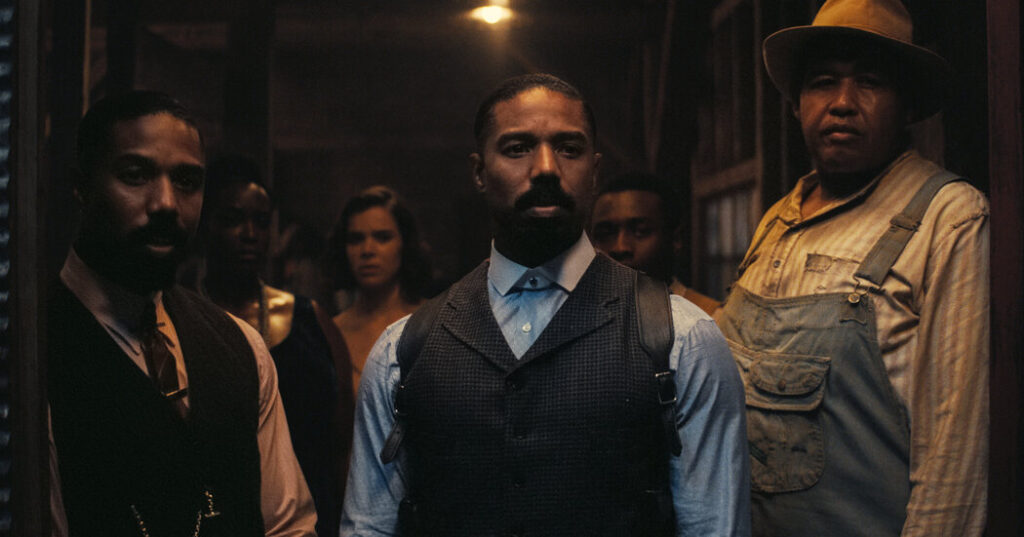
Ryan Coogler’s “Sinners” proposes different limits for the movie’s white liberal character. Taking place in the 1930s, the movie follows twin World War I veterans, Smoke and Stack (both played by Michael B. Jordan), as they seek fortune, family and freedom by building a juke joint in the heart of the Mississippi Delta. Initially, the biggest threat to their livelihood seems to be the white supremacists who violently uphold the racial order of the Jim Crow South. But the duo quickly realize that it is the vampire Remmick — disguised as an Irish banjo player eager to play the blues — who poses the threat to the Black club dwellers.
Remmick is unmasked as a vampire trying to gain entrance into Smoke and Stack’s place to take hold of the bluesman Sammie (Miles Canton), whose musical talent Remmick believes can connect him to his Irish ancestors. He tries to lure the nearly all-Black clubgoers with a multiracial vision that will never be actualized in America except through their dying and becoming immortal and singing all together. Oppression, he argues, can’t be overcome in the here and now, but it links their eternal fates. It’s a pitch he successfully makes earlier to a Ku Klux Klansman and his wife, resulting in the undead couple sharing in his Irish folk songs.
But Remmick’s version of solidarity is co-option. With Sammie in his arms, he begins to drown (and vampirically baptize) the bluesman, who is the son of a preacher. As the two men recite the Lord’s Prayer together, Remmick reverts to his original Irish accent, aligning the Irish struggle for independence from England with that of African Americans like Sammie whose oppressors also imposed religion. “Long ago, the men that stole my father’s land forced these words upon us,” he tells Sammie. “I hated those men, but the words still bring me comfort.”
As Remmick says those words and seamlessly slips back into his Southern dialect, I was reminded of how successfully he used racial solidarity to convince the Klansman, Bert, and his wife, Joan, to enter their house, resulting in the undead couple joining him. He rightly assumed that they’d trust an Irishman who would kill them rather than their Black neighbors whom they sought to terrorize (or the Indigenous men who tried to warn of the impending threat).
Overcoming such divisions, however, is at the heart of “The Lowdown,” Sterlin Harjo’s latest Hulu drama series since his acclaimed “Reservation Dogs.” Starring Ethan Hawke as Lee Raybon, a self-proclaimed “truthstorian” and citizen journalist bent on exposing political corruption in Tulsa, Okla., the show comically deconstructs the white liberal figure as both well-meaning, self-conscious and unreliable.
In Episode 6, “Old Indian Trick,” for example, Lee needs to track down a lead at an Indian community center, but he is too worried about appearing as a conspicuous cliché to pose as a costumer: He ends up paying his Native American employee, Deidre, to accompany him, heightening his outsider status even more. Later, his attempt at white savior-ism fails terribly: He divulges a Native family’s secret to a trusted white character who sells them out. Lee comes to understand that his naïveté can have dire consequences for the vulnerable people of color around him. It is only when he acknowledges these flaws and convinces other white characters to do the same that true reconciliation and repatriation can begin.
But, even in this imagining, we are reminded that racial justice has its limits. It is one thing to depict people of color dying or disappearing to diagnose the problem of inequality; it is something else, far more tragic, when their suffering becomes the precondition for white allyship.
Salamishah Tillet is a contributing critic at large for The Times and a professor at Rutgers University. She won the Pulitzer Prize for criticism in 2022, for columns examining race and Black perspectives as the arts and entertainment world responded to the Black Lives Matter moment with new works.
The post In 2025, They Asked What Racial Solidarity Really Looks Like appeared first on New York Times.