JERUSALEM — Under the cover of darkness, the helicopters from Israel began to arrive in southern Syria on Dec. 17, 2024, nine days after the ouster of former president Bashar al-Assad.
Packed alongside pallets of humanitarian aid were 500 rifles, ammunition and body armor — all discreetly airdropped by Israel to arm a Druze militia called the Military Council, according to two former Israeli officials directly involved in the effort.
The weapons shipments came in response to the sudden rise of Ahmed al-Sharaa, an Islamist militant formerly known by his nom de guerre Abu Mohammed al-Jolani and who had overthrown Assad. Israel viewed Sharaa with profound suspicion because he had led an armed group formally linked, until a decade ago, to al-Qaeda, which is vehemently opposed to Israel’s existence. Sharaa continues even now to have extremist fighters in the ranks of his supporters.
An increasingly dominant force in the Middle East, Israel has been seeking to shape developments in Syria by supporting allied Druze militiamen as part of an effort to weaken the country’s national cohesion, current and former Israeli officials said, and thus complicate Sharaa’s efforts to unify the country after its long civil war.
The covert Israeli supplies were part of a long-running effort to prop up the Druze — a religious minority that has traditionally played a role in the politics of several Middle Eastern countries, current and former Israeli officials said. And that effort continues until today, a Washington Post investigation has found.
The flow of weapons peaked in April, after Syrian Druze fighters clashed with Islamist gunmen aligned with Sharaa. And it ebbed in August after Israel pivoted to negotiating with Sharaa and doubts emerged among Israeli officials about the reliability of the Syrian Druze separatists and the feasibility of their aims.
But Israel continues to carry out airdrops of nonlethal military equipment such as body armor and medical supplies to Syrian Druze fighters, effectively undermining Sharaa’s ability to centralize power, according to Druze leaders in Syria and a former Israeli official. Israelis are also providing monthly payments between $100 to $200 to about 3,000 Druze militiamen, two Druze officials said, further demonstrating that it continues to maintain a counterweight to the central Syrian government.
The Post spoke with more than two dozen current and former Israeli and Western officials, government advisers and Druze militia commanders and political leaders in Syria, Israel and Lebanon for this report. Many of the people interviewed for this article spoke on the condition of anonymity to describe the inner workings of Israeli support for the Syrian Druze, which contained elements of covert cooperation that have never been publicly acknowledged or previously reported.
The Israel government’s overarching strategy since the fall of Assad has been ensuring that a regime with the capability to threaten Israel does not emerge on its northeastern border, and officials believe Washington is naive when it accepts Shaara’s insistence he has given up his extremist views.
Israel also says it remains committed to the Druze, who are spread across several Middle Eastern countries. Israel’s ties with the Druze, followers of a monotheistic religion that differs from both Islam and Judaism, go deep. They have played a prominent part in Israel, including by serving in senior positions in the Israeli military and government, and are therefore seen as a natural ally in Syria to many within the Israeli defense establishment.
Israel’s aid to the Syrian Druze has reflected its distrust of Sharaa and its long history of quiet intervention in a neighboring country long fragmented by civil war. Israel’s resistance to allowing Sharaa to unify the country — including through its continued support for the Druze — has been a source of tension between Jerusalem and Damascus and between Israel and the Trump administration, which has made support for Sharaa a key plank of U.S. regional policy. Many in the administration as well as in Congress are betting on Sharaa to restore stability to Syria, thus reducing tensions in the wider region, potentially clearing the way for millions of refugees to return home and helping curtail Iranian influence in the Middle East.
In a recent interviewin Washington shortly before he met President Donald Trump at the White House, Sharaa told Post journalists that Israel’s support for separatist movements was driven by its “expansionist ambitions” and risked igniting “broad wars in the region, because such expansion will create a threat to Jordan, Iraq, Turkey and the Gulf States.”
But Israel and Syria have “gone a good distance on the way to reach a [de-escalation] agreement,” Sharaa added, saying that he hoped Israel would withdraw its troops from territories it seized earlier this year and “not give space to parties or actors that don’t want Syria to be stable.”
Israeli officials say that although they distrust Sharaa given his earlier history as leader of an al-Qaeda affiliate, Israel has shown pragmatism by circumscribing its support for the Syrian Druze, dialing back military pressure on Syria and giving negotiations a chance in recent months.
After Trump first shook hands with Sharaa in May, Israel in August halted the flow of weapons to the Druze, Israeli and Druze officials say. Internally, Israeli officials have shelved discussions to turn the Syrian Druze into an Israeli armed proxy militia amid concerns about infighting among Syrian Druze leaders and the risk of Israel becoming entangled in Syria, according to Israeli officials and government advisers.
“We were helping when it was absolutely necessary and are committed to minorities’ security, but it is not as if we are going to have commandos take positions next to the Druze or get in the business of organizing proxies,” said an Israeli official, who described Israel’s support for the Druze as carefully calibrated. “We are trying to see how things develop there, and it’s no secret that the American administration is very much in favor of a deal.”
There has also been a growing recognition within Israel, the official added, that not all Druze have rallied around the Syrian Druze spiritual leader Sheikh Hikmat al-Hijri, who has been leading calls for splintering from Damascus with Israeli help.
In response to a request for official Israeli comment, an Israeli government official said, “After Oct. 7 [attacks by Hamas], Israel is determined to defend our communities on our borders, including the northern border, and to prevent the entrenchment of terrorists and hostile actions against us, to protect our Druze allies, and to ensure that the State of Israel is safe from ground attack and other attacks from the border areas.” The official spoke on the condition of anonymity. The Israeli military declined to comment for this article.
Some Israeli and American analysts argue that Israel’s aggressive use of military force in Syria and its clandestine efforts to promote Druze separatism were counterproductive and undercut relations at a time when Sharaa appeared eager to reach a diplomatic détente.
“There has been growing frustration in Washington that Israeli actions were setting back something most of Washington and everyone in the Middle East would actually like to see succeed: a stabilized, unified Syria,” said Dana Stroul, a former senior Pentagon official during the Biden administration who has closely studied the country. “The basic argument to Israel is, look, you actually have leaders in Damascus who are willing to say the word ‘Israel’ and talk about a potential future with normalized relations, yet you just keep bombing or looking for a surrogate to work through.”
On the brink
Months before Assad’s fall, officials within Israel’s security establishment already understood that the Middle East may be on the brink of sweeping change.
Israeli military and intelligence operations in 2024 had weakened key allies of Assad, Iran and the Lebanese militant group Hezbollah, increasing his isolation. Druze leaders in Israel sought out a Syrian Druze counterpart who could help lead the 700,000 Druze in Syria in case the Assad regime collapsed, the two former Israeli officials directly involved in the effort said. They turned to Tareq al-Shoufi, a former colonel in Assad’s army.
One of those former Israeli officials recalled tapping “20 men with military experience, dishing out ranks and tasks, and beginning to work on what was called the ‘Military Council’” in the Druze stronghold of Sweida province in southern Syria. At the time, the Military Council, led by Shoufi, enjoyed the support of Sheikh Hijri, a fiery, 60-year-old Venezuelan-born Druze cleric who has called for the establishment of a self-governing Druze state backed by Israel, another founding member of the council said.
To help Shoufi renovate an old building as a command center and buy uniforms and basic equipment, Druze members of the Israeli security establishment funneled him $24,000 via the Syrian Democratic Forces (SDF), a Kurdish-led militia that also maintains ties to Israel, said one the former Israeli officials. The official added that the money was meant to tide over the Council until the Assad regime fell. Around the same time, up to half-million dollars were separately sent by the SDF to the Military Council, said the former Israeli official and two Druze commanders in Syria.
To help the Druze cause, the SDF also trained Syrian Druze, including women, in Kurdish areas in northern Syria — a relationship that continues to this day, according to a senior Kurdish official, a Syrian Druze commander and a former Israeli official. A spokesman for the SDF’s political wing did not respond to requests for comment.
Meanwhile, Hijri, the spiritual leader, prepared maps of a proposed future Druze state stretching all the way to Iraq and pitched it to at least one major Western government in early 2025, a Western official recalled.
Scrambling the Apaches
When Assad fell on Dec. 8, 2024, following an 11-day, lightning offensive led by Sharaa and his militant group, Hayʼat Tahrir al-Sham, Israel sprang into action.
Immediately, Israeli land forces entered Syria and seized 155 square miles of territory, including additional positions atop Mount Hermon, a strategic peak straddling the Syria-Lebanon border. The Israeli Air Force launched hundreds of airstrikes on Syrian military installations to deny the new Syrian leader access to weapons. And within ten days, a colonel in the Israel Defense Forces’ Northern Command scrambled Apache helicopters to ferry rifles, cash and humanitarian supplies to bolster the Druze, a former Israeli official said.
The weapon shipments reached a peak in late April amid Israeli concerns that the Druze community could be in jeopardy. As religious tensions spiked in Syria, clashes had eruptedbetween Islamist gunmen backing Sharaa’s new government and Druze fighters, leaving scores dead. Israeli officials, fearing the Druze may be overrun, besieged or slaughtered, publicly vowed to protect the minority.
They responded by sending mostly used weapons that Israeli forces obtained from dead Hezbollah and Hamas fighters, said a former Israeli official, a Druze commander in Syria and a financial middleman. One Syrian Druze militia leader recalled also receiving sniper rifles, night vision equipment and ammunition for 14mm and 23mm heavy machine guns. From their Kurdish counterparts, some Druze leaders also obtained anti-tank missiles and battlefield imagery from Israeli satellites, two Druze militia commanders in Sweida said.
Pushing to arm a proxy
On the ground, Israeli troops established what they called a buffer zone, where they provided the Druze residents of 20 villages with “wood, petrol, diesel, food, a little bit of water,” as well as medical treatment at an army clinic set up outside the Druze village of Khader, an Israeli military official said.
Within the Israeli government, the Coordination of Government Activities in the Territories unit (COGAT) of the Israeli Defense Ministry created a new administrative office to coordinate sending humanitarian and other aid, including light arms, to the Syrian Druze, said Hassoun Hassoun, a former Israeli brigadier general and presidential military secretary who was involved in the assistance effort.
Hassoun, who is Druze and close to Hijri, led a faction within the Israeli security establishment that argued Israel should throw its full weight behind the Syrian Druze as an armed proxy in Syria. “Israel needs to move up a gear and conduct itself as a strategic power, one that will build alliances with all kinds of people and proxies and turn them into people who are loyal to it and to whom it is loyal,” Hassoun said in an interview.
Israeli officials supported arming the Druze based on two considerations, an Israeli official said. They broadly viewed American and European efforts to work with Sharaa as “naive,” seeing him as an unreformed Islamist militant who posed a threat to Israel if allowed to accrue power. They also felt a moral obligation to protect the Syrian brethren of the influential Druze community in Israel.
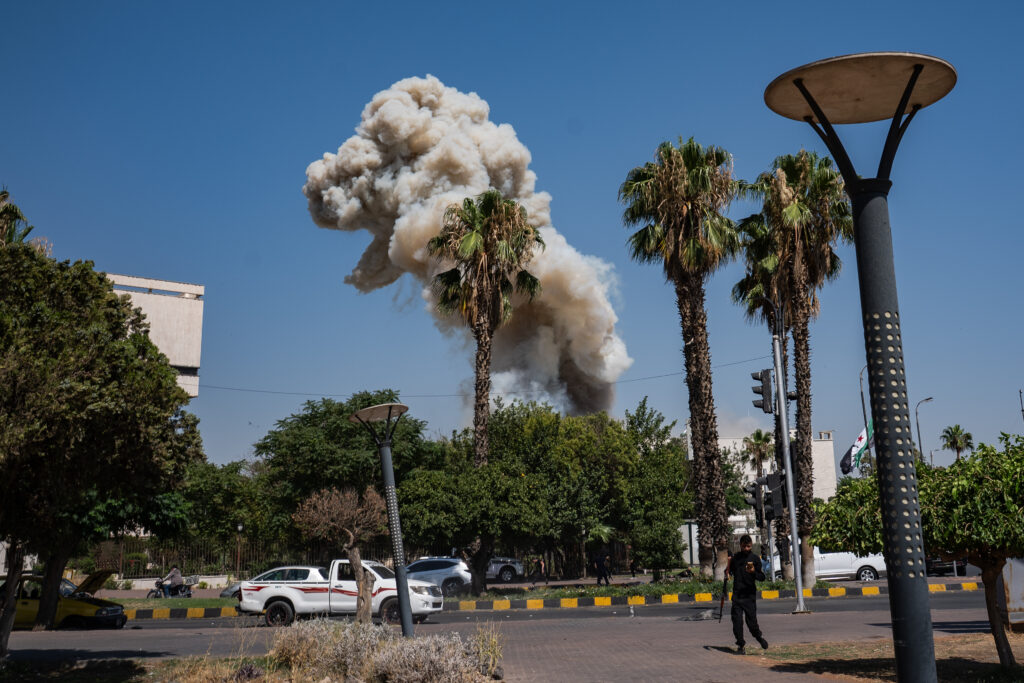
The pressure on Israeli Prime Minister Benjamin Netanyahu to intervene in Syria heightened in July after Sunni Muslim gunmen and Syrian government forces clashed again with the Druze in Sweida. The violence left more than 1,000 people dead, human rights groups said, and the Druze heartland besieged. The Israeli military, in response, bombed Syrian forces and the Defense Ministry in Damascus.
A history of covert support
Israel’s fears of an Islamist takeover next door — and its intervention in Syria — reach back years. After Syria descended into civil war in 2011, Israeli military officers entered Syria to train Druze militias and provided weapons and medical treatment to other rebels, often in coordination with Jordan and the United States, three former Israeli officials said.
Tamir Hayman, a former Israeli military major general and head of its northern command, which oversees the Syrian front, declined to discuss Israeli support for the Druze today but said that during the Syrian civil war, Israel and Jordan aided groups that were seen as hostile to Sunni Muslim extremists.
“There was joint interest between Israel and those local rebels to fight or defend the Israeli border from the Islamic State,” recalled Hayman. “In return for that, we provided logistics that was mainly medical treatment in Israeli hospitals, water, gas supply, and occasionally even some weapons.”
Today, Israeli analysts warn that propping up an autonomous Druze state or proxy militia would represent a far different mandate than cooperating with them to secure Israel’s border. One government adviser noted that Israel did not have a “good experience in south Lebanon,” where it supported a pro-Israel militia called the South Lebanon Army for two decades before the group crumbled in the face of Hezbollah advances in 2000.
Backing an independent state would create a situation where “Israel needs to now defend a population that’s 100 kilometers away from the border,” the Israeli adviser said. “If we have an interest here, it’s not to create an independent Druzistan.”
Israeli officials also grew wary of the internal power struggles that emerged among the Syrian Druze. In August, Hijri maneuvered to be recognized as the sole legitimate military authority among the Syrian Druze, and the “National Guard,” a new militia led by Hijri and his son Suleiman, replaced the Military Council as the recipient of weapons from Israel, according to a Syrian Druze commanders and the two former Israeli officials directly involved.
The move ignited schisms among Druze commanders. Shoufi, the former Military Council leader, was accused of collaborating with Sharaa and went into hiding, fearing arrest by Hijri’s men. Hijri, meanwhile, has been accused of kidnapping and his son of dealings with regional drug-smuggling networks, including Hezbollah, according to a former Israeli official, a Druze commander in Syria and a financial middleman.
“The Israelis know they have no one to work with on the other side — certainly not in any long-term capacity,” said one of the former Israeli officials involved in the effort.
Three people close to Hijri — a son, an adviser and a nephew — did not respond to detailed questions and requests seeking comment from The Post. Shoufi could not be reached for comment.
Medicine, body armor and cash
In the weeks leading up to the United Nations General Assembly in September, when Israeli officials were discussing a potential meeting between Netanyahu and Sharaa in New York that did not ultimately materialize, Syrian officials made clear that they did not wish for Israel to facilitate Druze separatism, the Israeli government adviser said. A proposed security agreement between Israel and Syria fell apart partly because of Israeli demands about guarantees for the Druze, including a walled humanitarian corridor stretching from Israel to Sweida, the adviser added.
Today, Israeli officials and others briefed on their thinking say the situation in Syria — and Israel’s policy toward the Druze — remain fluid. In November, Netanyahu visited Israeli troops inside occupied Syrian territory, which Syria sharply criticized as a violation of its sovereignty. Israel has demanded during talks over a bilateral security agreement that southern Syria be demilitarized and Syrian forces do not enter Sweida without prior coordination with Israel, a former Israeli official involved in the negotiations said. In his interview with The Post, Sharaa rejected Israel’s demand that the region of Syria south of Damascus be demilitarized.
Israel also will continue to push in its talks with Sharaa for “institutional autonomy” for the Druze, said one of the Israeli officials, who added that aid shipments from Israel continue but are smaller and less frequent.
In an official statement, an Israeli government officials said, “Israel expects Syria to establish a demilitarized buffer zone from Damascus to the buffer zone area, including the approaches to Mount Hermon and the summit of Mount Hermon. … It is possible to reach an agreement with the Syrians, but we will stand by our principles, including permanent protection for our Druze brothers and sisters, who were massacred this summer in atrocities reminiscent of October 7th.”
As recently as late September, Israeli helicopters ferried medicine and defensive military supplies, including body armor, to Sweida, according to Druze leaders in Syria and a former Israeli official. And the monthly payments to roughly 3,000 National Guard fighters have continued, two Druze officials said.
Carmit Valensi, a Syria expert at the Institute for National Security Studies in Tel Aviv, said Israel’s initial embrace of certain separatist Druze leaders like Hijri has waned and there are doubts about whether it would be realistic to provide too much assistance, such as electricity and water to a breakaway Druze state.
“Israel should acknowledge that there’s a limit to what extent we should interfere in domestic issues, especially while we’re conducting dialogue with a regime trying to reach a security agreement,” Valensi said. “As long as there is a stalemate and they’re not reaching a security agreement, I believe Israel will continue to support the Druze.”
Kareem Fahim and Louisa Loveluck in Sweida contributed to this report.
The post How Israeli covert activities in Syria seek to thwart its new government appeared first on Washington Post.