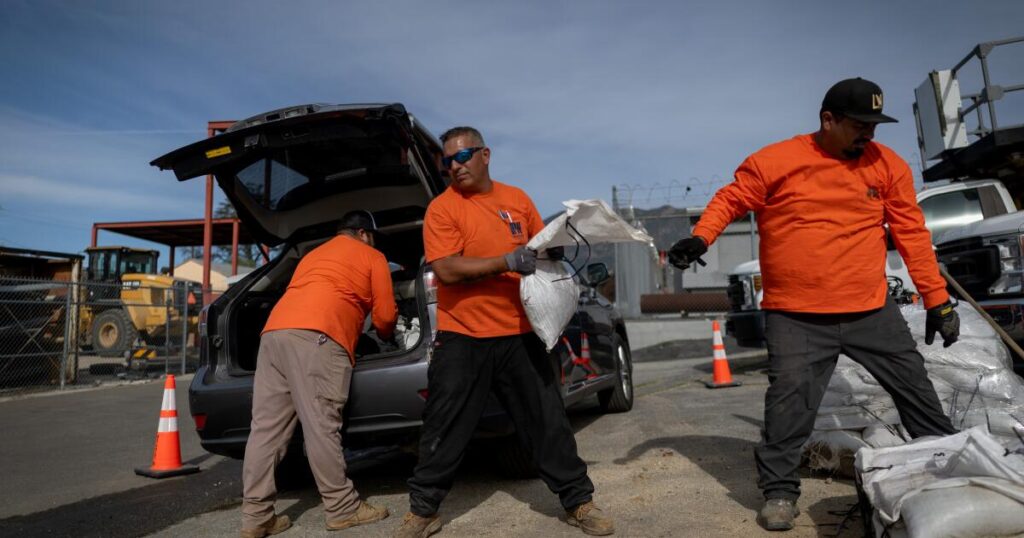
Southern California is bracing for record rainfall this week, with forecasters predicting five straight days of precipitation through the holiday.
Travelers should proceed with caution, county emergency officials warned. With peak rainfall expected Tuesday night through Thursday, safety crews had already begun to close roads along the coast and were knocking on doors to advise residents at vulnerable addresses to evacuate.
“There will almost certainly be numerous mudslides, severe flooding either from heavy rain or clogged storm drains, and possibly debris flows near recent burn scars,” the National Weather Service said.
Key warnings
Los Angeles city and county officials issued evacuation warnings ahead of the storm for several high-risk areas:
- Near the San Gabriel foothills hillsides of Altadena in the Eaton fire burn area.
- Near Pacific Palisades and Mandeville Canyon in the Palisades fire burn area.
- South of Runyon Canyon near the Sunset fire area.
- Near Soledad Canyon Road and Agua Dulce Canyon Road in the Lidia fire and Agua Dulce fire burn areas.
- Near Hasley Canyon and Val Verde in the Canyon fire burn area.
- Near Sylmar and San Fernando hillsides in the Hurst fire burn area.
- Near Sierra Madre foothill and canyon areas.
- North of Alizia Canyon Drive in the Kenneth fire burn area.
- Near Topanga Canyon in the Owen fire burn area.
- Near Mt. Baldy around Glendora Ridge Road in the Bridge fire burn area.
- Near Mulholland Highway, East Lake Shore Drive in the Franklin fire and east Palisades fire areas.
All evacuation warnings are in effect from 11 a.m. Tuesday through 11 p.m. Thursday.
Critical evacuation warnings and orders will be updated throughout the storm event here.
Wednesday will also bring a heightened risk for flash floods in Los Angeles, Ventura and San Bernardino counties, according to the NWS. The “high risk” area is just north of the city of Los Angeles and includes Altadena, Burbank, Glendale, Thousand Oaks and Santa Clarita.
Road closures announced
Road and lane closures were announced in coastal areas Monday.
- Caltrans will fully close a 3.6-mile stretch of Topanga Canyon Boulevard/State Route 27 between Pacific Coast Highway and Grand View Drive in Topanga at 9 p.m. Tuesday.
- Pacific Coast Highway/State Route 1 will remain open through the Palisades fire recovery work zone, which is from Sunset Boulevard to Carbon Beach Terrace, with crews pre-positioned at locations that are most susceptible to debris flows.
- Malibu Canyon Road is closed except to emergency vehicles between Francisco Ranch Road and Piuma Road starting 8 p.m. Tuesday.
- Tuna Canyon Road will be fully closed between 3400 Tuna Canyon Road and Pacific Coast Highway starting 8 p.m. Tuesday.
Closures will remain in place until rainfall subsides and crews can safely clear debris and reopen the roadways, authorities said.
Travelers are advised to plan alternate routes and to avoid driving in rainstorms. Officials warned that power outages and traffic signal failures are also possible, and additional closures are likely.
A countywide road closure map is available here.
Mudslide safety
- An intense rain (typically about half an inch per hour) on a recently burned slope can trigger a debris flow, even if it is not raining heavily where you live. Just a few minutes of intense rainfall can be enough to start one.
- Debris flows move fast and can hit areas that have not been affected before. If you wait to see whether a debris flow is coming your way, it may be too late to leave safely.
- Residents near steep slopes or burn scars should identify the highest nearby point in their home, such as a second-story room or roof, and be prepared to move quickly. Survivors often describe hearing cracking, breaking or roaring sounds before a debris flow hits.
- The National Weather Service will issue a flash flood watch or warning for your area when rainfall is anticipated to be intense.
- Be aware that the soil may be waterlogged and that more rain can trigger debris flows.
Driving in heavy rain
1. Don’t enter flooded streets. If you’re unsure, turn back. As little as 6 inches of water can cause cars to stall or knock an adult off their feet. Two feet of water can sweep away a vehicle, including SUVs and pickup trucks.
2. Turn on your headlights. If windshield wipers are on, headlights should be on — it’s the law.
3. Drive slowly. Speed limits are not minimums. Leave extra time and use added caution.
4. Don’t tailgate. Wet roads increase stopping distance.
5. Check your tires. Proper inflation and tread can reduce the risk of hydroplaning.
6. Watch our video.
The post Holiday storm: SoCal evacuations, road closures and safety tips appeared first on Los Angeles Times.