In early December, Germany’s centrist government didn’t have the votes to pass a law to save the country’s teetering pension system. A group of 18 coalition lawmakers balked at the cost, robbing the government of its parliamentary majority.
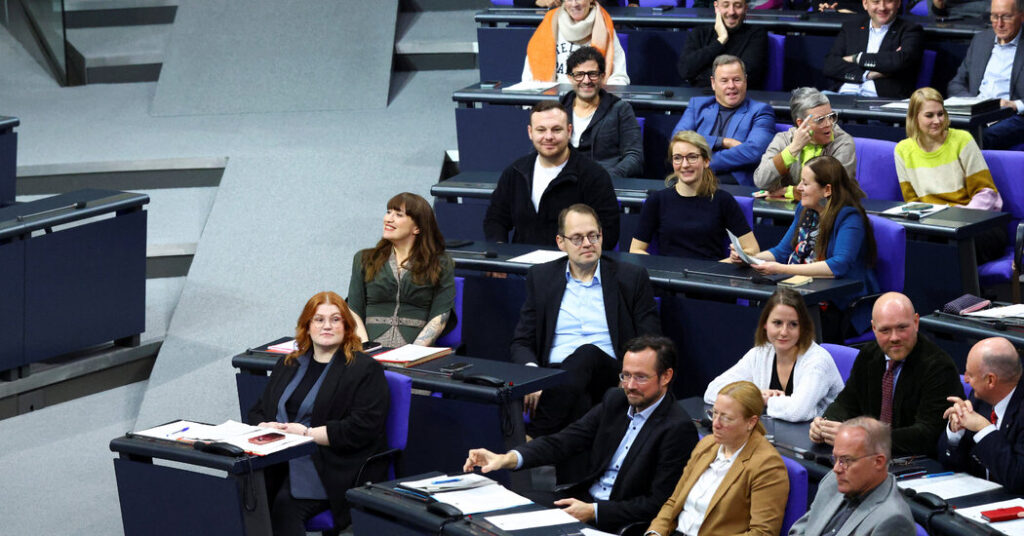
The bill was rescued at the last minute by an unlikely savior: The far-left Die Linke party and its 64 opposition lawmakers, who have rarely exerted so much political influence since the party’s founding nearly two decades ago. The party abstained from the vote, sufficiently lowering the size of the majority needed for the law’s passage — the latest example of how the far left has emerged as a key tiebreaker in German politics.
Since the fall of communism and the reunification of Germany more than three decades ago, the German far left has played a much more peripheral role. Parties from the center left and center right have taken turns in leading coalition governments, while Die Linke — a far-left party co-founded by former members of East Germany’s Cold War-era Communist Party — has remained in opposition.
Now, that center is cracking under pressure from the far-right Alternative for Germany, or AfD, which controls about a quarter of the seats in Parliament. Desperate to avoid relying on the far right, Germany’s establishment parties are turning to the far left for support — an unofficial alliance that could prove key to the government’s survival, or its undoing.
For its part, Die Linke — its name means the Left — has deployed its leverage in savvy ways, taking advantage of repeated opportunities to become something of a power player in German politics. In May, the party helped Friedrich Merz, the leader of Germany’s main center-right party, secure the chancellorship. In September, it helped Mr. Merz make a key judicial appointment.
The party says it has won important concessions from the government by lending it support — and prevented the far right from gaining influence. “Being pragmatic and being socialist — those are not contradictions,” said Ines Schwerdtner, who has been the party’s co-leader since October 2024.
When the current centrist alliance took office in May, many observers expected Die Linke, which still has many senior members who aspire to turn Germany socialist, to use its weight to impede the coalition’s legislation.
Such blocking power could be especially problematic for the government during votes on constitutional questions, which require a two-thirds majority, far more than the coalition has on its own. The two parties in the alliance, Mr. Merz’s center-right Christian Democrats and the center-left Social Democrats, control just over half of the 630 seats in the lower house of Parliament.
“On the evening of the election, a journalist said to me, ‘Now that you have this two-thirds majority going, you can block everything,’” Ms. Schwerdtner said. “I was like, Oh! We didn’t realize before that this could be an option.”
But instead of playing hardball, Die Linke has thrown the coalition a lifeline on several high-profile votes.
On May 6, the new government’s first day in power, Mr. Merz, the incoming chancellor, failed to win what was supposed to be a ceremonial vote of affirmation. To avoid the added embarrassment of having to wait several days to try again, he needed a two-thirds vote to change the rules.
Mr. Merz and his party despaired. Then Alexander Dobrindt, the incoming interior minister, remembered that he had the personal cellphone number for Janine Wissler, a member of Die Linke’s executive committee in Parliament.
After a quick back and forth, Die Linke agreed to provide the necessary votes, on the condition that Mr. Merz’s party publicly thank them.
It was most likely a bitter pill for the Christian Democrats, who officially refuse to work with Die Linke, which they consider an extremist party — but which they will have little choice but to rely on in the future.
“The fact that Chancellor Merz was elected on the first day, at the end, is due to the fact that we took responsibility,” said Bodo Ramelow, a senior member of Die Linke’s Parliament delegation.
Another similar moment occurred in September, when Die Linke provided the necessary votes for a nominee from the Christian Democrats for the federal Supreme Court. Again, a two-thirds majority was needed. Once more, Die Linke stepped in.
But watching Die Linke vote for a conservative judge angered many of its more ideological supporters. Writing in the left-wing magazine Jacobin, Fabian Nehring, a party member, called it “pre-emptive obedience.”
There is concern that too much compromise will risk turning off the tens of thousands of new, mostly younger and idealistic members who have flooded into the party over the past year.
“Younger party members are relatively open about expressing their opinion very quickly,” said Uwe Jun, a political scientist at the University of Trier. “The question will be whether they will now be able to keep these many younger voters and members to themselves in the long term.”
There is also some debate among members, and among Germany’s political observers, about where this all goes. Die Linke remains a small opposition party, and no amount of pragmatic maneuvering is going to push the coalition to support its agenda.
The leadership of Die Linke sees things differently. They say that their vote on the judicial nomination was a matter of democratic principle. Otherwise, the coalition would have needed the support of the far-right AfD, which several German states have labeled extremist.
And they insist that without their abstention during the pension vote, the breakaway conservative faction would have negotiated significant concessions from the coalition, severely weakening retirement support for millions of Germans.
“Socialist politics is always tangible,” Ms. Schwerdtner said. “And stopping cuts to millions of pensions is exactly that.”
Analysts are split over whether Die Linke’s newfound role hurts or helps the centrist governing coalition. On the one hand, it has helped the government enact its agenda. On the other, it risks energizing dissident factions within the coalition who feel that its informal relationship with Die Linke risks legitimizing a party they deem to be extremist.
One party unhurt by the far left’s pragmatism is Die Linke itself. A poll by Ipsos in early December found that if the next federal election were held then, Die Linke would have received 10 percent of the vote, up more than a point from February and just behind the left-leaning Greens and the center-left Social Democrats.
“I think a big part of our base understands perfectly well that we acted in the interest of ordinary people,” Ms. Schwerdtner said of the pension vote. “People in this country deserve stable rents just as much as they deserve institutions that actually function.”
Clay Risen is a Times reporter on the Obituaries desk.
The post German Leaders, Undercutting the Far Right, Are Leaning on the Far Left appeared first on New York Times.