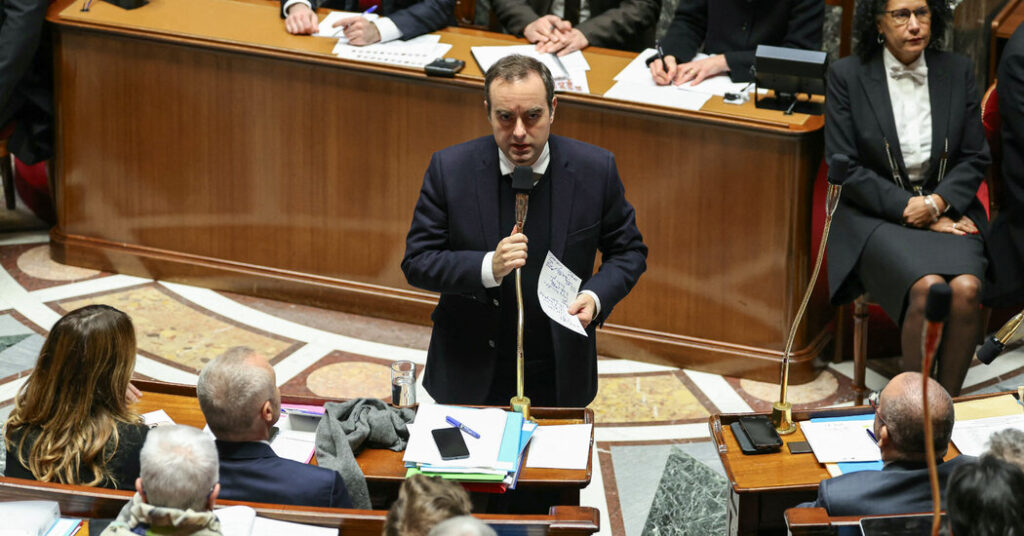
The French Parliament voted on Tuesday evening to pass a special law that will keep public services funded through January, after lawmakers failed — for the second consecutive year — to agree to a new national budget by the end of the legislative calendar.
The failure to agree on a new budget reflected the political paralysis that has afflicted France since a general election 18 months ago brought a hung Parliament. No faction currently controls a majority of lawmakers, meaning that the centrist government appointed by President Emmanuel Macron has had to search — often unsuccessfully — for compromises with lawmakers from opposition parties.
Still, the passage of the special law gave the government some respite, because it granted Mr. Macron’s choice as prime minister, Sébastien Lecornu, more time to reach a deal. Mr. Lecornu’s two predecessors were ousted after failing to finalize a budget, but at least for now, he appeared to have persuaded opposition lawmakers against bringing down his government with a vote of no confidence.
Marine Le Pen, the far-right leader, summarized that spirit of compromise in a speech in Parliament on Tuesday, proposing a “Christmas truce” and saying that the holidays offered an opportunity to “take a break from political combat.”
Still, senior government officials said the temporary budget measures should not be celebrated, given France’s large deficit. The special law allows the state to use the previous year’s budget to keep basic state operations running, but it is only a temporary solution until a full new budget is passed and delays long-term decisions.
“We need a budget in January, and our deficit must be reduced to less than 5 percent of G.D.P. by 2026,” Mr. Lecornu said in a speech on Tuesday evening. “I remain convinced that this is possible if political calculations are put aside,” he added.
During a special cabinet meeting on Monday, Mr. Macron said the special legislation was “not satisfactory,” according to Maud Bregeon, the government spokeswoman. “It’s a stopgap measure, a Band-Aid that gives us the right to take a few extra days or weeks to discuss,” Ms. Bregeon said.
With no national budget, France cannot meaningfully address the country’s ballooning debt, officials said. The country’s public debt reached about 3.5 trillion euros — about $4 trillion — in September, according to a report by the French statistics agency published last week. The country ranks third behind Greece and Italy among the most indebted countries of the eurozone.
Lawmakers have struggled to find a way to address the challenge of a Parliament that is gridlocked among several political blocs. Conservatives have fiercely pushed for spending cuts and supported tax reductions, while socialists have called for taxes on the rich and rejected cuts on social spending. Lawmakers on the far right and the far left have refused to negotiate with Mr. Lecornu.
Budget negotiations collapsed at the 11th hour on Friday when lawmakers scheduled to discuss the bill in a lengthy joint committee meeting instead ended their discussions after roughly half an hour.
Mr. Lecornu does not seem to be at an immediate risk of dismissal. A close ally of Mr. Macron who quit and was reinstated in a single week in October, he has lasted longer than expected in a period of deep instability in the country — partly because of his willingness to compromise.
In a bid to cater to the Socialist Party, Mr. Lecornu said he would refrain from using an article of the Constitution that allows the government to pass a bill without a vote, a tool long criticized as undemocratic. He also promised to suspend a much-contested pension overhaul that raised the retirement age to 64 from 62.
These huge concessions yielded a rare win last week, when the National Assembly passed a new budget for the country’s generous social security system, enshrining the suspension of the pension overhaul.
Still, Mr. Lecornu’s future remains unclear, despite the praise across the political spectrum for his cool temperament and apt negotiating skills.
Political analysts predict that Mr. Lecornu will ultimately have no choice but to use the article of the Constitution to pass the budget without a vote, like his predecessor did in February. Politicians from centrist and conservative parties have already urged him to do so.
“The political crisis is far from over,” said Benjamin Morel, a lecturer in public law at Panthéon-Assas University in Paris. A government that relies on 120 lawmakers out of 577 “is, by definition, a government that does not have control of the National Assembly and is particularly unstable,” Mr. Morel added.
Ségolène Le Stradic is a reporter and researcher covering France.
The post France Fails to Adopt a Budget by Year’s End. Again. appeared first on New York Times.