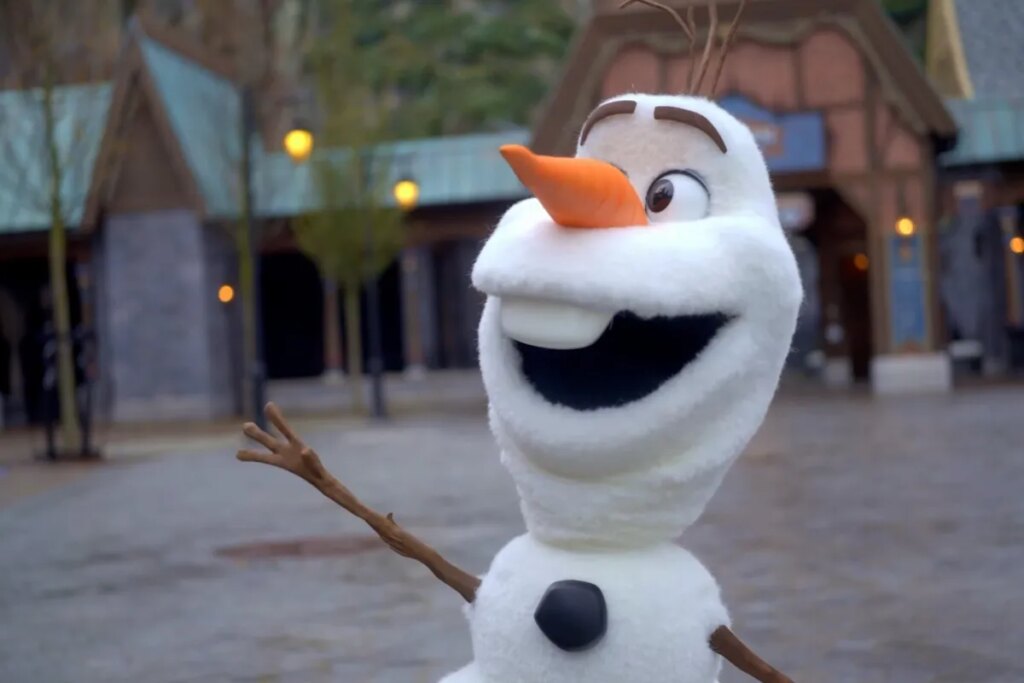
Disney’s robot of its character “Olaf” is incredibly impressive.
It’s also kind of terrifying.
This weekend, engineers at Disney Research Hub published a paper describing how they brought the beloved talking snowman from the “Frozen” films to life as a walking robot — and boy did they succeed.
In a video explaining their work, you can see footage of the robot Olaf, true to its size in the movies, roaming around a Disney park and the lab.
To describe it as uncanny would be harsh, since it does near-perfectly emulate pretty much everything about the character, down to its subtle waddle. But you are left with the distinct impression that what you’re seeing shouldn’t be physically possible; you wouldn’t expect someone with the eyes and proportions of an anime character to step in the real world, and it’s much the same for a 3D-animated snowman. And yet here it is, waltzing before your eyes. You may no longer want to build a snowman ever again, for fear of it coming alive like this one has.
All that aside, it’s a remarkable feat of engineering. You couldn’t get something more true to the character if you shrunk a person and stuck them in an Olaf-suit. You can yoink off the robot snowman’s carrot nose, and it’ll gasp and cackle. It’ll casually smile and wave at you as it ambles by.
The robot posed an unusual challenge to the engineers, who were tasked with building no mere humanoid. It has a huge head the size of its torso supported by a tiny neck, and no visible legs — just feet.
Nonetheless, they prevailed. With the legs, for example, the team concealed most of the lower limbs inside its snowball torso, leaving just the feet showing.
But simply having the robot take short little steps wasn’t enough. They meticulously fine-tuned its gait to mimic Olaf’s from the movie, and in particular ensured it walked with a heel-to-toe pattern to make it as fluid as possible.
To fine tune the robot’s movements, the engineer trained it in a virtual environment using a technique known as reinforcement learning, in which the robot’s AI is rewarded based on it achieving a specific objective across thousands of simulations.
Perfectionists through and through, the team used the technique to reduce the noise of the bot’s steps. No loud plodding for our stout snowman; after implementing some “impact reduction,” the bot’s footfalls dropped from nearly 82 dB in volume to just 64 dB. Even neck temperature was a consideration: since the neck contained a host of small actuators controlling the head, it was at risk of overheating. With reinforcement learning, the bot’s AI system learned to slightly adjust its posture to prevent a thermal buildup, thereby preventing the illusion of animation from melting before our eyes.
More on robots: Robots Tear Up Stage as Backup Dancers
The post Disney’s Robot Olaf Is a Straight Up Nightmare appeared first on Futurism.