The baby-faced teen called his mom for the fourth time that November day. He was homesick, but he wanted her to know he was OK.
Benjamin Guerrero Cruz had recently turned 18, and he was farther from his mother and younger siblings than he’d ever been before.
But he wasn’t off at college or starting a new job. He was calling from San Bernardino County, where he’d been held in an immigration detention center for months.
“You have to be strong,” he consoled his mother.
In August, days before Benjamin was set to start his senior year at Reseda Charter High School, masked agents surrounded him as he walked his family’s puppy, Athena. He said they did not identify themselves.
He was still wearing what he slept in — black shorts and a T-shirt — when the agents arrested him, he told The Times in his first interview with a news outlet since his ordeal began.
“I didn’t know who they were, I didn’t know what they wanted,” he said. “But they handcuffed me and left me wondering: ‘What did I do?’”
Tricia McLaughlin, a spokesperson for the Department of Homeland Security, said that Benjamin, a Chilean national, overstayed his visa by more than two years. She said Border Patrol agents arrested Benjamin and placed him into the custody of Immigration and Customs Enforcement pending removal.
The teenager had fled his home country to seek asylum in the U.S. because of threats of violence, according to the Immigrant Defenders Law Center, which is representing Benjamin in his immigration case and argued for his release in federal court.
Benjamin is among more than 10,000 undocumented immigrants who have been arrested in the L.A. area since raids began in June, according to the Department of Homeland Security.
As Benjamin sat in ICE detention, community members — many of them local teachers — rallied around him and his family, raising tens of thousands of dollars and holding news conferences demanding his release.
But as weeks of detention turned into months, Benjamin obsessed over the school semester, well underway. He worried about what he’d be missing in class. He wondered if he’d get back to his family. And if he’d be able to accomplish his dream of graduating from high school.
::
Benjamin arrived in the U.S. from Chile through the Visa Waiver Program, which required him to depart on March 15, 2023, according to the Department of Homeland Security.
The teenager quickly built a life in Los Angeles. He played soccer like he had since he was 5 years old. He started dating. His favorite food became the spaghetti at Olive Garden.
And, like other newcomers to the country, he began learning English.
His English language development teacher, Lizette Becerra, affectionately called him a “velcro kid.” He would come up to her desk and talk for so long that she’d pull up a chair for him. He talked about soccer and his life in South America.
“He just had this really warm charisma,” Becerra recalled. He was the only newcomer from Chile, she said, earning him the nickname “el Chileno” among his classmates.
Like everyone else, Benjamin said he watched the raids unfolding across the L.A. area starting in June. He tried to avoid the news as much as he could, because he said it was so distressing.
“I never thought it would happen to me,” he said.
The morning of Aug. 8, he’d awakened late. He needed to walk Athena, a mini Pomsky, and they left their home shortly before 8 a.m. It was his brother’s dog, but because the 6-year-old was so young, Benjamin said, he had taken it upon himself to care for the puppy.
It was a Friday and Benjamin was preparing for school, which was scheduled to start the following week. That weekend, he planned to buy a backpack, notebook, pencils and other school supplies.
As he walked Athena, Benjamin said, he spotted unfamiliar, unmarked black SUVs on his residential street. Within minutes, several agents — in plainclothes and some wearing vests that read “Police” — surrounded him. He said the agents gave him the name of someone else they were looking for.
But it wasn’t him. He told them they had the wrong person, but he said it didn’t make a difference. The agents took Athena’s leash and cuffed Benjamin’s hands behind his back. He said they told him to call a family member to get the dog.
He watched from inside an SUV as a neighbor, who asked to be identified only as Valerie T., confronted the agents. In an interview with The Times, Valerie said she’d been out walking her dog Leroy when she spotted the scene unfolding. She said she saw Athena wrapping her leash around an agent’s leg and barking frantically.
After turning away briefly to give her dog’s leash to her boyfriend, she said, she turned back and saw that Athena’s collar had been unclipped and the black and white puppy was now in the middle of the street. Benjamin said he saw an agent unclip the collar, although officials deny that claim.
“Why did you do that? Whose dog is that?” Valerie demanded of an agent. She and another neighbor tried to catch Athena, but the dog, frantic, kept running out of reach, almost getting hit by a car, she said.
When Valerie demanded to know where the person they detained lived, she said, an agent vaguely motioned at a nearby apartment building. Valerie wrote a note with her contact information and taped it on the apartment building front door.
“I witnessed an ICE kidnapping on our block,” she wrote, offering to help.
::
Soon after, Benjamin was shackled and transported to the chilly downtown Los Angeles ICE facility known as B-18. Once he was there, he said, officials took his sandals, leaving him barefoot.
That afternoon, he said, he was transported to Santa Ana, where 25 detainees shared a room. He said they slept on the floor with nothing to cover themselves to keep warm.
He heard stories from other detainees. A man grabbed as he left work, his face still cut up after agents shattered his car window and dragged him out. Another taken as he bought construction materials for work. A man arrested on a Friday, his baby born the following Monday. Benjamin shared his story, telling them he was supposed to start school soon.
“Aqui vamos a aprender,” they said, joking that he was going to get a different kind of education.
Back home, his mother called Valerie, who works as a teacher. Athena had made it home, but Benjamin’s mom had no idea where her son was being held. Valerie enlisted a friend and fellow teacher, who asked to be identified only by her first name, Rita, to help.
The two women have known each other for more than 15 years, previously worked at a school together and have always connected on social justice work. They reached out to their community of moms and teachers, started a meal train and bought the family essentials, such as diapers and wipes for Benjamin’s months-old twin brothers. They launched a GoFundMe and figured out how to put money onto Benjamin’s detainee account so he could call home.
“We had to really fully immerse ourselves into figuring out this whole system and trying to become as expert as possible,” Rita told The Times. Another mother in the community, Alida Garcia, helped connect them with the Immigrant Defenders Law Center.
Benjamin spoke with his mom on the Monday after he was seized. Unable to mark the passing hours, he asked her what time it was and how the family was doing. Four days later, he was transferred to the Adelanto ICE Processing Center, where, he said, he finally received shoes after seven days barefoot.
As the GoFundMe gained traction, someone flagged it to Becerra, Benjamin’s former teacher, asking: “Is this Benji?”
Becerra reached out to Rita and soon joined the teachers in their efforts. On Aug. 17, Becerra was Benjamin’s first visitor at Adelanto. She wondered if her former student, whom she hadn’t seen in years, would recognize her.
“Tanto tiempo sin mirarnos,” he told her when he saw her. “So much time without seeing each other.”
Benjamin stayed strong throughout their visit, she said. But as Becerra turned back as she walked away, she said, she saw him wiping tears from his eyes.
“I just came out of there livid,” Becerra said. “I came out with the fire and drive to do something about what was happening.”
Becerra worked with Unión del Barrio, an independent political organization advocating for immigrant rights and social justice, to hold a news conference the following Tuesday.
Former classmates of Benjamin were present, alongside teachers from the Los Angeles Unified School District. The crowd chanted: “Bring Benji home.”
“He wants to graduate,” Becerra told attendees. “He is in detention, he should be in a classroom with us.”
::
At the end of August, Benjamin said, he was put on a plane and transferred to Arizona. He was scheduled to be transferred to Louisiana, a major hub for deportation flights, but at the last minute he was taken off the plane and sent back to Adelanto.
His family and friends said they weren’t told by officials that he was being transferred and struggled to find him in the system. As a result, U.S. Rep. Luz Rivas (D-North Hollywood) introduced a bill that would require ICE to notify an immediate family member of a detainee within 24 hours of a detainee’s transfer.
Back in Adelanto, Benjamin said, he was among the youngest detainees. The men teased him about his age, he said, telling the guards, “There’s a baby in here, let him out.”
He tried to pass the time playing cards, watching TV and exercising. He said he thought about how hard he’d need to work to be able to graduate on time. Benjamin also got to know his fellow detainees well.
“They grab people like animals, as if they’re hurting someone by going to work,” he said. “These weren’t criminals. They worked, they were the breadwinners of their house and their families were scared without them.”
Benjamin looked forward to yard time, when he was able to see the sun. He said he’d look up and think how beautiful the sky and freedom was.
A little more than three months after he was detained, Benjamin was released. He reunited with Becerra, who drove hours to get him, hugging her so tight that he lifted her off the ground. At home, his mother made his favorite food, spaghetti.
Rivas, who said she’s been working with Benjamin’s family throughout the ordeal, announced his release on the House floor. Rivas said his mother “can hold her son again after months of fear and uncertainty at the hands of ICE.”
“I’m glad that Benjamin is home and I hope he and his family can begin the healing process,” Rivas said on the House floor.
McLaughlin, the Homeland Security spokesperson, said that on Nov. 17 “an activist” judge ordered Benjamin’s release. McLaughlin said Benjamin will have periodic mandatory check-ins with ICE “to ensure he is abiding by the terms of … release.”
Sarah Houston, Benjamin’s immigration attorney, said his detention “was the result of a system designed to terrorize immigrant families and criminalize everyday life for immigrant communities.”
“His release is proof that families and communities have power when they resist together,” she said. “We will continue to fight for a future where immigrant children can walk their dogs, go to school, and live without fear.”
::
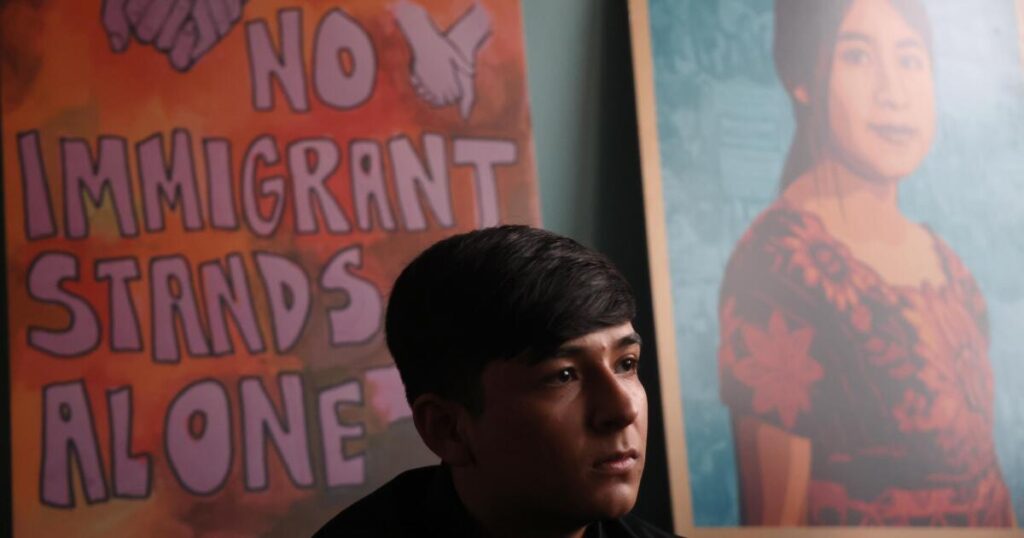
Since his release, Benjamin has started his senior year at a new school. In an interview from the Immigrant Defenders Law Center in downtown L.A., he said it felt great “to get back to my routine, going to school, not being locked up, being free, laughing, learning more.”
Benjamin requested that Becerra, Rita and Valerie join him for an interview with The Times on Wednesday night. Valerie referred to the women as Benjamin’s “three new aunties.” The teenager repeatedly expressed his thanks to those who helped him while he was detained.
“A lot of people helped me without even knowing who I was,” he said.
After Benjamin’s return, Rita hosted a get-together at her home with his family and the three women and their families. They celebrated the teenager’s release with a chocolate cake that read “Welcome home.”
Benjamin said his relief at being home has mixed with panic — that at any time he’s out on the street, he could be detained again. For days, he stayed inside, too afraid to walk Athena.
“I go out now, but always watching,” he said.
The post As he sat in ICE detention, a teen dreamed of finishing his senior year of high school in L.A. appeared first on Los Angeles Times.