Big Tech companies, including Apple, Google, Microsoft, and ServiceNow, have warned employees on visas to avoid leaving the country amid uncertainty about changing immigration policy and procedures.
Following an attack on National Guard members in Washington, the Trump administration expanded travel bans earlier this month, and beefed up vetting and data collection for visa applicants. The new policy now includes screening the social media history of some visa applicants and their dependents.
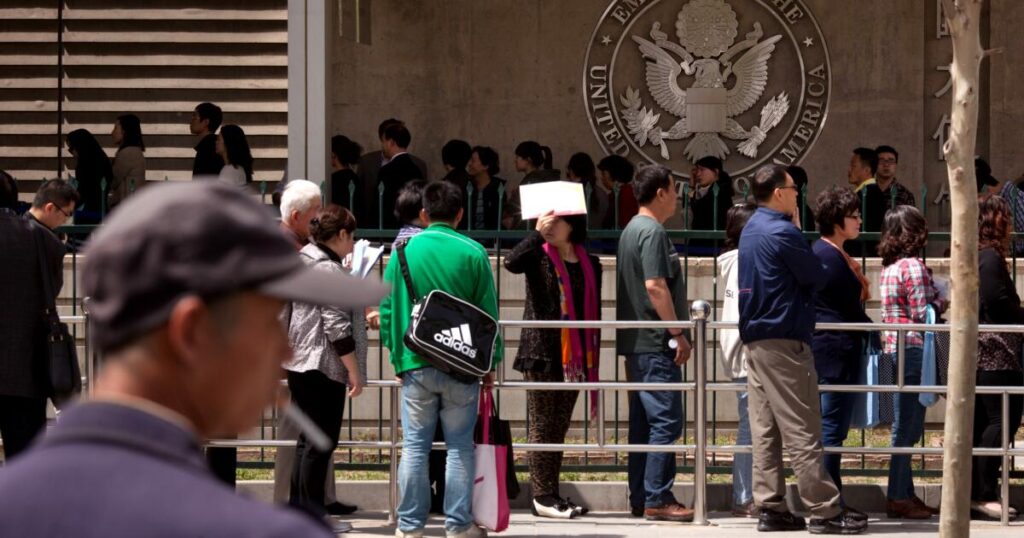
Soon after the announcement, U.S. consulates began rescheduling appointments for future dates, some as late as summer 2026, leaving employees who required appointments unable to return.
“Please be aware that some U.S. Embassies and Consulates are experiencing significant visa stamping appointment delays, currently reported as up to 12 months,” noted an email sent by Berry Appleman & Leiden LLC, the immigration firm that represents Google. The advisory also recommended “avoiding international travel at this time.”
Business Insider earlier reported on the travel advisories.
Microsoft’s memo noted that much of the rescheduling is occurring in India, in cities such as Chennai and Hyderabad, and that new stamping dates are as far out as June 2026.
The company advised employees with valid work authorization who were traveling outside the U.S. for stamping to return before their current visa expires. Those still in the U.S. scheduling upcoming travel for visa stamping should “strongly consider” changing their travel plans.
Apple’s immigration team also recommended that employees without a valid H1-B visa stamp avoid international travel for now.
ServiceNow, a business software company, similarly issued an advisory recommending that those with valid visa stamps return to the U.S.
Microsoft declined to comment on its memo. Apple, Google and ServiceNow did not immediately respond to requests for comment.
Companies warned that delays due to enhanced screening is for H-1B, H-4, F, J and M visas.
H-1B is a high-skilled immigration visa program that allows employers to sponsor work visas for individuals with specialized skills. The program, capped at 85,000 new visas per year, is a channel for American tech giants to source skilled workers, such as software engineers.
Big Tech companies such as Amazon, Google, and Meta have consistently topped the charts in terms of the number of H-1B approvals, with Indian nationals as the largest beneficiaries of the program, accounting for 71% of approved H-1 B petitions.
H-1B visas are awarded through a lottery system, which its critics say has been exploited by companies to replace American workers with cheap foreign labor.
In September, the Trump administration announced a $100,000 fee for new H-1B employee hires. But after severe pushback, it clarified that it applied only to employers seeking to use the H-1B visa to hire foreign nationals not already in the U.S.
The H-1B program is an issue that has not only animated the right but also splintered it. Those on the tech-right, such as Elon Musk and David Sacks, are strongly in favor of strengthening skilled immigration, while the core MAGA base is vehemently opposed to it.
Proponents of the program often highlight that skilled worker immigration made the U.S a technological leader, and nearly half of the fortune 500 companies were founded by immigrants or their children, creating jobs for native-born Americans.
The post Apple, Google and others tell some foreign employees to avoid traveling out of the country appeared first on Los Angeles Times.