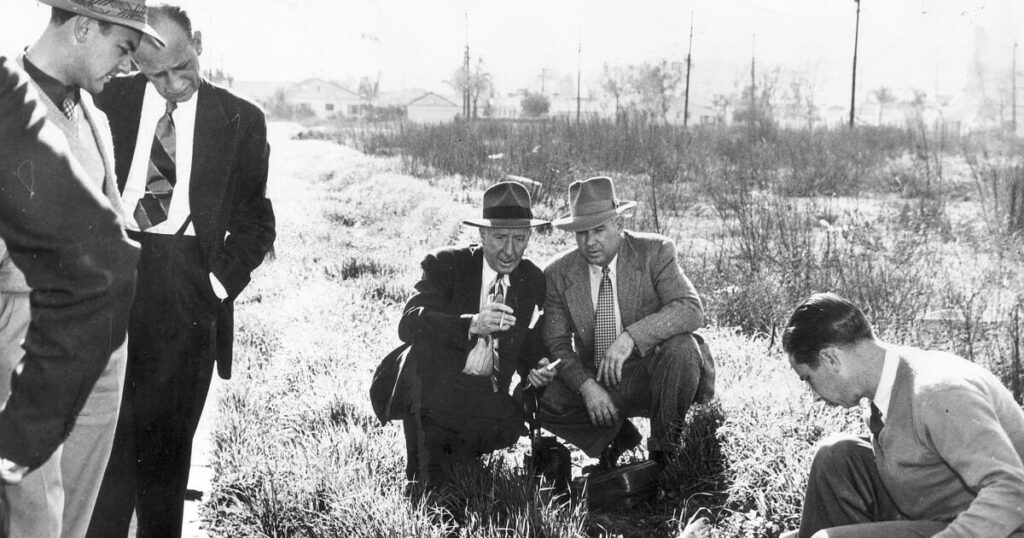
When police questioned Marvin Margolis following the murder of Elizabeth Short — who became known as the Black Dahlia — he lied about how well he had known her. The 22-year-old Short had been found mutilated in a weedy lot in South Los Angeles, severed neatly in half with what detectives thought was surgical skill.
Margolis was on the list of suspects. He was a sullen 21-year-old premed student at USC, a shell-shocked World War II veteran who had expressed an eagerness to practice surgery. He was “a resentful individual who shows ample evidence of open aggression,” a military psychiatrist had concluded.
At first, Margolis did not tell detectives that he had lived with Short for 12 days at a Hollywood Boulevard apartment, three months before her January 1947 murder.
Margolis later admitted they had lived together in Apartment 726 at the Guardian Arms Apartments. But he soon moved to Chicago and changed his name, frustrating further attempts to question him. Among many suspects, a district attorney investigator would note, Margolis was “the only pre-medical student who ever lived as a boy friend with Beth Short.”
A generation later and hundreds of miles north, a killer who called himself the Zodiac terrorized the San Francisco Bay Area with five seemingly random murders from 1968 to 1969, taunting police and media for years with letters and cryptograms.
The toughest to decipher was the letter he sent in April 1970 to the San Francisco Chronicle, with the words “My name is —” followed by a 13-character string of letters and symbols. It came to be called the Z13 cipher, and its brevity has stymied generations of PhDs and puzzle prodigies.
Alex Baber, a 50-year-old West Virginia man who dropped out of high school and taught himself codebreaking, now says he has cracked the Zodiac killer’s identity — and in the process solved the Black Dahlia case as well.
“It’s irrefutable,” said Baber, obsessive, hyperfocused and cocksure in manner, his memory encyclopedic and his speech a firehose of dates, locations and surprising linkages.
Baber has never been a cop. He is not a licensed private eye. Critics have called him overconfident and underqualified. Said one: “This guy is a great smooth talker, but it’s a lot of empty calories.”
Diagnosed with autism at 12, Baber said he endured schoolyard beatings throughout his childhood in rural Florida. He got a GED, skipped college and taught himself cryptography, forensics and computer science.
He runs a firm called Cold Case Consultants of America, with victim-advocate investors and inherited money, and since 2021 has devoted himself day and night to proving a nexus between what might be the two most infamous unsolved cases in America.
“I started running variables based on letter-frequency analysis,” Baber said. “It’s my autism. Once I start on something, I have to see it through. The deeper I go, the harder I push. My mind’s wired differently.”
He became interested in the Bay Area killings when he saw David Fincher’s 2007 film “Zodiac.” He learned that the Z13 cipher is regarded as the Holy Grail of Zodiac studies; the killer sent it to the newspaper after the head of the American Cryptogram Assn. publicly dared him to put his real name in a code.
To attack the problem, Baber used artifical intelligence and generated a list of 71 million possible 13-letter names. Using known details of the Zodiac killer, based on witness descriptions, he cross-checked those names against military, marriage, census and other public records.
“This takes me nine months of working 18-20 hour days,” he said. “I’m starting to kill this onion. I’m starting to eliminate layers: Too tall, too short, or wrong race.”
The candidates narrowed to 185, to 14, and then, he said, to one.
The name he found buried in the Z13 code: “Marvin Merrill.”
Who was Marvin Merrill? It was the alias Marvin Margolis adopted after Short’s murder. It was the name he lived under until his death by cancer in Santa Barbara in July 1993, age 68 (though his gravestone at Riverside National Cemetery bears the Margolis name).
What does it mean? It may take time for anything like expert consensus to emerge. But according to two veteran homicide detectives who once served at the LAPD — including the former cold case detective who oversaw the Elizabeth Short investigation — Margolis is probably responsible for both the Short murder and the five murders attributed to the Zodiac.
They say Margolis left a complex lattice of hidden clues connecting both cases. Among the links, they contend, is his eerie 1992 sketch of a woman that carries the name “ELIZABETH” in plain writing and the name “ZODIAC” hidden in the shading, but visible with the aid of filters.
“In my opinion, these are solved cases,” said Rick Jackson, who was a homicide detective for 36 years, both at the LAPD and at the San Mateo County sheriff’s office. “There are too many links with both. There’s overwhelming circumstantial evidence. He’s left breadcrumbs all along.”
In early 2025, Baber presented Jackson with his conclusions. Jackson was skeptical — the era of internet sleuthing has seen a proliferation of screwball solutions to unsolved crimes. But he was also intrigued. He tried hard but could not find obvious flaws in the theory.
Although the Zodiac murders appeared random, Jackson believes the condition of Short’s body reflected the savagery of an intensely personal fury — she was naked, posed and severed between the second and third lumbar vertebrae, her face carved with a clown smile.
It also reflected anatomical knowledge Margolis would have possessed, Jackson said. Margolis had served as a Navy corpsman during the Okinawa campaign, a battlefield on which “foxhole surgery” included combat-knife amputations.
“He wasn’t a doctor, but he had done things doctors often do,” Jackson said. “He had a lot of experience dealing with the human body.”
Jackson enlisted his former partner, Mitzi Roberts, who knew the Black Dahlia case intimately as a former detective on the LAPD’s cold case unit. In that job, she had been inundated with wild theories from people claiming to have solved the long-cold case.
Fielding “nuts and crack jobs” became a time drain. The LAPD prioritized more solvable cases involving suspects who might be alive to prosecute.
“You really needed someone on the case full time — that’s a big ask for a department that’s low on personnel,” she said. Somebody like Alex Baber “is exactly who you needed.”
As their fascination deepened, the retired detectives alerted the crime writer Michael Connelly, who explores the investigation in the just-released podcast, “Killer in the Code.” Connelly found Ed Giorgio, a mathematician who served as the chief codemaker and codebreaker for the National Security Agency, and who agreed to check out Baber’s solution to the Z13 cipher.
Giorgio said that many people have approached him over the years with similar claims, which were easily debunked.
“All of Alex’s work checked out to me,” he said. To verify his work, Giorgio contacted two other former NSA crypto-mathematicians, Patrick Henry and Rich Wisniewski.
Not only did they endorse the Z13 solution, but Henry discovered another detail cementing the link between the two unsolved cases: the Zodiac code was generated by the key word “Elizabeth.”
The odds that so many interlocking discoveries might be coincidence, Giorgio said, are vanishingly small. “The probability that anything else is correct is orders of magnitude smaller,” he said. “It is the greatest sleuth story ever told.”
Los Angeles detectives initially considered Margolis a viable suspect in Elizabeth Short’s murder, but he has received relatively little attention in the carnival free-for-all of Black Dahlia literature. Other theories proliferate: The killer was a bellhop, a Skid Row alcoholic, the gangster Bugsy Siegel, the director Orson Welles, a venereal-disease doctor.
William J. Mann’s upcoming “Black Dahlia: Murder, Monsters, and Madness in Midcentury Hollywood” takes Margolis seriously as a suspect. Former Times copy editor Larry Harnisch, a longtime student of the case, has already denounced the book as “fraud and fakery” and regards the Margolis-as-killer theory as a waste of time.
Harnisch points to an LAPD report that says police interviewed and cleared Margolis, along with his sometimes housemate, “due to their work and where they were during the time the victim was missing.”
The report does not give details of the supposed alibi, however, and other evidence makes it clear Margolis remained an active suspect even after he relocated to Chicago. In remarks before a grand jury, a prosecutor found it relevant that Margolis had lived with Short not long before her death, and noted that as a USC student he would have dissected a body.
Roberts, the former cold case detective at the LAPD, said the original investigators erred in assuming that Short was kidnapped soon after she was seen at the Biltmore Hotel in downtown Los Angeles on Jan. 9, 1947, while dismissing evidence she had been alive and free for days afterward.
That evidence included the account of a policewoman who claimed (at least initially) that on the day before the body’s Jan. 15 discovery, she found Short at a downtown bus station, sobbing in fear that an ex-boyfriend was stalking her and wanted to kill her. (Short also told people the ex-boyfriend she feared had been a Marine — a branch which Margolis, as a corpsman, had served with.)
Roberts said the mistaken timeline — the assumption that Short’s killer had control of her for a whole week — permitted Margolis to peddle a convincing alibi.
“He was in the Top 10 [suspects] in the D.A. file,” Roberts said. “He got pushed to the back because of the timeline.”
But he could not be ruled out, she said, and then he vanished.
The initial investigation uncovered evidence of Margolis’ psychological instability. Lt. Frank Jemison, who worked at the district attorney’s investigative unit, studied his military records. He learned that Margolis had seen immense carnage in the Navy medical corps, and was among the first wave of troops landing on Okinawa in April 1945.
Three months later, Margolis was diagnosed with “tremulousness, recurring battle dreams, tiredness which is chronic and intermittent, startled reactions and periods of depressions,” according to Jemison’s May 1950 summary of the records.
The Navy had thwarted Margolis’ ambition to be a surgeon. “He desired operation room technique which was never granted to him and this is one of the underlying bases for his resentment and disgust,” Jemison wrote.
Because of his mental trauma, the Navy discharged him with a 50% disability. He seemed to suggest that he would kill whoever tried to send him to war again. “The next time there is a war, two of us are not going — the one who comes after me and myself,” he told a military psychiatrist.
In August 1945, after the war, Margolis was back in Chicago, his home state. He posed smiling with his battle ribbons and a rifle for a glowing feature story in the Chicago Garfieldian newspaper, which said he had cared for the wounded as a “pharmacist’s mate” during the war.
“Professionally Margolis plans to be a surgeon,” the article said.
He never became a doctor. After dropping out of USC, he moved between several states and plied many trades, working as a builder, architect and portrait painter. He married twice and had four kids.
He seemed to relish attention, and in 1961, he was smiling again as the subject of another glowing feature story, this time in the Wellington Daily News in Kansas.
He was now calling himself “Skip Merrill.” The article described him as an artist and an intellectual who hoped to bring artistic culture to Kansas. He exaggerated his service record, saying he was a pilot with the Flying Tigers during the war, and claimed to have studied art under Salvador Dali at USC.
Later, in California, he ran a restaurant in Atascadero and worked as an engineer at Intel in Santa Clara. In the early ‘70s, he ran Bucksavers Automotive Repair & Parts Supply in Oceanside and got a 30-day jail term — plus three years’ probation — for defrauding customers.
Margolis’ interest in art proved critical in catching him, said Baber, the amateur sleuth.
Baber approached Margolis’ son, Roark Merrill, with the ruse that he was researching his father’s World War II service but soon revealed his interest in the Black Dahlia case.
Merrill, it turned out, had inherited a peculiar drawing from his father, and kept it on his own office wall. His father had sketched it as cancer was killing him. Would Baber care to see it?
The sketch, called “Elizabeth,” depicts a woman who is peering with one eye through a curtain of hair that hangs over her face. She is naked from the waist up. Her lower half is not visible, as if cut off above the navel. One of the nipples appears to be severed. The torso bears a series of marks that might be stab wounds, amid an area of shading that suggests blood. It is signed “Marty Merrill ‘92,” reflecting another alias Margolis used.
To Baber’s team, the similarities it bears to Short’s bisected and mutilated body are hard to ignore, suggesting firsthand knowledge of the killing. Making this claim hard to prove: Graphic photos of her corpse went public as early as the mid-1980s, in Kenneth Anger’s book “Hollywood Babylon II.”
Because Margolis died in 1993, Baber and the two retired detectives view the drawing as a kind of deathbed confession to Short’s murder. And because “Zodiac” appears to be hidden in the shading, they also see it as a confession to the Zodiac crimes.
Although The Times has reviewed an image of the sketch, Roark Merrill — when contacted — declined to grant permission for the image to be published, and also declined to comment.
Baber also believes he has found the so-called “murder room” that has eluded investigators for nearly 80 years — the place Short was killed, drained of blood and cut in half. He thinks it was at 2615 Santa Fe Ave., in Compton, a cluster of stand-alone bungalows and one of the few area motels in 1947 that had a bathtub.
On the night before the killing, newspaper accounts say, a nervous young man had been driving between motels in the area, desperately seeking a room with a bathtub and claiming his wife needed it.
At the time, the Compton bungalow complex was called the Zodiac Motel, a fact Baber discovered by using AI to unearth a newspaper ad. He thinks it inspired the name the Bay Area killer called himself.
“That was the key to where she was murdered as well as his future moniker,” Baber said.
Roberts, the former cold case detective, said the LAPD has been made aware of the new findings, but the case is not one of the department’s priorities. “It’s not a burning thing on their radar right now,” Roberts said. “I don’t think the LAPD will ever take a position and say it’s solved.”
The post An amateur codebreaker may have just solved the Black Dahlia and Zodiac killings appeared first on Los Angeles Times.