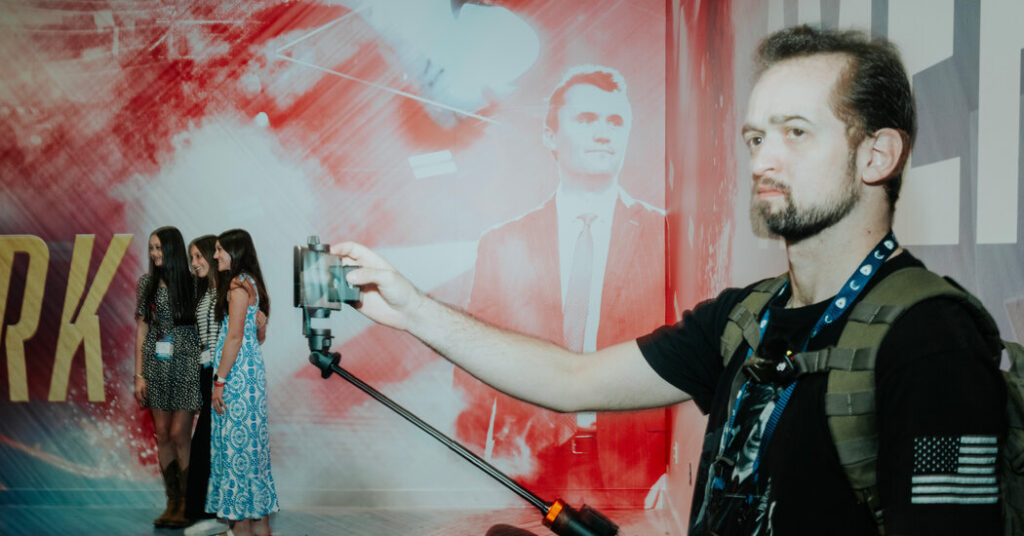
Content creators with fuzzy TikTok haircuts cornered attendees for man-on-the-street style interviews. Aspiring influencers, hoping to build up follower counts, sat at tables beneath signs reading “Prove Me Wrong” as they egged on passers-by to debate subjects including Israel, the white nationalist Nick Fuentes and the concept of American identity.
It was the first major gathering of the Turning Point USA organization since the assassination of its founder, Charlie Kirk, who minted a singular style of combative discourse in American politics. Inside a Phoenix convention center, the promise of discord loomed.
But many of the attendees at the four-day conference, especially those under the age of 30, had come primarily to pal around with fellow Christians in an environment that could feel like an evangelical youth-group service crossed with a college football tailgate. For them, the drama unfolding on the main stage — where the event’s star speakers griped and traded insults — appeared to be taking place in some remote realm.
“IDGAF,” said Dane Hoff, 20, who studies at Clemson University in South Carolina, using a shorthand for not caring one bit.
“Like, it doesn’t really matter. This is online, insider-y stuff. It’s niche,” he added, describing himself as a moderate within the MAGA movement. “I’m all about electoral politics and winning.”
The conservative commentator Ben Shapiro, for instance, condemned Mr. Fuentes and then criticized Tucker Carlson for hosting an interview with him. Mr. Carlson, in turn, mocked Mr. Shapiro’s comments, calling him a “cancer” plaguing the Make America Great Again movement. Megyn Kelly said she was no longer friends with Mr. Shapiro because of his attacks. Vivek Ramaswamy set his sights on Mr. Fuentes and his followers.
Andrew Gilbey, a student at Rock Valley College in Illinois, said conservatives were not “creating a good positive message.”
“Right now, we’re just seeing hostility and division at the top of the party, and it’s trickling down to the lower half and to the grass roots,” Mr. Gilbey, 22, said. “It’s creating division instead of building a movement that keeps everyone together. I mean, what direction are we going in?”
Many would have rather focused on Mr. Kirk, whose likeness and quotations were plastered on walls across the convention site. Merch tables were piled high with trucker hats and T-shirts printed with phrases like: “Live like Charlie,” “I am Charlie” and “Make America Charlie Again.”
Near the entrance to the main hall, visitors could pose for photos in a mud-flecked recreation of the tent in which Mr. Kirk was fatally shot in September during a campus tour. On the first day of the conference, a line for it snaked through the exhibition hall.
In a megachurch-size room housing the main stage, the event officially kicked off on Thursday with a moment of silence to honor Mr. Kirk. A capacity crowd of 30,000 stood quietly, many dressed in their Sunday best blazers and khakis. Onstage, a single spotlight shone down on what was said to be the very microphone Mr. Kirk was holding at the moment of his death.
But without their “peacemaker,” as Erika Kirk, the new Turning Point chief executive, described her husband during her opening speech that evening, disunity has become a norm across this coalition of the new right.
“We’ve seen fractures,” Ms. Kirk said. “We’ve seen bridges being burned that shouldn’t be burned.”
While most attendees were aware of the “fracture” and “division” chatter, the speakers at times seemed to talk right past the Turning Point masses, who mostly opted to keep their heads down while the debate played out.
Reluctant to take sides or get into ideological debates without knowing all the facts, they wondered aloud if this was what “Charlie would want.”
“Things are just too fiery, and it’s creating so much unrest and division,” said Jack Oertle, 17, a Phoenix native still in high school. “We don’t need it. We’ve been watching Democrats tear each other apart for so long and now it’s happening here.”
Laiken Combs, 22, similarly described being disheartened by the “division” on display.
Ms. Combs, who was dressed in a MAGA-red pantsuit, had come with members of the Turning Point chapter she helped found at Shawnee State University in Ohio in the days after Mr. Kirk’s killing.
“I thought we were a party of free speech, so why are we attacking other podcasters for their viewpoints?” Ms. Combs asked.
The podcasters in question were Mr. Fuentes, the far-right antisemitic commentator, and Candace Owens, a one-time Turning Point employee who has spread baseless conspiracy theories about Mr. Kirk’s death to her large audience.
Neither Mr. Fuentes nor Ms. Owens attended the weekend’s events, but they were influential forces in absentia, haunting the proceedings.
Most attendees had appeared to sour on Ms. Owens, particularly because of the growing volume of her takes. Lingering by the entrance of the conference’s V.I.P. lounge, a tightly guarded banquet room lit by flashing club lights, set against the thump of generic-sounding dubstep, one female attendee described it as exhausting, a ploy to stay relevant.
Many were stronger in their denouncements of Mr. Fuentes, 27, whose name popped up in nearly every marquee speech and who has declared a “love” for Stalin and Hitler.
They made it a point, though, to state their support for his America First platform, particularly its most contentious position: ending U.S. support for Israel. The idea, mired in arguments on the right over antisemitism, has been top of mind for many American conservatives under the age of 30.
Ana McMahon, a manager at a Trader Joe’s in Idaho, described Mr. Fuentes as “cynical” and “hateful.” But when asked about the issues most pressing for her that weekend, she brought up Israel and the pro-Israel lobbying group AIPAC. “I don’t want my tax dollars going to a foreign country,” Ms. McMahon, 26, said. “We should be prioritizing the American people.”
Followers of Mr. Fuentes were rumored to be peppered among the conference goers over the weekend, and a few boldly declared their presence by wearing the insignia of their political affiliation, America First. All declined requests to talk when approached.
In a speech on Friday night, Mr. Ramaswamy, who had earlier written in an opinion essay in The New York Times to warn of the rise of what he called “blood-and-soil” nationalism, declared that the Groypers, as Mr. Fuentes’s followers are known, “had no place in the conservative movement.”
The message seemed to resonate with many in the crowd, some of whom shared his wariness of Mr. Fuentes, who has quickly become one of the most divisive figures on the right.
“The party is going to fall to the wayside if we let these outspoken lunatics drive things,” Corbin Wills, 25, a student at Arizona Christian University, said. “It’s just ugly right now.”
“His message was really unifying,” Katherine Mickelson, 21, who had traveled from Baylor University in Texas, said of Mr. Ramaswamy’s speech. “American exceptionalism is a concept that we should all be able to get behind as conservatives. I think it’s what we need to hear because there is this fracturing that’s going on right now. If we truly focus on putting America first, that can bring us together. We also need to renounce hatred.”
Others were more curious about Mr. Fuentes, or at least wary of creating further division by trying to cut him out of the broader right-wing movement.
“Do I agree with Nick Fuentes? No,” said Joe Donnelly, 66, who had brought his daughter, Jess, 26, with him from New Jersey. “But he’ll expose himself. You let people talk and expose themselves and the party will naturally move away from him.”
Mr. Donnelly described himself as a “big-tent guy.”
Christian Kent, 25, a graduate of University of North Carolina, Charlotte, described Mr. Fuentes as “pretty smart.” He hesitated when asked to reflect on Mr. Fuentes’s views, instead noting that the political influencer had some “maturing to do.”
When Vice President JD Vance finally weighed in on Sunday, after the rapper Nicki Minaj made a surprise appearance, he acknowledged that some in the crowd might have been put off by the disagreements among the adults in the room.
“I know some of you are discouraged by the infighting over any number of issues. Don’t be discouraged,” Mr. Vance said. “Wouldn’t you rather lead a movement of freethinkers who sometimes disagree than a bunch of drones who take their orders from George Soros?”
But well before Mr. Vance’s attempt at patching things up, he might’ve already lost a crowd eager to tread new ground.
“They’re trying to keep this thing chugging along like it was before,” said Caleb Gasca, a 23-year-old construction worker who was grinning by an exit Friday afternoon. “I think they’re kidding themselves.”
The post Young Turning Point Crowd Finds Infighting Distracting appeared first on New York Times.