President Trump’s drive to crack down on vessels moving oil from Venezuela, an escalating part of his pressure campaign against the government of Nicolás Maduro, took an unusual turn over the weekend.
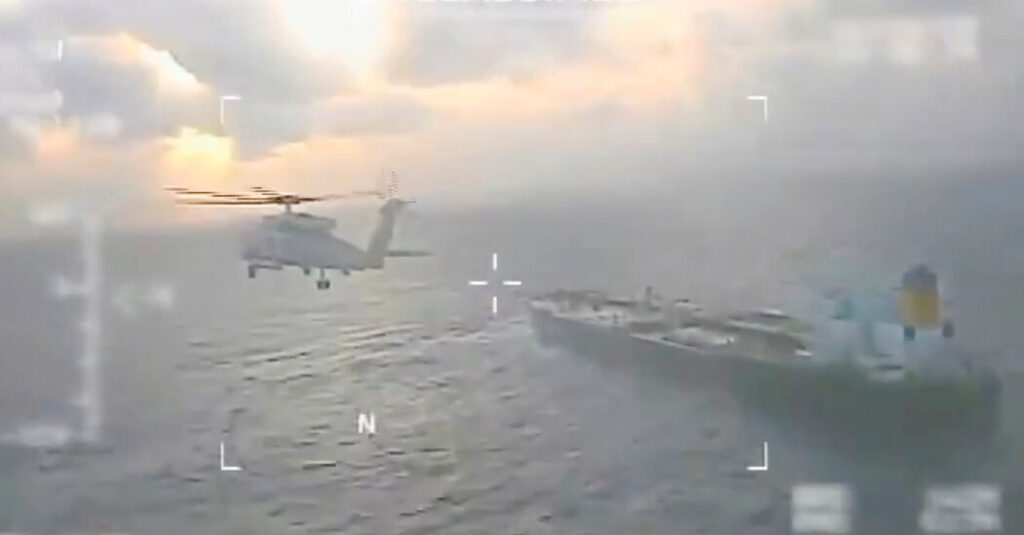
In the Caribbean Sea on Saturday, the U.S. Coast Guard tried to intercept a tanker called the Bella 1, which officials said was not flying a valid national flag, making it a stateless vessel subject to boarding under international law. U.S. officials had obtained a seizure warrant for the Bella 1 based on its prior involvement in the Iranian oil trade, but officials said the ship refused to submit and sailed away.
Here’s what we know about the situation.
The ship fled into the Atlantic Ocean.
Ship-tracking data showed the Bella 1 had been en route to load Venezuelan crude oil and was not carrying cargo. The vessel has been under U.S. sanctions since last year for transporting Iranian oil, which the authorities say was used to finance terrorism.
The Bella 1 had not yet entered Venezuelan waters and was not under naval escort. The cargo it was scheduled to pick up had been purchased by a Panamanian businessman recently put under sanctions by the United States for ties to the Maduro family, according to data from Venezuela’s state oil company.
U.S. forces approached the Bella 1 late on Saturday. But it refused to be boarded, instead turning and creating what one U.S. official described as “an active pursuit.”
By Sunday, the Bella 1 was still fleeing the Caribbean and was broadcasting distress signals to nearby ships, according to radio messages reviewed by The New York Times and first posted online by a maritime blogger. The vessel was traveling northeast into the Atlantic Ocean, more than 300 miles away from Antigua and Barbuda, the messages showed. By Sunday evening, Bella 1 had sent over 75 alerts.
It is not clear what steps the United States is taking to pursue the ship. The White House said Mr. Trump would make an announcement on Monday afternoon with his defense secretary and his navy secretary but provided no indication of the subject.
The tanker was one of two intercepted by the U.S. this weekend.
The Coast Guard on Saturday stopped and boarded the Centuries, a tanker that had recently loaded Venezuelan oil, reportedly for a Chinese trader. The U.S. authorities did not have a seizure warrant for the Panamanian-flagged vessel and said they were verifying the validity of its registration. It was unclear how long the ship would be detained.
On Dec. 10, the United States had seized another tanker, the Skipper, which was transporting Venezuelan crude but had earlier carried Iranian oil. The Skipper has been escorted to Galveston, Texas.
Mr. Maduro has responded by ordering the Venezuelan Navy to escort some tankers, raising the risk of armed confrontation at sea.
U.S. officials say the operations aim to weaken Maduro’s finances.
Trump administration officials have sought to justify the effort to curb tanker traffic in and out of Venezuela by arguing that it is necessary to choke off oil export revenue that funds narco-terrorism, according to officials. Mr. Trump has accused Mr. Maduro of stealing oil from American companies and using petroleum revenues to fund criminal activity, though he has offered no evidence for those claims.
The threat of additional seizures is already influencing tanker routes. Some vessels that appeared to be heading to Venezuela have turned around, according to global shipping monitors. Much of Venezuela’s oil is sold to China, some through Cuba, and some is licensed to the United States.
Trump Administration: Live Updates
Updated
- Vance refuses to take sides at a Turning Point conference in the fight over antisemitism, free speech and bigotry.
- Russia dismisses reports of progress in Ukraine peace talks.
- The U.S. Coast Guard is pursuing an oil tanker linked to Venezuela.
The actions have fueled uncertainty about the administration’s ultimate aims. Allowing most ships to continue operating would fall short of a true blockade — an act of war — and instead resemble a series of law enforcement operations.
Blocking the tankers is part of a larger anti-Maduro effort by the U.S.
The Trump administration spent the past few months building up a heavy military presence in the Caribbean under the banner of a counternarcotics campaign.
The United States has attacked boats the Trump administration says were smuggling drugs, killing at least 104 people. Mr. Trump has accused Venezuela of flooding the U.S. with fentanyl.
But Venezuela is not a drug producer and has no known role in the fentanyl trade. Most cocaine transiting the country is bound for Europe, and many legal experts say the strikes on the boats are unlawful.
Privately, U.S. officials say the campaign is aimed less at curbing drug trafficking than at removing Mr. Maduro, long accused by successive Democratic and Republican administrations of rigging elections, repressing dissent and committing human rights abuses.
More recently, Mr. Trump and his advisers have pointed to another objective: gaining leverage over Venezuela’s vast oil reserves, the largest in the world and the backbone of its economy. Venezuela once welcomed American energy companies and Mr. Trump has indicated he wants access to those resources again.
The targeted ships are part of a “ghost fleet.”
Experts estimate up to 20 percent of global tankers move oil from Iran, Venezuela, and Russia in violation of U.S. sanctions. These ships often disguise their location and file false paperwork. The Bella 1, for instance, faked its location signal on a previous voyage.
U.S. officials say they have identified other tankers carrying Venezuelan oil whose previous involvement in the Iranian oil trade makes them subject to U.S. sanctions. Mr. Trump said last week that more seizures could follow, announcing a “complete blockade” of “sanctioned oil tankers” traveling to and from Venezuela. But at least one vessel boarded by U.S. forces, the Centuries, does not appear on the Treasury Department’s public sanctions list.
Venezuela’s government has condemned the boarding of the Centuries as theft and hijacking, accusing the United States of forcibly disappearing the crew.
Genevieve Glatsky is a reporter for The Times, based in Bogotá, Colombia.
The post What We Know About U.S. Interceptions of Oil Tankers in Venezuela appeared first on New York Times.