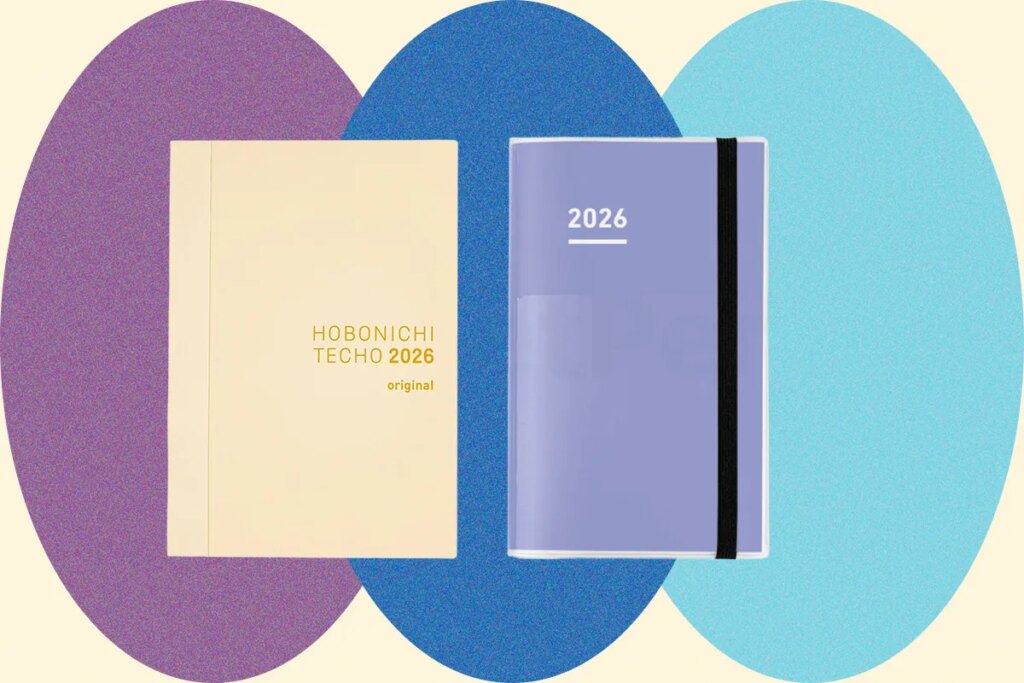
If you’re looking to get more organized in the new year, a planner is a good place to start, and Japanese planners might have caught your eye. Once you start looking into paper planners, it won’t take long to start seeing recommendations of cult favorites like the Hobonichi Techo. If you’re new to the wide world of planners, you might be wondering: What’s all the hype about the Japanese versions?
There are a few key differences between popular Japanese planners and popular American ones. A primary difference is paper quality, as Japanese planners use thinner, smoother paper that’s still strong enough to keep ink leakage between pages at bay, while American planners have thicker paper. You’ll also see a different design aesthetic, with Japanese planners leaning more minimalist. There’s also more space for you to manually customize your planner in a Japanese version, while American planners tend to come with everything pre-organized.
One isn’t necessarily better than the other, since the best planner for you will depend on your own needs and what best suits the organizational side of your brain. As the resident paper planner tester here at WIRED, I’ve tried several popular planners from America and Japan alike, and more and more often the Japanese planners have risen to the top.
Table of ContentsLargeChevron
What’s Different About Japanese Planners?
Here’s a quick breakdown of the major things you’ll notice when shopping for Japanese planners compared to American ones.
Paper Quality
The biggest difference is one you’ll feel right away: the paper. While popular Japanese planner makers each have their own signature paper, there’s a similar experience in writing on some of the most popular planners and notebooks. Compared to American planners, Japanese planners like the Hobonichi and Kokuyo Jibun have much thinner, smoother paper, but both papers are still plenty durable and won’t let ink leak through to the other side (you can faintly see the writing on the other side, though). Meanwhile, American paper planners have a cardstock feel to them, and thus American planners with the same number of pages end up much thicker than a Japanese planner.
The Hobonichi uses Tomoe River S paper; originally, Hobonichi used regular Tomoe River paper, but after the manufacturer stopped making it, Hobonichi found another manufacturer to make Tomoe River S paper, and the brand has been using it in its planners since 2024. Meanwhile, Kokuyo has two Kokuyo-exclusive papers it uses in its planners, the Thin Paper and the Mio Paper. I also tested the Jibun Techo, which uses the thin paper. Both these papers feel very similar to each other, with a smooth writing experience and no bleeding, and the pages are satisfying to touch and turn.
Design Focus
Japanese planners have a much more minimalist design style compared to American ones. Especially when you compare the colorful, youthful designs of American planners like Happy Planner and Ban.do to one like the Hobonichi—the Hobonichi feels very minimalist and plain. There are fun covers you can add onto Japanese planners to make them more your style, while American planners try to guess your style and offer it as an option. Depending on your personal aesthetic, that might be easy to find or quite difficult; I struggle to find a Happy Planner or Ban.do cover, for instance, that feels appropriate for my thirties.
You’ll also see a lot more grid paper rather than lines or blank spaces, which was a little off-putting for me at first, but I grew to really enjoy how much freedom it gave me to use the space as I liked, and helped me keep my writing tidy versus accidentally writing crooked in an empty box.
Customization Approach
Granular customization is a popular feature in some American planners. Brands like the Erin Condren LifePlanner are beloved for their ability to allow a user to fully customize what will be printed on each page. Others, like Agendio, give buyers the freedom to change things like page order and add special sections.
This isn’t something you’ll see in Japanese planners. Instead, you’re given more free space to write in your own things like daily habit trackers or a daily schedule, rather than having those sections pre-made for you. You can also build a planner with different workbooks, like the Jibun Techo First Kit, which is reminiscent of refillable Filofax-style systems but with a much cooler aesthetic.
As I got used to using Japanese planners, I found I actually prefer their open-ended customization. If my goals change during the year, I’m not locked into a concept I cooked up in January—it gives me a true fresh start for each month, week, and day spread.
Which Ones Are Worth Buying?
I’ve tried a few different Japanese planners this past year. Here are the ones I’ll keep using in 2026.
Hobonichi
While Hobonichi’s beloved flagship is undoubtedly the OG Techo, I love my Techo Cousin. It adds a weekly spread at the front of the planner, and the A5 size is ideal for me to have enough space to write out my daily must-haves. This includes my work to-dos, my personal to-dos, my habit tracker, and my schedule for the day, and there’s still room for other miscellaneous lists or musings without needing to crack out an extra notebook.
The regular Techo is cheaper since it skips out on the weekly spread section (which you really don’t need, since it’s in the front of the book, separate from the daily spreads, and easy to forget about). It’s also a little smaller—A6 size instead of A5. I really like the A5 size, but the regular Techo is a great and affordable place to start if you want to see if Japanese planners are for you.
Kokuyo Jibun
As someone who already has a favorite weekly planner, I was surprised to find myself falling in love with the Kokuyo Jibun Techo. I got the 2026 First Kit, which included the last two months of 2025, so I’ve already been able to start testing it out in my daily life. It’s a rarity among Japanese planners in that it has three notebooks built into it: Diary, Life, and Ideas. The Diary is the true planner part with monthly and weekly spreads, plus other pages like a book list, money tracker, and project tracker (which has become my habit tracker). The Life booklet has more prompt pages, like 100 Wishes and places to track information about your life, including a password manager and anniversaries list, and space to log your life events between ages 0 and 99. Finally, the Ideas notebook in the back is just grid paper where you can write lists and ideas to your heart’s content.
All three books are interlaid in the cover to sit as one planner, but you can remove one and refill it any time. It’s a really handy system, especially as someone who will definitely need to refill the Ideas booklet before the year is up. I’ve got the B6 slim size, and it’s been a really nice size to fit onto my desk.
Midori
The Midori notebooks are popular—specifically, those with MD paper. It’s described as versatile, and the paper does feel plenty versatile, but it also feels a little thicker and more akin to a regular notebook than the super-thin paper you’ll get on a Hobonichi or Kokuyo Jibun planner. It’s still a little smoother to the touch than my American planners, though the paper weight feels similar.
I’m testing both the MD Diary and the Stand+ notebook, and I really like how the Stand+ is created to stand up on its own; it makes for a much more fun way to view my to-do list. There’s a monthly calendar at the front and then grid paper pages afterward for freeform notes and lists. The Diary has a similar feel to it and a similar design, but instead of grid paper, it has lines. The lines are wide, which is nice if you have large handwriting, but it doesn’t feel like enough space for me given how small the notebook is.
Are These Planners Available Only in Japanese?
If you worry that you won’t be able to read the Japanese characters in a Japanese planner, good news! Some of these planners also have English versions or use English phrases. The Hobonichi has English versions on Amazon, and the Jibun Techo uses English titles on its pages. For the Jibun, I still have to look up some translations since the descriptions under those titles are in Japanese, but I can usually infer how to use a page from the title and design. JetPens has an entire page dedicated to translating the Jibun Techo here.
Power up with unlimited access to WIRED. Get best-in-class reporting and exclusive subscriber content that’s too important to ignore. Subscribe Today.
The post The Best Japanese Planners (2026): Hobonichi Techo, Kokuyo Jibun Techo appeared first on Wired.