Lawmakers in both parties view simmering fury over the cost of living as the top issue in next year’s midterm elections and are pitching a growing profusion of proposals to tackle the notoriously difficult problem of affordability.
Republicans are touting the tax cuts they passed in July and considering a second party-line package to address health care and other matters. Democrats, meanwhile, are drafting proposals aimed at making everything from health care and housing to energy and groceries more affordable.
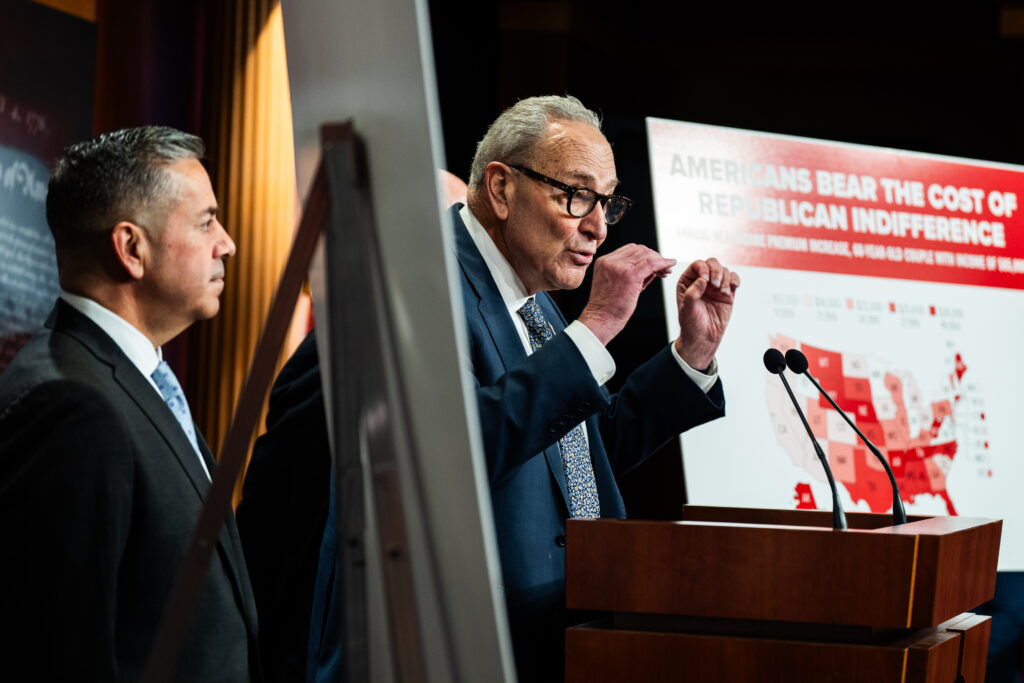
“The number-one issue is costs, and we intend to make that the issue till the next election,” Senate Minority Leader Charles E. Schumer (D-New York) said in an interview.
Democrats have spent months unsuccessfully pressuring Republicans to extend enhanced health insurance subsidies set to expire at the end of the year. Without the subsidies, premiums will rise for millions of Americans covered through the Affordable Care Act.
Now Democrats are broadening that message, with Schumer comparing Americans’ frustration with high prices under President Donald Trump to President George W. Bush’s politically disastrous effort to privatize Social Security during his second term.
The backlash to Bush’s Social Security plan — along with fatigue with the Iraq War — helped Democrats retake both chambers in 2006. The challenge in 2026 may be tougher for Democrats, however: This time, they will need to win back voters whose anger over high inflation under President Joe Biden helped return Trump to the White House last year.
Trump — who described affordability concerns as a Democratic “hoax” earlier this month — appeared to take the issue more seriously last week, addressing it in a prime-time address from the White House. He boasted that the prices of cars, gasoline, hotels and airfare, all of which rose sharply under Biden, are “coming down fast.”
Some prices have come down since Trump returned to office. The price of gasoline declined by 4.6 percent between January and November, according to consumer price index data. Airfares declined 9.3 percent, and lodging away from home — which includes hotels — declined 5.1 percent. The price of new vehicles rose less than 1 percent.
But overall prices have not fallen and Americans remain stressed about affordability, with 64 percent of registered voters describing the cost of living as a very serious problem, according to a Quinnipiac University poll conducted this month. A fifth of voters said it was very difficult to afford health care, 13 percent said it was very difficult to afford housing, and 12 percent said it was very difficult to afford groceries.
Nearly half of consumers blame high prices for their poor personal finances, according to University of Michigan consumer sentiment data — almost as many as at a peak in August 2022, when inflation was much higher.
Economists are generally skeptical that Congress can do much to lower prices.
“The only way you get broad price declines in an advanced, large economy like ours is by having a very deep recession,” said Jared Bernstein, who served as chairman of the Council of Economic Advisers in the Biden White House.
However, Bernstein said lawmakers can influence affordability in sectors such as health care, housing, child care, utilities and groceries. And Doug Holtz-Eakin, a former Congressional Budget Office director who leads the conservative think tank American Action Forum, said lawmakers could try to indirectly increase wages through policies that make it easier for businesses to invest and grow in the United States.
Senate Majority Leader John Thune (R-South Dakota) has argued that voters will begin to feel more of the effects of the tax-cut bill that Republicans passed in July. “Those steps that we took last summer, you’re going to start to see that and the American people are going to start to feel that,” Thune told Fox News’s Bret Baier last week.
Holtz-Eakin agreed that the legislation would help but said many provisions will take longer to kick in. “When the political timescale is between now and next November and the economic timescale is measured in years, it’s a tough moment,” he said.
Some Republicans are also worried and have pressed the party to take more immediate action to address affordability.
“I just hope that we’re not going to slip into the mentality that we think that we’ve done everything we should do and this is just great and we’ll just spend the next year messaging,” Sen. Josh Hawley (R-Missouri) told reporters. “I think we need to spend the next year acting.”
Last week, a handful of moderate Republicans pushed House Speaker Mike Johnson (R-Louisiana) to hold a vote on extending the expiring ACA subsidies before lawmakers left for the holidays. After Johnson balked, four House Republicans joined Democrats in signing a discharge petition to force a vote in January.
“We do have to provide some sort of relief for Americans,” said Rep. Nick LaLota (R-New York), who did not sign the petition but pushed Johnson for a vote on the subsidies.
As Republicans and Democrats tussle over which party deserves blame for high prices, a litany of other ideas for addressing affordability has emerged.
Sens. John Kennedy (R-Louisiana) and Lindsey Graham (R-South Carolina) have urged Republicans to use the budget reconciliation process to address affordability concerns, which would allow Republicans to avoid a Democratic filibuster. Kennedy suggested such a bill could include provisions to address taxes, housing and health care.
Trump, meanwhile, has touted his efforts to lower the price of some prescription drugs. More than a dozen pharmaceutical companies have struck agreements with the administration since July to lower the cost of certain drugs in the U.S. Trump also seemed to call on Republicans in Congress to pass health care legislation along the lines of a Senate bill that failed earlier this month, which would have funded health savings accounts for some Americans.
Energy prices are another focus. Last week, the House passed a permitting bill aimed at making it easier to build infrastructure; the measure drew 11 Democratic votes.
But bipartisan efforts on other topics have fizzled so far.
A bill from Sens. Tim Scott (R-South Carolina) and Elizabeth Warren (D-Massachusetts) that aimed to increase the housing supply passed the Senate in October as an amendment to the annual defense policy bill. But House Republicans insisted on stripping it from the bill after Rep. French Hill (R-Arkansas) objected to it. (The House Financial Services Committee, which Hill chairs, advanced its own bipartisan housing bill last week, raising hopes for a potential compromise.)
Now Warren and other Democrats are drafting their own affordability plans. Their ideas include helping home buyers with down payments. Last week, Sen. Bernie Sanders (I-Vermont) pitched Democratic senators at a closed-door lunch on expanding Medicare to cover dental, vision and hearing aids, Schumer said.
Bharat Ramamurti, who served as deputy director of Biden’s National Economic Council, warned Democrats to be careful about overpromising. The next president would need to raise revenue by at least $3 trillion just to reverse Trump’s cuts to Medicaid and the nation’s food stamp program without adding to the ballooning national debt, Ramamurti said.
“Candidates are going to run on things like down-payment assistance or money for affordable housing or a Medicare buy-in or restoring the child tax credit, all of which cost money,” Ramamurti said. “I think [that’s] good. But they have to make the case for robust revenue alongside that.”
But Schumer predicted it would not be hard to make progress on prices if Democrats retake Congress. The first step, he said, would be undoing Trump policies that he argues have driven prices higher, such as imposing tariffs and repealing clean energy tax credits.
“I think we’ll get Republican support,” Schumer said.
Rachel Siegel contributed to the story.
The post Republicans and Democrats pitch competing plans to tackle affordability appeared first on Washington Post.