When it comes to K-drama, my taste doesn’t run to elaborately costumed history or complicated rural romance. I like the hard stuff. It makes sense that two of the South Korean series that claimed my attention in 2025 start the same way: with a woman coming home and finding a man she loves bleeding out on the floor.
“The Price of Confession” on Netflix and “Nine Puzzles” on Hulu (and Disney+) have other things in common. In each case, the protagonist’s struggle for justice is complicated by her refusal to conform to Korean expectations of how a woman should behave, especially a woman whose husband or uncle has just been murdered. A combination of unconventionality, stubbornness and a reluctance to trust anyone makes each the prime suspect in the killing she discovers.
The shows also share the love-it-or-hate-it common denominator of South Korean thrillers: the sheer volume, speed and dubiousness of the clues and twists thrown at the viewer. The sense of reverse engineering, and the propensity for advancing the plot simply by playing scenes over again — the second time with the essential information left in — can be wearying. “Confession” was the No. 1 non-English language series in Netflix’s most recent rankings, but you have to wonder whether people who are not devoted K-drama fans make it through all 12 episodes; things really start to get out of hand around Episode 8.
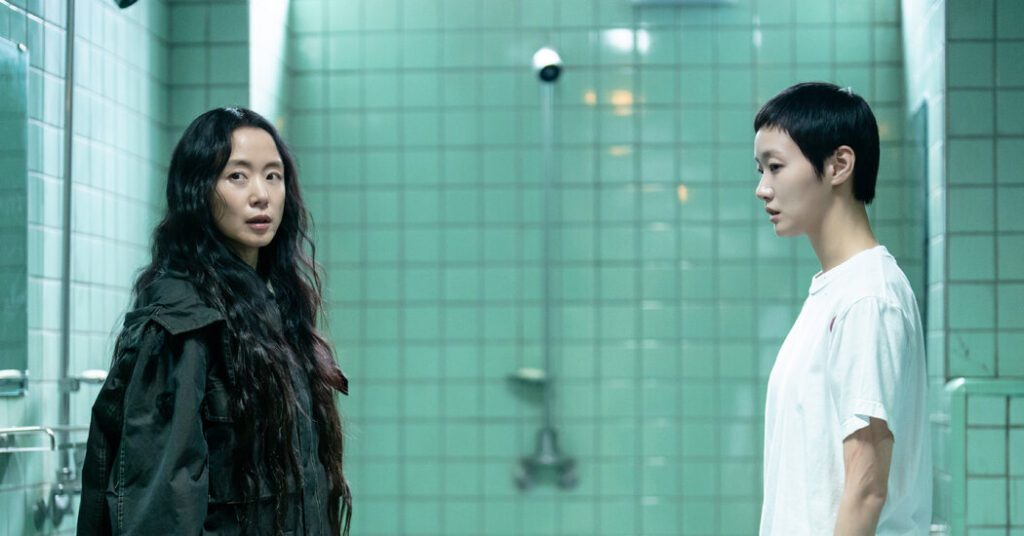
If they do, it has a lot to do with Jeon Do-yeon, the eminent South Korean actress who plays Yun-su, a middle-aged artist whose husband is stabbed with a painter’s knife. Jeon, a veteran film star (“Secret Sunshine,” “The Housemaid”), de-glams herself and declines to play for the audience’s sympathy, even as Yun-su is vilified, jailed and relentlessly hounded.
For most of its length, “Confession” is, by K-drama standards, admirably unsentimental. (It does provide a focus for our mushy feelings in Yun-su’s daughter, played by Erin Choi, who suffers stoically through even greater tribulations than her mother.)
The hook of “Confession” is less in melodrama than in high-concept story design. The show is a variation on the premise of “Strangers on a Train,” with a “Thelma and Louise” twist. A fellow prison inmate, Mo Eun (Kim Go-eun), offers to take the rap for killing Yun-su’s husband if Yun-su will do something for her in return.
This sets in motion a puzzle box of a plot that zooms back and forth from prison to courtroom to the outside world, ingenious and loony by turns. It eventually arrives at a culprit who is cleverly placed in the story but whose motivations may not be as strong or as interesting as you would like.
More important than the solution is the relationship between the two women, which develops from suspicious distance to an outlaw rapport, united against the arrogant certainty of the mostly male authority figures. Their foil, a prosecutor whose arrogance is mitigated by his competence, is given an engaging stoniness by Park Hae-soo (who played the hero’s frenemy in Season 1 of “Squid Game”).
Yun-su is a challenge for Korean society, and to some extent for the viewer, because of her reserve; in public, she doesn’t display the overt grief expected of a recent widow. In “Nine Puzzles,” the young police profiler Ena (Kim Da-mi) has the opposite effect: Her force of personality, expressed as a determined eccentricity and contrariness, overwhelms her colleagues on the force.
Ena investigates a series of serial murders — each announced personally to her, by the arrival in a yellow delivery pouch of a jigsaw-puzzle piece — that are somehow connected to the killing of her uncle a decade earlier. An excitable detective, Han-saem (Robert M. Lee), investigates alongside her while also investigating her. Where “Confession” gets its energy from partners-in-crime formulas, “Puzzles” is in part a rom-com, with Ena peremptorily moving into Han-saem’s apartment (it’s better for work) where his mother dotes on her and cooks for her.
Both shows are original productions made in South Korea for U.S. streaming services, but Netflix’s “Confession” feels more culturally pure — its tone and style would fit seamlessly on South Korean TV. Hulu’s “Puzzles,” by contrast, feels more American, both in the rhythms of direction and editing and in the conception of Ena’s character. She is, for want of a better word, quirky, and “Puzzles” plays like a dark, more sober cousin of American shows like “Monk,” “House” or “Veronica Mars.”
One last, specific thing the shows share: When the murderers are finally identified and the real question — their reasons for killing — is answered, each declares that all of the bloodshed could have been prevented by a simple apology. In the K-drama, nothing says motive for murder quite like injured pride.
Mike Hale is a television critic for The Times. He also writes about online video, film and media.
The post In These K-Dramas, Women Are Unjustly Accused (Maybe) appeared first on New York Times.