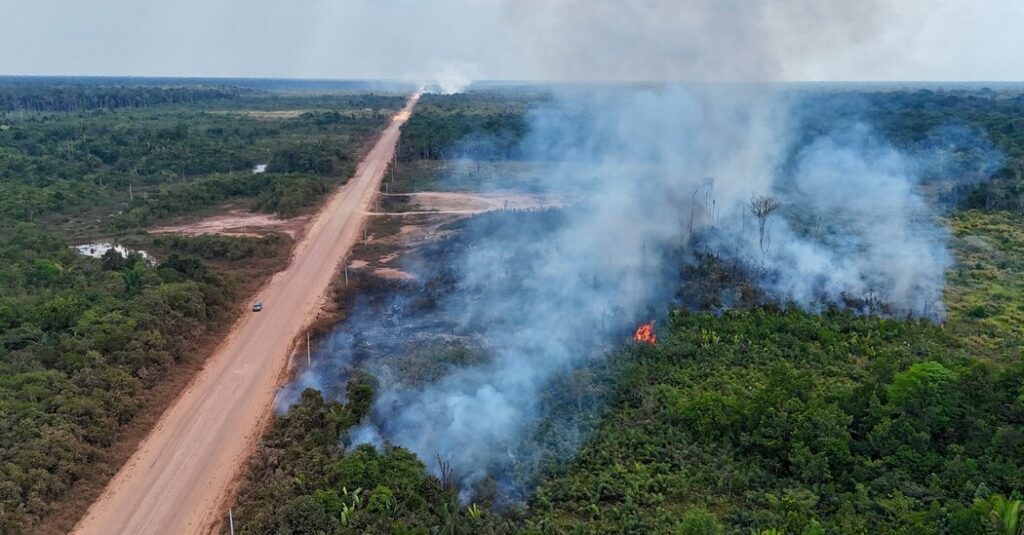
Preventing illegal road building could help protect tropical forests. New research tries to identify which areas are most at risk.
A study published on Monday in the journal Proceedings of the National Academy of Sciences analyzed 137 million hectares (about 338 million acres) of existing roads built across tropical forests in Brazil, Congo and Southeast Asia. It identified features, such as soil quality, proximity to a river, topography and nearby population density, that make it more likely someone will build a new road. Researchers then mapped out which areas are most at risk for future development.
Most roads into sensitive land are built illegally. These “ghost” roads, as they are called, are not visible on maps and are unknown to officials. By opening up previously inaccessible areas, roads foreshadow tropical deforestation, said Jayden Engert, an ecologist at the Max Planck Institute of Animal Behavior in Germany who led the study.
The first roads into intact forests are often built by development programs, Dr. Engert said. But once they exist, it is easier for land grabbers to build many more, taking over nearby rainforest by logging it or clearing it with fire. Then the razed area can be turned into cropland, cattle ranches or mines. These encroachments displace and threaten Indigenous communities, spread pathogens and empower poachers.
“We don’t know where all the roads are to start with, and we don’t know where roads are going to be in the future,” Dr. Engert said. “So if we can understand what sort of conditions allow people to build roads, we can figure out where to allocate the resources for protection.”
For instance, he said, there are large areas suitable for road building in New Guinea, a Pacific island split between Indonesia and Papua New Guinea with the third-largest rainforest in the world. While there are many plans to develop it, he said, the forest is largely intact and could still be conserved.
Other places, such as the Guiana Shield (a swath of largely intact rainforest across the top of South America), the southern half of the Brazilian Amazon and the edges of the Congo Basin, also scored high in the researchers’ risk assessment.
Tropical forests are rapidly declining around the world, with a record amount lost last year. They are home to nearly half terrestrial animal species and traditionally absorb large amounts of planet-warming carbon dioxide from the atmosphere.
But deforestation by logging and burning has become so severe in recent decades that some tropical forest areas have switched and now release more greenhouse gases into the atmosphere than they remove. Carbon dioxide, mainly from the burning of fossil fuels, acts as a blanket in the atmosphere, trapping the sun’s heat and warming the world.
The authors of the new study previously mapped out hidden roads in various tropical basins across the globe, including large parts of Southeast Asia and the entire Brazilian Amazon. These maps, which were made possible by recent advances in satellite technology, revealed large networks of ghost roads and were used in the new analysis.
Unmapped roads are up to seven times as common as official ones, according to the earlier studies. The resulting forest loss tends to follow a similar pattern. Once a road is built, it sets off a burst of deforestation, followed by the construction of many additional roads as people push further into the forest.
These branching networks are much larger than the initial road, said William Laurance, a professor of ecology at James Cook University in Australia and senior author of the new study.
For example, one kilometer, or about 0.6 miles, of new road in the Amazon led to 50 kilometers of secondary roads, on average, according to an April study led by Dr. Laurance and Dr. Engert. The secondary roads enabled more than 300 times the amount of deforestation as the first one.
“Avoiding the first cut is key,” Dr. Laurance said.
The new research is an important step toward predicting future road construction, said Philip Fearnside, an ecologist at the National Institute for Amazonian Research in Brazil who did not contribute to the study. But he added that the analysis has a key blind spot: political decisions to build new roads where they might not otherwise spring up.
The study acknowledges the risk-analysis method’s inability to account for political and economic interests. One example lies in the northwest corner of the Brazilian Amazon, which has a relatively low road-building risk, according to the analysis. But the government plans to pave the BR-319, a 550-mile highway that slices through the region.
Environmentalists say that construction would make large areas of protected rainforest vulnerable to fires, logging and poaching. The controversial project was bolstered this month when Brazilian lawmakers passed a bill to speed up environmental reviews and approvals. There are over 740 miles of state highways planned to link up to the new federal one, according to an analysis by the InfoAmazonia news organization.
Sachi Kitajima Mulkey covers climate and the environment for The Times.
The post How Blocking Illegal ‘Ghost’ Roads Could Protect Tropical Forests appeared first on New York Times.