Nadine was a top student at her high school in eastern Congo. Then, in April, she was gang-raped by four men as she was gathering firewood for her family.
The 17-year-old set off on a frantic search for help — first to her local clinic, where there were no rape kits left, and then to the hospital, where she was told that none of the medication she needed was available. It took her several days to scrape together enough money to travel the few miles to neighboring Uganda for medical care.
By the time she got there, it was too late: Her tests showed she was HIV-positive and pregnant.
“I sat down with my friend and cried,” said Nadine, who like others in this article is being identified only by her first name. The Washington Post does not identify victims of sexual assault without their permission.
Sexual violence is endemic in this part of the Democratic Republic of Congo, where it has become a weapon of war in a region that has rarely known peace over the past 30 years. Women and girls are raped in the forest, by the roadside, in their homes, anywhere they are vulnerable, by men and boys using guns, knives or sticks, secure in their impunity.
For more than two decades, U.S.-funded humanitarian groups were relentless in spreading a message: If you are raped, seek help within 72 hours at the nearest clinic, where you can get a post-exposure prophylaxis (PEP) kit. Inside is medicine that can prevent pregnancy and sexually transmitted diseases, including HIV, if taken within the three-day window. For tens of thousands of women, it was a life-changing — sometimes lifesaving — intervention.
But the sudden cancellation of a contract paid out by the U.S. Agency for International Development (USAID) removed this layer of protection for many Congolese rape victims, according to nearly 50 interviews with survivors, health care professionals and aid workers in eastern Congo. The Post visited 10 health facilities in South Kivu and Ituri provinces and spoke to health workers in North Kivu to document the impact of the U.S. cuts, reviewing medical records to corroborate victims’ accounts and analyzing data from the government and from humanitarian groups.
Reliable figures are hard to come by in Congo, a country hollowed out by corruption and poor governance, but the available statistics tell a consistent story. Last year, 96 percent of women who came to a clinic in Ituri within 72 hours of an attack received the medication they needed, according to a database kept by the Congolese Health Ministry. That figure fell to 76 percent in the first six months of this year, the database showed. The actual number was probably significantly lower, experts said, because it didn’t include data from many smaller clinics, where The Post found that shortages of PEP kits were most pronounced.
A separate database kept by the U.N. Population Fund (UNFPA), which includes reporting from the government and other sources, showed that 44 percent of women in Ituri this year have been able to get the medicine they needed within 72 hours.
In North Kivu, under occupation by Rwandan-backed rebels, a UNFPA assessmentin August showed that only 845 PEP kits were available across 34 health zones, where an estimated 23,000 women were projected to need them through November.
The scarcity of resources has coincided with a spike in fighting and sexual violence throughout eastern Congo this year. UNFPA says cases of reported rape are up by about a third over last year. But women and girls coming to clinics — terrified, in pain and at great personal risk — often found the shelves empty. Many survivors said in interviews that they were referred elsewhere for help but were unable to make the trip, or had already missed the 72-hour window. They included a penniless 16-year-old, impregnated by her rapist and kicked out by her family; a woman gang-raped next to the body of her husband, who had been killed by armed men; and a mother of four who contracted syphilis and gonorrhea after being assaulted by members of a militia.
Their plight underscores the far-reaching consequences of the United States’ decision to abruptly eliminate USAID and dismantle its vast global architecture. On his first day in office, President Donald Trump signed an executive order freezing billions of dollars’ worth of foreign assistance that was “not aligned with American interests and in many cases antithetical to American values.”
Billionaire Elon Musk, Trump’s erstwhile ally and the head of the short-lived U.S. DOGE Service, spoke of“feeding USAID into the wood chipper” as thousands of programs were subsequently canceled. Among them was a contractwith Interchurch Medical Assistance (IMA), a Washington-based nonprofit that was the sole supplier of PEP kits to eastern Congo.
Most of the money for the two-year contract — $5.5 million out of $7.5 million — had already been paid by USAID, according to a March document the administration provided to Congress. That covered the purchase of more than 116,000 PEP kits for the coming year, but not the shipping costs, said a person familiar with the contract, who spoke on the condition of anonymity to avoid professional retaliation. So the kits never arrived, health and aid workers confirmed.
IMA declined to comment for this article.
The nonprofit CARE, which has long worked with rape survivors in Congo, said it had lost $12 million in U.S. funding this year, forcing it to withdraw support for 12 clinics. In the health centers where it still operates, the organization told The Post, only 2 in 5 women are able to access PEP kits.
Terminating their supply “is not only shameful, callous and causes incalculable harm to the women and girls who relied on this support,” said Kate Almquist Knopf, former head of USAID Africa, “it also undercuts goodwill towards America.”
In response to questions from The Post, White House deputy press secretary Anna Kelly said in a statement, “America remains the most generous country in the world because President Trump has a humanitarian heart. The administration will continue to make thoughtful agreements through the America First Global Health Strategy that match local investment from signatory countries.”
The State Department and Musk did not respond to requests for comment.
Congo’s health minister did not respond to requests for comment, but local health officials uniformly described severe shortages this year.
Rape victims in Congo are frequently rejected by their families and ostracized by society. Unable to find HIV tests, most of the more than two dozen women interviewed by The Post were still unsure whether they had the virus. None were taking the antiretroviral drugs needed to prevent or control an infection. Among 56,000 survivors tested in North Kivu, South Kivu and Ituri this year, HIV rates were up more than 50 percent compared with 2024, the government database showed.
Some women said they continued to sleep with their husbands, fearing abandonment if they disclosed their ordeal. Others had been kicked out of their homes.
USAID-funded outreach programs that aimed to reduce the stigma around sexual violence were also eliminated, aid agencies said, along with initiatives that helped rape survivors start small businesses to survive.
Nadine dropped out of school in August. Then she miscarried. Now she sells food by the side of the road.
“I have no plans for the future,” she said.
‘A moral responsibility’
American efforts to combat the rape crisis in this Central African nation began in 2002, during the second Congo war, a conflict so deadly and diffuse it was called “Africa’s World War.” Millions died. Local and external actors pumped weapons into villages to arm militias that preyed on the population. Dozens of armed groups are still operating in the country; no one knows exactly how many.
Trump claims to have resolved the conflict between Congo and neighboring Rwanda, which has provided funding and military support to M23, the most powerful rebel group in the east.
“President Trump has done more than anyone to save lives on the Democratic Republic of the Congo, where he just solidified a historic peace agreement to end a 30-year conflict,” Kelly said in her statement to The Post.
But there has been no letup in the violence. M23 remains in control of large parts of eastern Congo, and Rwandan troops are still in Congolese territory. M23 fighters seized a major town in December, just days after the leaders of Congo and Rwanda traveled to Washington to pose with Trump and reaffirm a peace deal first agreed to in June.
Despite Congo’s wealth of minerals, the vast majority of its people live in poverty. The administration in Kinshasa, the capital, is weak and fractious. Basic state services are nonexistent in many parts of the country. Two years ago, the government set up a foundation funded by mining royalties to help victims of rape. But a government audit found a pattern of irregular, unexplained expenses.
Before 2018, the U.S. and other donors supplied prophylactic medication to Congo in bulk, but distribution was a challenge. Clinics often lacked the full array of medicines that rape survivors required. So USAID decided to fund individual, sealed kits. Between 2018 and 2024, IMA supplied 130,000 such kits to Congolese women, USAID documents showed.
Each PEP kit typically included drugs to prevent sexually transmitted diseases, antiretrovirals to prevent HIV infection, a pregnancy test — and levonorgestrel, an emergency contraceptive used to prevent pregnancy up to 72 hours after unprotected sex.
After years of intensive public information campaigns, more than 60 percent of Congolese rape survivors seek medical help within the crucial three-day window, UNFPA says, one of the highest rates in the world. With USAID funding, IMA also trained health workers in drug management and information collection, according to a 2023 report by the agency, and ran databases that allowed resources to be directed to the areas of greatest need.
Helping the country’s most vulnerable women and girls “is not merely a medical obligation, it is a moral responsibility,” said Denis Mukwege, a Nobel Peace Prize-winning Congolese surgeon and campaigner who founded Panzi Hospital, which has treated tens of thousands of rape survivors. “It is unacceptable that, after decades of conflict, survivors in eastern DRC still struggle to obtain something as basic and essential as a PEP kit.”
Through other humanitarian partners, the U.S. funded counseling, supported safe houses, and helped traumatized survivors find work away from the remote farms and forests where many women are attacked.
USAID also assisted victims seeking redress. With backing from the U.S. and others, the international charity Physicians for Human Rights (PHR) helped develop a standardized form to record forensic medical evidence for prosecutors. The forms, included in each IMA PEP kit, were used in the 2017 conviction of a sitting member of parliament and 10 allied militia fighters for sexually abusing dozens of young girls and infants, some as young as 18 months. In 2025, PHR said, it was set to receive its first USAID grant — $340,000 to help survivors pursue justice — but the Trump administration terminated it in February.
For more than two decades, Republicans and Democrats alike took a stand “against the defilement of women and girls’ bodies as a weapon of war,” said Knopf, the former head of USAID Africa. “It has always been in the interests of the United States to combat the worst human rights violations on the planet.”
Other donors, including European nations and Canada, have scrambled to fill the gap left by USAID. UNFPA PEP kits, funded in part by $12 million from the Congolese government, started arriving in bulk in October. A separate World Bank program will provide 25,000 kits to 25 health zones in Congo, down from the 115 zones IMA had planned to cover this year.
Medical staff said the suddenness of the U.S. cuts magnified their impact. And for many women, the new help came too late.
Impossible choices
On Aug. 26, fighting was closing in on Rebecca’s town of Tchomia, a cluster of small cement and adobe homes on the shores of Lake Albert. It was too dangerous to sell fish at the market, so the mother of four went to the forest to search for bananas to feed her children. Two men accosted and raped her — almost casually, she said, “as if I was nothing.”
After they left, Rebecca said, she lay for a while on the damp ground in shock and pain. Then, remembering the advice of the community health care worker, she recounted staggering for more than four miles to the closest clinic, the Centre de Santé de Tchomia, where splashes of pink flowers cluster around a neatly stenciled sign, emblazoned with the logos of USAID and the International Rescue Committee (IRC).
But there were no PEP kits left, Rebecca said, an account confirmed by IRC, which said it has since tried to source medications itself. An apologetic nurse told her she should try the general hospital, but Rebecca said she could hear gunfire and explosions in the distance. She had recently found bullet casings under the tree where she hung her family’s laundry. She’d left her abusive husband during her last pregnancy. Scared to leave her children alone for any longer, she decided to go home.
“I lay awake the whole night,” she recalled. “I couldn’t even cry in case I started to panic. Then people would know I was raped.” She comforted her children — bright-eyed boys of 10, 8 and 6, and a chubby daughter of 3 — who Rebecca said were having nightmares about the violence. She never made it to the hospital.
Neither did Rosalie, 17, who said she was raped by a Congolese soldier in August when she was out fetching water. She had no one to tell. Her mother, the only person who had ever loved her, died when she was 10, she said, staring at the floor.
“Even if I told my dad, he wouldn’t care,” she said flatly. “I have no one.”
She went to the same clinic as Rebecca, where she knew a nurse by name, whispering a plea for help. No medicine was available.
She went home and thought about her mother and cried, Rosalie said. She didn’t have the energy to walk to the hospital, and she was afraid someone she knew might see her.
Neither Rosalie nor Rebecca know their HIV status. The clinic they visited had also run out of free tests in June.
“No HIV tests, no rape kits, no TB drugs, no pediatric ARVs,” sighed clinic chief Amos Agenonga Vyirodjo, using the abbreviation for antiretroviral drugs. He has worked there 13 years. “We’ve had stock-outs before, but never this long.”
The sudden freeze on USAID programs caught everyone here by surprise, health care workers said, but the effects weren’t always felt immediately. Some health zones had stocks of PEP kits that they sent out to local clinics. Pharmacists said they reserved the last of the supplies for big urban hospitals. Eventually, there was nothing left.
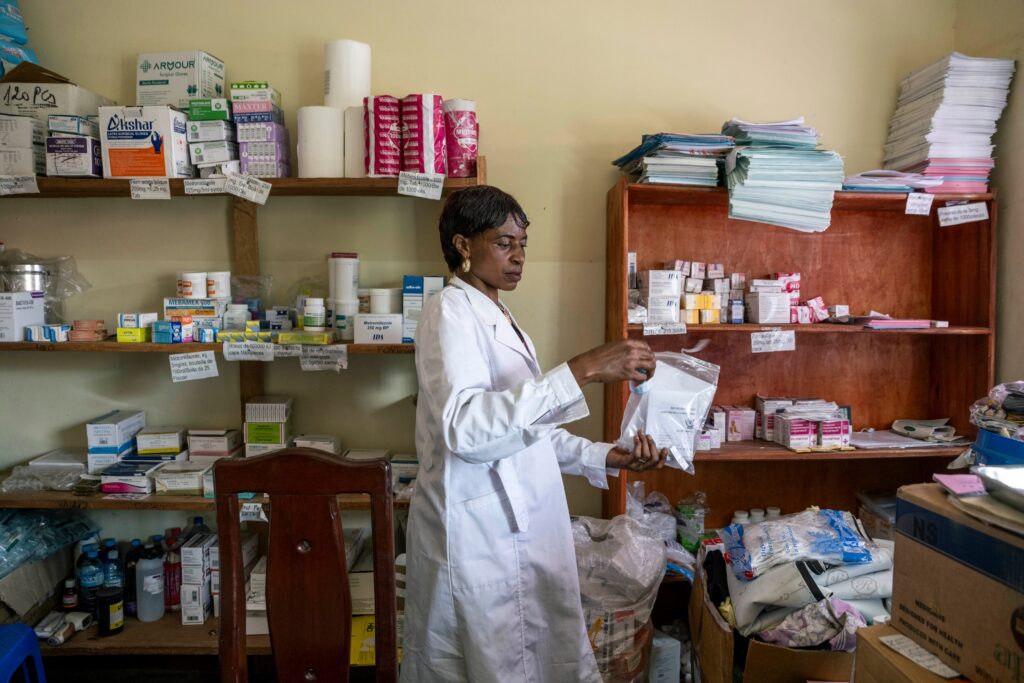
Florence Mbabzi Katabuka, Tchomia’s head pharmacist, ran a fingernail down a blue folder. In 2024, she said, the zone had received 279 adult PEP kits, mostly from IRC, the Christian charity Cordaid and the Congolese group SOFEPADI — all USAID partners previously supplied by IMA. This year, she said, they received 50 kits. They ran out of supplies for the entire zone, which serves more than 50,000 people, in August, and again on Oct. 13.
“Right now, our stock is zero,” she said, snapping the folder shut.
The Post found the region’s eight remaining PEP kits at Tchomia General Hospital. But a nurse who spread them out on a scratched wooden table pointed out that some of the medication inside had expired. The kits usually have a shelf life of two years, making a consistent supply chain essential.
“Should we still give these out?” the nurse wondered, poking at the pill boxes. “We don’t have anything else.”
A desperate search for help
Several hours north of Tchomia is the Centre de Santé Mungere health clinic, a modest collection of whitewashed buildings perched among the rolling green hills of the Mahagi region.
It was where Nadine, the high school student, first sought help after being assaulted. But the clinic ran out of PEP kits around April, according to nurse Christine Tumaini. She said it typically received about five rape survivors a month.
There had recently been a worrying drop-off in the number of women seeking immediate treatment, she added, perhaps because word of the shortages had spread.
“When there’s medicine, more people come, but if there is not, then they get discouraged,” she said. “They are ashamed to go to another place where people might look at them.”
Increasingly, Tumaini said, rape victims were showing up well after the three-day window had closed, with more advanced cases of sexually transmitted diseases such as gonorrhea.
Unlike most of the women interviewed by The Post, Nadine was able to make a second trip, by motorbike, to the Mahagi General Hospital. But there, too, she hit a wall.
Jeanette Nikuma, a rape counselor at Mahagi, said the hospital had run out of PEP kits several times this year and was repurposing ARVs supplied by the national HIV program to give to rape victims. Nadine should have been able to get ARVs during her visit to the hospital, Nikuma said, but may have come when the pharmacy was closed or been given bad information.
When Nadine discovered she was HIV-positive, her family mustered just enough money to purchase a round of ARVs from a local pharmacy, only to discover they were fake.
The fear of ostracism has driven some survivors to seek dangerous abortions, Tumaini said. “One woman tried to get rid of the baby, and she died,” she said, citing accounts from a nearby village. “Another one came while she was bleeding, and we sent her to the Anglican hospital, and they saved her, but the baby died,” she said. The Post could not independently confirm these accounts but heard similar stories from other health and aid workers.
“It’s like all the work we did before was thrown into the water,” the nurse said.
On a recent afternoon in a dimly lit hospital room in Bunia, the capital of Ituri, 26-year-old Antoinette sat trying to nurse her fussing baby to sleep. The colorful print wrap she wore around her thin frame was frayed, and worry lined her face, but her hand caressed the child’s back steadily as she told her story.
She was raped by militia fighters in February, she said quietly. She went to her local health center the next day, but there was no medication, and she couldn’t afford the trip to a bigger hospital. When she developed symptoms of a sexually transmitted disease, she told her husband what had happened. He abandoned her and their four children.
Later, she was diagnosed with syphilis and gonorrhea. A nurse wrote her a prescription, but the money she made washing clothes and digging crops wasn’t enough even to feed the children. The drugs she needs cost $22. So far, she said, she had saved about 50 cents.
“I’m all alone taking care of the kids,” she said. “If something happens to me, what will happen to them?”
Child victims
Pediatric PEP kits — which mostly have similar drugs in different dosages — have always been in short supply in Congo. After the cancellation of the IMA contract, which covered thousands of pediatric kits, they were especially hard to find, health care workers said.
At clinics in Bunia and Beni, a city in North Kivu, nurses said they had to tell families of child rape victims that there was nothing they could do but refer them elsewhere.
At the Kuka clinic in Beni, USAID stickers cling to almost every surface, from the ancient wooden cupboards to the dust-covered car battery powering the room’s lightbulb. Three children, ages 5, 6 and 10, were brought here after being raped in the last couple of months, according to nurse Alfred Bambiti Bikemu.
Giulia Kanugho Maghozi works at the Tuungane clinic, near Beni airport. Insurgents aligned with the Islamic State roam the countryside here, killing farmers and kidnapping children to use as soldiers and sex slaves.
From February to April, she said, the clinic had no PEP kits of any kind. In that time, she said, they saw seven rape victims, three of whom were children, brought in bleeding from injuries suffered during their attack, Maghozi said.
She and her colleagues make less than $2 a day, but they pooled their money so the families could afford the bone-shaking $5 motorbike ride to the town hospital.
“We try to do what little we can,” she said.
The post Congolese rape survivors search in vain for medicine after USAID cuts appeared first on Washington Post.