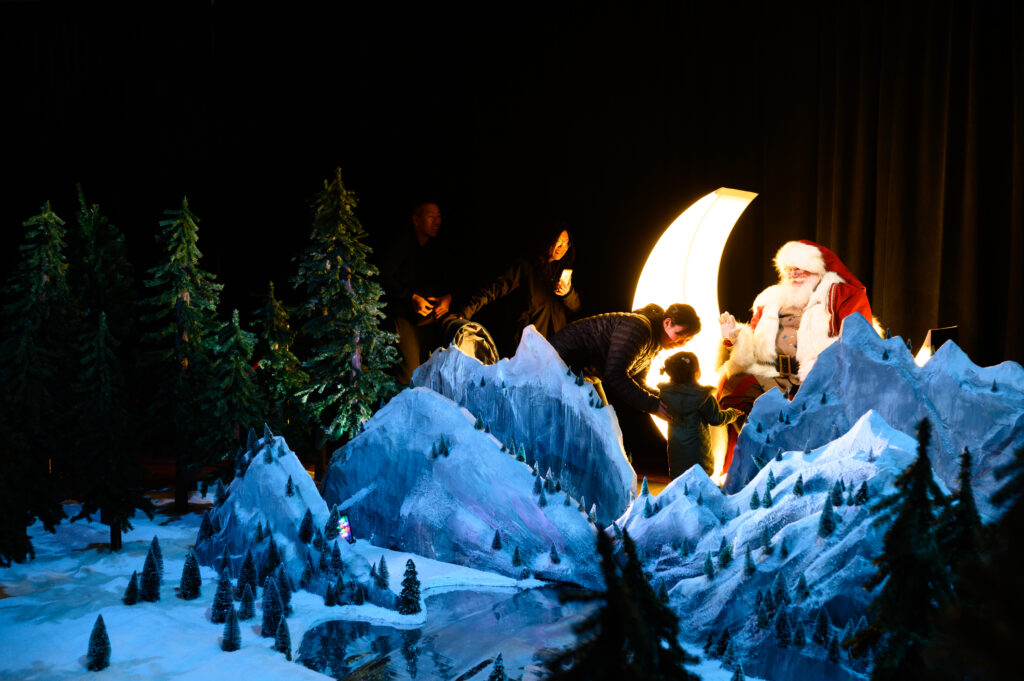
It was the second week of December, and Ed Taylor was instructing his Santa School students on the art of improvisation.
For example: When a kid asks you if reindeer really fly, Taylor — who also goes by “Santa Ed” — told the nearly three dozen Santas gathered on Zoom, you don’t just say yes. You say “yes, and they only fly on Christmas Eve” to advance the story. The students, mostly older men with snowy white beards, listened intently.
Taylor, who’s been running a free Santa School since 2015, said he’s seen a burst of interest in recent years. Many of the novice Clauses are recent retirees, added Taylor, who has been performing as Santa for more than two decades.
These fresh-faced Santas were once law professors, teachers, photographers, real estate agents, or health care providers. A high-end Santa can make upward of $10,000 a month, but most of Taylor’s students aren’t suiting up for the financial benefits.
Rather, they say they’ve found deep fulfillment and purpose in their post-retirement roles.
Stephen White, 73, is one of Taylor’s newest students. Christmas wasn’t the same for White and his daughter after his wife, Kathy, died of leukemia several years ago. Kathy “made things magic for us,” he said.
White’s outlook on the holiday changed recently, when a friend asked him if he would consider volunteering as Santa for a community event in Plano, Texas, where he lives. White looked the part, with hair and a beard as snowy as his surname.
A self-described “terrible introvert,” he eventually decided the role could help him embrace the holiday.
“I can’t summon Christmas up for myself these days,” White remembers thinking. “But if I was out there surrounded by Christmas and people, maybe I could enjoy Christmas again.”
And he did. “For three hours, I was not a sad widower,” he said. “I was Santa.”
It’s a story Taylor has seen play out many times, he said. “People have said the best part for them about being Santa is who they’ve become,” Taylor said. “They’ve just changed themselves.”
White, who wrote for the children’s television show “Barney & Friends” for 16 years before retiring, said he was thrilled to connect with children again. After his first few classes with Taylor and several gigs, he’s decided to embrace the Santa lifestyle.
“I’m finding it very interesting to dive deeper into the professional side of the Santa stuff,” he said. “And I don’t mean necessarily the business or promotions, but I mean the philosophy of it — the connecting with the more human side. Since losing my wife, I’ve struggled with that, and so, on a human level, this can be therapeutic. I’m hoping giving to others can be healing for me, too.”
Joshua Carlile, who introduces himself as Father Christmas, was also driven to the role by personal losses. His mother, brother, two sisters and nephew all died between 2013 and 2022.
“My world [had] fallen apart,” said Carlile, who lives in Portland, Oregon. “And I really was nervous about how Christmas would go — like the joy was just sucked out of it all. And I thought, ‘How am I ever going to get the Christmas spirit?’”
But then, he said, it came to him: Why not become Santa Claus?
It was life-changing, he said. The joy is back.
“It gives me such purpose every day,” he said. “To come from those types of tragic events … you can’t control those things, but you can control how you behave afterwards. You can control the next chapter of it, and that’s what I decided to do.”
Unlike White, Carlile didn’t look the part. At 48, he’s on the younger end of Santas. He’s 5’6 and weighs 155 pounds, and he still grows a full head of dark-brown hair. He also still works as a full-time caregiver.
But after reading inspirational stories in the news, like of people with physical disabilities still competing in sporting events, he convinced himself that he could play the part.
“If these people can triumph in doing what they’re doing,” he thought to himself, “certainly a little bit of dark hair couldn’t stop me from being Santa Claus.”
With the help of Taylor’s Worldwide Santa Claus Network, he dedicated himself to looking and embodying the part. He took over 200 pages of typed notes from Taylor’s classes, which are generally once a week, in his first year, and is now set to release a book with Taylor on all the lessons they’ve learned.
“I now can look in the mirror and go, ‘You’re Santa,’” Carlile said. “I carry that badge of honor proudly. No more do I have the impostor syndrome.”
Becoming Santa is not just about performing as the character, Taylor said. It’s also about who they have become outside the character, when the famous red-and-white hat comes off. Taylor said his Santas have noticed they’ve become gentler with those around them.
Jim Monsen, or “Santa J,” who is from Orem, Utah, started his journey to becoming Santa about four years ago. His daughter teases him that he’s since become a much nicer driver.
“If somebody turns their blinker on, I’ll back off and let them in,” Monsen said. “That’s what Santa would do, right?”
Many also hope to create a legacy, Taylor said. “We’d like our kids, or grandkids, to have this better way of viewing us than what we did our whole career.”
“Not that we did anything bad,” he added. “But it wasn’t Santa Claus.”
The post After retirement or loss, these men found purpose learning to be Santa appeared first on Washington Post.