Grand coffeehouses have fueled the cultural life — and caffeine cravings — of Vienna for nearly two centuries, offering plush salons where customers linger forever over newspapers and cups of frothy melange delivered by tuxedoed waiters.
While I remain faithful to weathered haunts like Cafe Sperl, Vienna’s food and drink scene has also seen welcome changes. As Severin Corti, the city’s leading restaurant critic, put it to me, “The art of Viennese pastry never really evolved beyond its prewar glory. But now a new generation is bringing back drinkable coffee, interesting microconcepts and a revival of French-style patisserie — along with classic Austrian rolls — all with a focus on local ingredients and an organic sensibility.”
Exploring fresh takes on cafe culture this time, I found inspired dishes and a vibe that felt both rooted and current, a counterbalance to the glossy confections of Vienna’s historic imperial cafes with their endless queues and forests of selfie sticks. I was reminded, plate by delicious plate, that Vienna is also one of the world’s greenest capitals, a city that grows grapes and vegetables within its own borders and champions farm-to-table cuisine.
So I skipped the velvet banquettes where the ghosts of Klimt and Freud might still brood. What cured my angst: breakfasts of biodynamic eggs cooked by alumni of Noma, coffee pulled from obsessively sourced beans, sourdough breads baked from near-extinct grains, and pastries as pretty as they are personal. But first, my partner and I visited a cafe where grandparents and their homemade recipes take center stage.
At Vollpension, in the Freihausviertel quarter, a dapper septuagenarian in a bright yellow apron introduced himself as Opa Bert, the cafe’s suave maître d’. Opa means Grandpa, and Oma means Grandma, and at Vollpension they insist on using their first names. Soon we were devouring Buchteln, jam-filled brioche-like buns with vanilla sauce, as a crowd of mostly young diners bantered happily with the Opas and Omas who make up more than half the staff at this warmhearted multigenerational cafe. Kardinalschnitte followed — a mosaic of meringue, sponge cake, jam and coffee cream — and then a raisin-studded warm cheese strudel tasting like the distilled essence of Mitteleuropa.
Moriz Piffl, a social entrepreneur, and his partners launched Vollpension as a pop-up in 2012, then turned it into a full cafe in 2015 because they couldn’t find cakes in Vienna that tasted homemade. The deeper mission? “To address old-age poverty and the social isolation that often comes with it” by providing retirees with extra income and a chance to feel valuable, Mr. Piffl said.
“Some guests say they never knew their grandparents,” Oma Doris, a former teacher, said. “Here, they finally feel what that’s like.” With two locations and a baking academy, Vollpension has become a model of social entrepreneurship — and a beloved first-date spot for Gen Z. “Couples love chocolate,” declared Opa Johannes, 73, the resident Sacher torte master. “I usually ask whether they met on Tinder or Hinge,” Oma Doris added slyly. “Grandmas do keep up with the times.”
Schleifmühlgasse 16; pastries from 6.90 euros, or about $8.
Even in Austria, where organic agriculture is practically a civic virtue, Meinklang is singular: a 5,000-acre biodynamic family farm near the Hungarian border, raising livestock, growing heritage grains and fruit, and producing some of the country’s best-loved natural wines. When the Michlits family opened a Fifth District farm shop and bakery three years ago, their fans flooded in. Mornings mean lines for flaky pumpkinseed croissants, cinnamon spiked Apfelstrudel from the rosy-cheeked apples stacked in crates by the counter, and big burnished loaves made from the farm’s stone-ground wheat. Thick slabs of that bread anchored our breakfast, slathered with village butter and chives — a Viennese morning classic — and perfect for dipping into softly poached farm eggs with Day-Glo yolks ringed by a light mountain-cheese foam.
We returned for dinner, when the room shifts into a soft-lit bistro and natural-wine bar. At the counter, beneath bunches of dried flowers, we dunked cheesy churros into a porcini-celeriac purée and watched the chef Thomas Piplitz, an alum of the Swedish restaurant Fäviken, plating roasted cabbage with kimchi beurre blanc and Mangalitsa pork with crackling-flecked dumplings. His tight menu blends New Nordic edge with Austrian comfort. To drink: Meinklang’s skin-contact Weisser Mulatschak, a blend of Traminer and Welschriesling that smells like peach skins.
Margaretenstrasse 58; breakfast dishes from €6.50; dinner dishes from €12.50 to €28.
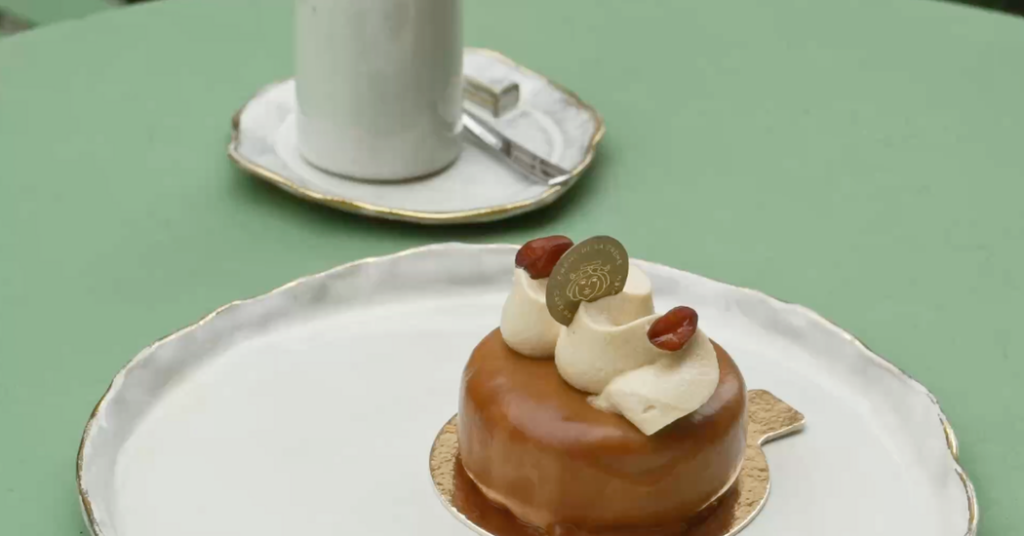
The Fifth District around Naschmarkt is fast becoming a magnet for pastry pilgrims. After breakfast at Meinklang, we continued to Crème de la Crème-La Petite. Its pastry chef, Julia Kilarsky, 39, traded a legal job for an apprenticeship at Pierre Hermé, the French patisserie, and opened her first shop in 2017. She filled this new pistachio-hued jewel-box cafe with exquisite orchids, glazed ceramics made by her mother and aunt, and pastries to match. From the dozen seasonal creations that gleamed in the case we tried the moist, flourless poppy seed torte rippled with raspberry jam; an artful pistachio-praline-salted caramel “snowflake” she calls “the best antidepressant in winter”; and a ruby globe of ethereal gingerbread mousse hiding a plum core. Ms. Kilarsky took over two shops previously owned by men and now employs mostly women. “People see me and ask for the boss,” she laughed, “expecting a man.”
Kettenbrückengasse 20; pastries from €7.50; breakfast dishes from €7.
Vienna’s artisanal sourdough renaissance owes much to Joseph Brot, the organic bakery Josef Weghaupt founded in 2009 in the Waldviertel region and has since expanded across Austria. Raised on hefty rye loaves his grandmother baked in community ovens, Mr. Weghaupt feared that those flavors and skills were fading as industrial methods encroached. At his countryside facility today, every loaf is shaped by hand; small farmers supply rare grains once near extinction.
I tasted the signature wheat-rye loaf called Joseph — nutty, earthy and complex — at the bakery’s Landstrasser branch bistro. There was also a fragrant Roggenbrot made with heritage Waldstauden rye and tart apples, and an ur-Viennese Kaiser roll folded six times, instead of the usual five, for maximum crisp. And I kept daydreaming about the nougat-and-apricot Scheiterhaufen (crusty bread pudding reborn from leftover pastries), even as I stood blinking at the Bruegels in the Kunsthistorisches Museum.
Landstrasser Hauptstrasse 4; breakfast sets from €12.20; pastries from €5.
Cà Phê Lalot and Die Cafetière
Joseph Brot supplies bread to some of Vienna’s best restaurants. At Cà Phê Lalot, it accompanied a plump French-style omelet unexpectedly glossed with mouth-tingling Sichuan chili oil. The petite breakfast and lunch cafe, with mint-green walls and wood wainscoting, opened last year with a playful mission: Vietnamese cafe culture meets Viennese kaffeehaus. The owners — Lukas Stein (of Vietnamese descent, with Michelin-star experience in Salzburg) and his fiancée, Viola Waldeck (who worked at Noma) — bring serious kitchen cred and cross-cultural whimsy to dishes like hojicha-oat porridge swirled with tart plum purée and toasted buckwheat, and a rice-paper omelet with bacon and cheese and peanut-hoisin sauce, irresistible even in this city of epic breakfasts. With our Vietnamese drip coffee came Austro-Asian mochi cake studded with poppy seeds.
Right next door sits Die Cafetière, a sleek new-wave coffee bar retrofitted from a 1960s espresso joint by Peggy Strobel, the German-born owner who jokes that Vienna’s grand cafes serve beautiful ambience and terrible coffee. Here the rich complex brews are drawn by chatty baristas from Stoll Kaffee’s single-origin beans in a gleaming Slayer machine. Try the signature Cafe Cafetière (Brazilian-bean double espresso with orange-cayenne-infused whipped cream) or an affogato with bourbon-vanilla ice cream made at two-Michelin-star Mraz & Sohn, whose co-owner happens to be Strobel’s husband.
Cà Phê Lalot — Wipplingerstrasse 25; breakfast dishes from €9.80.
Die Cafetière — Wipplingerstrasse 25; coffee drinks from €4.50.
Our farewell meal was at Meierei, the casual sibling to the three-Michelin-star restaurant Steirereck run by Birgit and Heinz Reitbauer, on a bank of the Vienna River’s trickle in Stadtpark. The starkly white, airy space isn’t exactly a cafe, but it’s one in spirit. Meierei is a beloved all-day institution known for its perfectionist takes on vernacular hits like goulash, and for vegetable-forward seasonal dishes, like a gorgeous salad of charred and fresh winter greens laced with kumquats. The Reitbauers salute Meierei’s past as a dairy depot with a menu of different milks, in flavors like tonka bean, and over 100 farmhouse cheeses, about a third of them Austrian. You can come for sourdough waffles or poppy seed noodles at breakfast, pass an afternoon at the bar with hot chocolate or a Grüner Veltliner, or have a ur-Viennese lunch as we did. It featured that beautiful salad, strong beef consommé with traditional trimmings, and an echt suckling-veal Wiener schnitzel with a buttery, soft sheath of breading. For dessert, the Apfelstrudel made with four heirloom apple varieties — each retaining its own orchard character — keeps tradition vital and fresh.
Am Heumarkt 2a; breakfast dishes from €6.90; lunch entrees from €24.50; dinner prix fix from €85.
Follow New York Times Travel on Instagram and sign up for our Travel Dispatch newsletter to get expert tips on traveling smarter and inspiration for your next vacation. Dreaming up a future getaway or just armchair traveling? Check out our 52 Places to Go in 2025.
The post 7 Spots Shaking Up Vienna’s Cafe Scene appeared first on New York Times.