It started with “Red Comet,” an 1,118-page biography of Sylvia Plath, undertaken with far-flung friends during the pandemic (obviously). The audiobook was 45 hours long, the Mount Everest of listening. I summited, knitting a chunky striped blanket along the way. I never looked back.
Or did it start when my husband surprised me with a pair of AirPods in a case with my name on it, book-ended by stars? Or, further back, when our then teenage son used to walk around the house wearing what looked like a cigarette butt in his ear, bass pumping so loudly I could feel it in the floorboards? (“What,” he’d say, no question mark. “I hear you.”) Or was it when my eyesight became so finicky, I needed contact lenses, reading glasses and a klieg light just to distinguish between shampoo and conditioner?
I’ll never know. The fact is, over the past five years, I’ve migrated from books on paper to books in my ears. I still love the feel of a fat hardcover — the weight of pages, the smell of print, all the tangible details I’ve celebrated since I first read a chapter book on my own. (It was “B is for Betsy” by Carolyn Haywood; it felt like taking flight, more exhilarating than learning to ride a bike and equally unforgettable.)
Now, suddenly or not so suddenly, I prefer … recordings. Honestly, the transition probably has more to do with my kids growing up than anything else. As the house went silent, I cranked up the volume on my phone. It turned out that the peace I’d been craving was too quiet.
Like many audiobook devotees, I’m sheepish about my conversion, which seems blasphemous for a writer at the Book Review. I wonder whether listening “counts” as reading. I wonder whether I retain information the same way I would if it entered my brain through my eyeballs. I wonder whether I’m lazy, whether audiobooks are the boneless chicken wings of the book world — satisfying, convenient and not quite the real deal.
But here’s what I love about listening: I can do it all the time, not just while sitting still. I read (and yes, it is reading) while making my bed, brushing my teeth, unloading the dishwasher, commuting to work, waiting in line, driving and occasionally while falling asleep. (I set a timer so I don’t miss too much when I doze off.) Unless I’m washing my hair, I also wear an AirPod in the shower — only one, so the other is always charging — and I travel with wired headphones in case of emergency.
Obsessive, yes, but this has always been my approach to reading. I love the way an audiobook brings me one step closer to a story, removing the middleman of paper or a screen. I’m not just hovering over the action, I’m in it. Channeling it. Bonus: No trees are harmed in the recording.
You might wonder what else I do while I’m listening.
In the beginning, I walked. Then I got tired of the same old loop around my neighborhood and — I’m ashamed to say it — of bumping into friends when I was in the middle of a good part.
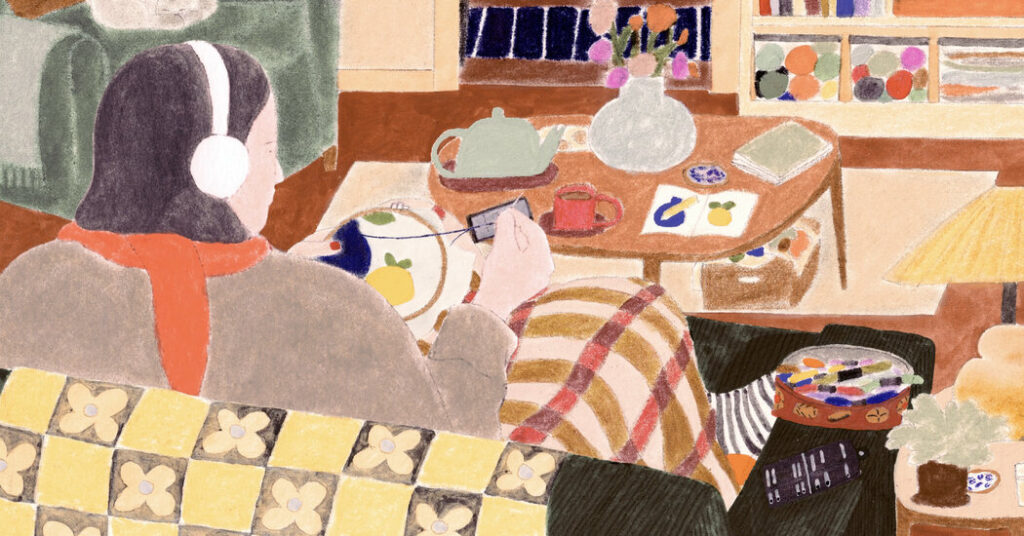
So I took to my couch and started knitting. Scarves, blankets, anything that didn’t require a pattern or too much concentration. I rush ordered wool when I was running low. Late one Sunday night, I peered into the window of a local yarn shop: Wasn’t that the owner’s car out front? Could I grab a skein of super soft merino? I had the new Liane Moriarty to plow through. I hadn’t been this desperate for my next fix since I knocked on the door of a closed Kentucky Fried Chicken while pregnant. (“Sorry about your broken fryolator. Do you have any leftovers?”)
I hit peak fiber art when I completed four blankets for a single newborn, one for each season. Her parents had no choice but to name me co-godmother. I listened to John Lewis’s biography on the way to the baptism and “The God of the Woods” on the way home. I still remember the intersection I passed through when Lewis finally made it across the Edmund Pettus Bridge — how momentous it felt when the red light turned green.
From there I moved on to decoupage, shellacking cocktail napkins into clam and oyster shells, then painting the edges gold. This diversion carried me through eight Michael Connelly novels, Anne Tyler’s entire oeuvre, Cher’s memoir and an aggressive, near daily denuding of the Jersey Shore.
You know you’re a little too into shell collecting when you’re competing against toddlers with plastic buckets. But at least I had Elizabeth Strout and Abraham Verghese to keep me company as I elbowed youngsters out of the way.
Speaking of Verghese: His latest novel, “The Covenant of Water,” is 31 hours long. I approached it like a runner training for the New York City Marathon, in short bursts, then long stretches followed by total immersion. You’ve heard of a runner’s high; I’m here to tell you about the listener’s trance. It’s a thing, even if I made it up.
Eventually I ran out of friends and daughters in need of jaunty trays for earrings. Actually, neither of my daughters needed or wanted gilded clam shells but they accepted my handiwork graciously, the same way they ask for reading recommendations before downloading what the influencers are raving about on TikTok.
I am now in my needlepoint era, having completed a succession of floral and geometric canvases I will never frame or turn into pillows, coasters, luggage tags or passport covers. (Needlepoint people are really into travel accessories.) Alas, the completist energy I bring to books does not apply to crafts.
Last month I listened to Kiran Desai’s “The Loneliness of Sonia and Sunny” (25 hours) while stitching two bookmarks, one that says “Read the Room” and another that says “Plot Twist.” Unfortunately I couldn’t figure out the whipstitch required to affix them to their velvet backings, so in my pile they remain. And I don’t mean my TBR (To Be Read) pile, since I no longer have one of those. I mean, I do, but it’s a list of files, not a leaning tower on my bedside table.
You might wonder about the effect of all this listening on my marriage.
My husband loves an audiobook on a long drive about as much as he does not love a needlepoint belt (which is to say, a lot). But he recently admitted that my reading habits are giving him flashbacks to our son’s sophomore year of high school, minus the endless requests for new sneakers. Chastened, I plucked out my AirPod, only to reinsert it on the other side of my head so he couldn’t see it (a trick I learned from the pros: teenagers).
“I hear you,” I said.
I also heard myself, distracted and bellowing over noise cancellation. I turned off my book, plucked out my pod and removed the reading light I wear around my neck to illuminate my craft projects.
My husband and I talked about how much we miss the old noise of our house, full of young people. We heard each other, loud and clear.
Here’s some good news about audiobooks, best enjoyed in moderation. You can borrow them from the library (via the Libby app) or buy them from an independent bookstore (through Libro.fm). You can return them if you don’t like them and, if you have Amazon Prime, share them with a family member, although these transactions are more complicated than they should be. You can even add a bookmark or mark a favorite passage, albeit without the satisfaction of folding down a page.
Favorite narrators are subjective, but mine are Julia Whelan, Kimberly Farr and Edoardo Ballerini. I love an ensemble cast, as in “There There” by Tommy Orange and “The Fraud” by Zadie Smith. If I happen to be using Speechify, an app that reads text aloud, I’ll tee up Barack Obama, Gwyneth Paltrow or Paris Hilton, all of whom have mellifluous A.I. voices. (There’s something funny about a former president reading romance or Paltrow on foreign policy.)
Hands down, though, my favorite listening experience is a memoir read by its author. You can’t beat the intimacy of a story in the voice of the person who lived it.
To audiobook skeptics, I say this: Listening is to reading what jogging is to running, a different means to the same end. After all, a conversation is a conversation whether you have it on the phone or in person. A movie is a movie whether you see it in a theater or in your own living room. Are there circumstances where it’s preferable to chat face to face or watch on a big screen? Certainly. But I’d argue that the alternatives are solid, sometimes preferable, options — and, for some, the only ones.
Finally, I think we can all agree that the world would be a better place if we spent more time listening, and really hearing, as many voices as we possibly can.
Audio produced by Tally Abecassis.
Elisabeth Egan is a writer and editor at the Times Book Review. She has worked in the world of publishing for 30 years.
The post Why I Stopped Reading and Embraced Audiobooks appeared first on New York Times.