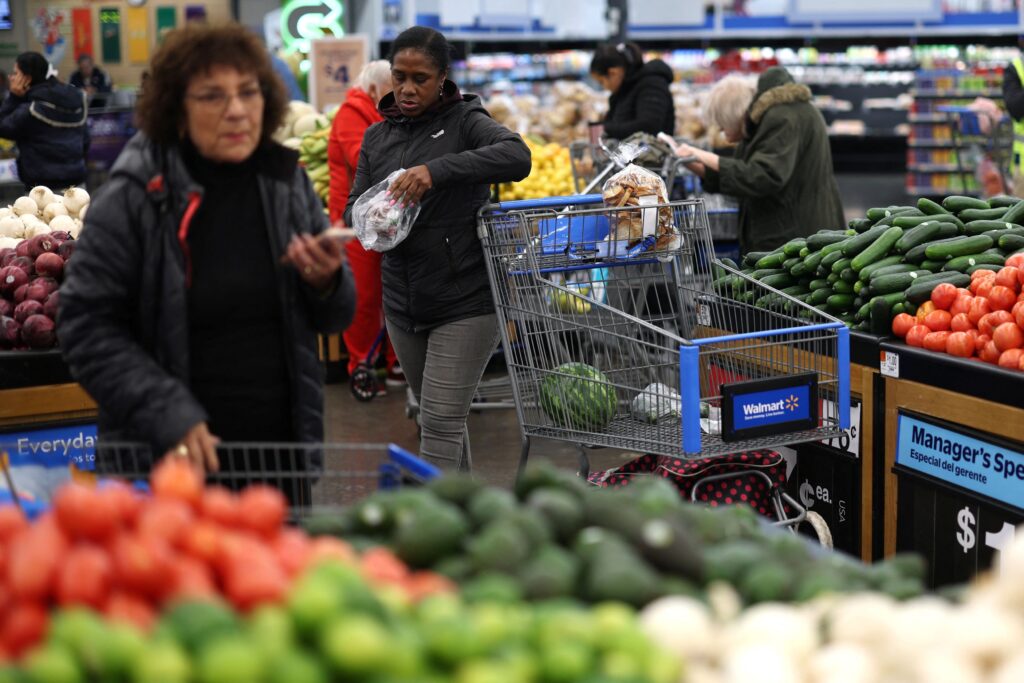
Marian L. Tupy and Gale L. Pooley’s Dec. 6 op-ed, “Actually, today’s food prices are a bargain” would have one believe that food is more affordable than ever, based on a comparison of blue-collar wages and the consumer price index of “Food at Home,” both courtesy of the Bureau of Labor Statistics. But a more reasonable measure of what shoppers can spend to feed their family would be the median household income. Likewise, they also used the American Farm Bureau Federation’s cost of the Thanksgiving meal basket of ingredients (at $55.18 for a 10-person dinner this year) to assess food costs growth over time, but that would be appropriate only if one ate nothing but turkey and cranberries every day.
When shoppers express frustration over rising food prices, they’re comparing today’s prices with recent history. So, let’s take a look at 2020 through 2024. Over that time, according to the Federal Reserve Bank of St. Louis, median household income grew by a healthy 23 percent but not enough to keep up with food costs, which increased by 28.4 percent, according to the BLS.
The op-ed came to the opposite conclusion by citing statistics over the past one, two, 10, 30, 40, and 50 years, but over the past five years for which statistics are available, food costs did indeed significantly outpace wage growth. Wage growth has yet to catch up with the dramatic yearly food inflation of 2020, 2021 and 2022 (3.9 percent, 6.3 percent, and 10.4 percent, respectively). Of course, food shoppers know this.
Jack Connerney, Annapolis
Leave local golf alone
Regarding the Dec. 13 online news article “Trump takes first step in possible bid to control D.C.’s public golf courses”:
Though President Donald Trump intends to improve the courses’ conditions, I worry he would not maintain the inclusivity and accessibility that these courses offer to local communities and residents. I’m a 16-year-old D.C. high school student and avid golfer, and my school plays frequently at East Potomac due in part to the low greens fees. If the president takes over operation of D.C.’s public golf properties, he must ensure the cost to play does not grow.
The golf course land is federally owned but managed by National Links Trust, a nonprofit I have worked with for the past two years. Every May, we hold a fundraiser to ensure that kids from all backgrounds can have the opportunity to fall in love with the game of golf. My worry is that if these municipal golf courses become pricier, children and adults will be deprived of the sport. Everyone in D.C. should be able to have the ability to play on our public courses.
Sachin Kundra, Bethesda
So now President Donald Trump wants to get involved with East Potomac Golf Links and the 50-year lease National Links Trust (NLT) has with the National Park Service to rebuild and operate the course?
I’ve played this course for more than 45 years. I’ve met countless municipal golfers who agree the changes and improvements made by NLT since its lease was signed five years ago have been nothing short of spectacular. NLT has cleared brush and dead trees around the perimeter and between holes, upgraded tees, fairways, bunkers and greens, and hired staff who are helpful and courteous. It’s all made us proud to call East Potomac Park our home course. And it’s been achieved before the full-scale renovation to return it to the original reversible 18-hole layout.
The trust has enlisted some of the sport’s top architects, including Tom Doak, to make this municipal course a jewel in the District of Columbia. That speaks both to the professional way in which the trust is carrying out its commitment to municipal golf in the District and nationwide and also to the potential result of those designers’ work.
I’m sure I speak for the many thousands of local golfers when I plead: “Please, Mr. President, leave us alone!”
Oakley Brooks, Washington
The promise and pitfalls of the air taxi industry
Regarding the Dec. 13 news article “Trump administration hopes to give air taxis a lift”:
As an aerospace engineer who studied aviation fuel-powered vertical takeoff and landing (VTOL) aircraft in the late 1960s, I consider it inconsistent for the Trump administration to try now to aid the electric VTOL air taxi industry while simultaneously trying to torpedo the electric land vehicle industry. If it truly cares about the environment, which I doubt, the Trump administration should be aiding both industries.
Joseph Scafetta Jr., Falls Church
Air taxis are an interesting concept. If successful, they would alleviate serious traffic congestion. However, in addition to ensuring air taxi technology is safe for passengers, the gaps in U.S. air traffic control must also be addressed. Drones create hazards for planes. Air taxis are no more than large drones.
Howard Pedolsky, Rockville
Post Opinions wants to know: Have you ever gotten an opportunity to set the record straight? Tell us what happened, and your response might be published in the letters to the editor section. wapo.st/recor”
The post Shoppers know food is expensive appeared first on Washington Post.